
Podothrombium
Berlese, 1910
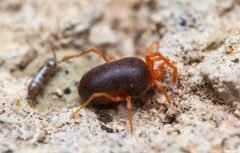
Podothrombium is a of terrestrial mites in the Podothrombiidae, first established by Berlese in 1910. The genus contains 19 described globally, distributed across Europe, Asia, and North America. Members exhibit the typical Parasitengona : larvae are ectoparasitic, while post-larval stages are free-living of arthropods.
Pronunciation
How to pronounce Podothrombium: //ˌpoʊ.doʊˈθrɒm.bi.əm//
These audio files are automatically generated. While they are not always 100% accurate, they are a good starting point.
Images
Habitat
Has been collected from moss and leaf litter in montane environments, including at 1181 m elevation on Murat Mountain, Türkiye.
Distribution
Recorded from Greece, Türkiye, Serbia, Denmark, Norway, Sweden, the British Isles, and Oregon (USA). The has a broad geographic range across Europe, western Asia, and North America.
Host Associations
- aphids - associatedNature of association (, , or phoretic) not specified in available sources
Life Cycle
Larval stage is ectoparasitic; post-larval forms are free-living . This pattern is characteristic of Parasitengona mites, though specific developmental details for Podothrombium are not well documented.
Similar Taxa
- ErythraeidaeBoth belong to Parasitengona and share the characteristic of parasitic larvae and predatory post-larval stages; Podothrombiidae is distinguished by specific morphological features in the gnathosoma and leg chaetotaxy
- TrombidiidaeHistorical confusion in placement—some Podothrombium were formerly classified in Trombidiidae; separated based on larval and morphological differences
Sources and further reading
- BugGuide
- Wikipedia
- GBIF taxonomy match
- iNaturalist taxon
- NCBI Taxonomy
- Description of Podothrombium sultanae sp. nov. (Trombidiformes: Podothrombiidae) from Türkiye and an updated key to species Türkiye’den Podothrombium sultanae sp. nov. (Trombidiformes: Podothrombiidae)’nin tanımı ve türlere ilişkin güncellenmiş bir anahtar
- The adult and larva of a new species ofPodothrombium(Acari: Trombidiidae) associated with aphids in oregon