
Acrocera
Meigen, 1803
small-headed flies
Species Guides
8Acrocera is a of small-headed flies in the Acroceridae. These flies are endoparasitoids of spiders, with larvae developing internally within arachnid . The genus is one of the most -rich in North America and includes regionally rare species such as A. orbiculus. are rarely encountered due to their brief lifespans and elusive .
Pronunciation
How to pronounce Acrocera: /ˌækrəˈsɪərə/
These audio files are automatically generated. While they are not always 100% accurate, they are a good starting point.
Identification
Distinguished from other Diptera by the combination of small , humpbacked , and Acroceridae characteristics. Separation from related within Acroceridae requires examination of wing venation, antennal structure, and male genitalia. Acrocera orbiculus shows considerable variation in body size and coloration, previously leading to description of multiple now synonymized under that name.
Images
Appearance
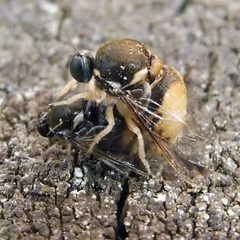
Small to medium-sized flies with characteristically small relative to body size. Body often humpbacked in profile. typically have reduced mouthparts and large . The specific epithet 'orbiculus' refers to rounded body shape in some . Coloration and body size show high phenotypic plasticity within species.
Distribution
Widespread in the western Palaearctic; present in northern Europe including Denmark, Norway, Sweden, and Germany (Schleswig-Holstein). Acrocera cabrerae is to the Canary Islands. North American records indicate the is -rich on that continent. GBIF records confirm presence in Scandinavia.
Host Associations
- Amaurobius erberi - Reared specimen of A. orbiculus
- spiders (Araneae) - General group for ; larvae are endoparasitoids
- mites (Acari) - First-instar larvae described from mites
Life Cycle
laid on ground or vegetation near . First-instar larvae () actively seek or wait for spider hosts. Upon host contact, larvae burrow through and attach to book lungs, entering for several months. Subsequent larval instars develop rapidly, consuming liquid contents of host. Larvae emerge posteriorly from host, attach to spider silk for . emerge in 7–10 days.
Behavior
are rarely observed and presumably short-lived. First-instar larvae exhibit -seeking , either waiting or actively searching for spiders. Larvae maintain prolonged attached to host book lungs before resuming development.
Ecological Role
Endoparasitoid of spiders; regulates spider . Larval consumption of internal contents represents complete tissue utilization with no waste.
Human Relevance
Subject of entomological research due to specialized and . Featured in public outreach (Bohart Museum of Entomology Halloween event, 2017) to illustrate parasitoid . of A. orbiculus sequenced as part of biodiversity initiatives.
Similar Taxa
- OgcodesRelated within Acroceridae; also endoparasitoids of spiders but differs in morphological details of wing venation and body proportions
- ParacroceraFormerly recognized as distinct ; three (P. kaszabi, P. manevali, P. minuscula) synonymized with A. orbiculus based on molecular and morphological evidence
More Details
Taxonomic synonymy
Based on mitochondrial COI analysis and morphological evidence, Paracrocera kaszabi, P. manevali, and P. minuscula have been placed in synonymy with Acrocera orbiculus. The shows high phenotypic plasticity with no distinct barcoding gap between .
Fossil record
The fossil 'Acrocera hirsuta' Scudder, 1877 is not considered an acrocerid and appears closer to Mythicomyiidae.
Sources and further reading
- BugGuide
- Wikipedia
- GBIF taxonomy match
- iNaturalist taxon
- NCBI Taxonomy
- Catalogue of Life
- A Piñata That Only Entomologists Could Love | Bug Squad
- Bug Squad
- OVIPOSITION BEHAVIOR AND THE EGG OF ACROCERA ORBICULA (FAB.) (DIPTERA: ACROCERIDAE)
- Ein neuer Nachweis der regional seltenen Kugelfliege Acrocera orbiculus (Fabricius, 1787) (Dipt. Acroceridae) in Schleswig-Holstein
- New host records for European Acroceridae (Diptera), with discussion of species limits of Acrocera orbiculus (Fabricius) based on DNA-barcoding
- The genome sequence of the Top-horned Hunchback fly, Acrocera orbiculus (Fabricius, 1787).