
Spirostreptidae
Flatplate Millipedes
Genus Guides
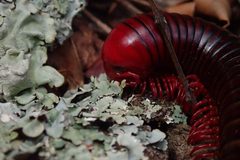
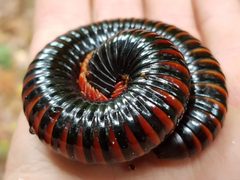
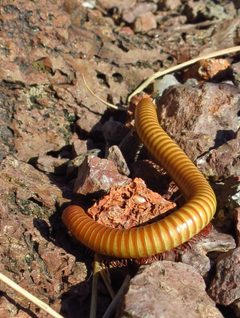
1Spirostreptidae is a of large millipedes in the order Spirostreptida, commonly known as flatplate millipedes. The family comprises approximately 100 distributed across tropical and subtropical regions of the Americas, Africa, Madagascar, Seychelles, and the eastern Mediterranean. Members are characterized by their elongated cylindrical bodies and are primarily soil-dwelling , though some exhibit arboreal habits. The family includes both species that can become urban pests and species with specialized thermoregulatory and social .
Pronunciation
How to pronounce Spirostreptidae: //spɪroʊˈstrɛptɪdiː//
These audio files are automatically generated. While they are not always 100% accurate, they are a good starting point.
Identification
Spirostreptidae can be distinguished from other spirostreptid by , particularly the structure of male copulatory appendages used in -level . Geometric morphometric analysis of gonopods has revealed significant intraspecific variation, complicating taxonomic assignment based solely on qualitative shape categories. Species identification typically requires examination of gonopod structure; molecular data (COI and 16S rRNA) may be necessary for definitive identification in some such as Sechelleptus.
Images
Habitat
range from tropical riparian forests and arboreal environments to desert . The desert-dwelling Orthoporus ornatus occupies subsurface soil in rocky hillside, sandy wash, and desert pavement habitats in Arizona, using vertical to exploit thermal gradients. The arboreal species Sechelleptus arborivagus inhabits trees on Mayotte Island. Urban of Urostreptus atrobrunneus have established in built environments in São Paulo State, Brazil.
Distribution
Disjunct distribution spanning North and South America, eastern Mediterranean, continental Africa, Madagascar, and Seychelles. The Plagiotaphrus is distributed across Africa with likely broader occurrence than currently documented due to incomplete survey coverage.
Seasonality
Surface activity in desert is constrained by temperature extremes, with movement occurring primarily during evening and morning hours when thermal conditions are moderate. In tropical species, surface activity patterns have been observed during specific breeding periods.
Behavior
has been documented in multiple . In Alloporus uncinatus, aggregations of 6-42 individuals are associated with feeding activities of stages rather than reproductive functions. Males of this species obtain mates through random encounters and by forming triplet associations with copula pairs; mating is size-selective, likely due to female choice. Active behavioral includes vertical in soil, microhabitat selection (burrows, rock crevices, under vegetation), and coiling responses to reduce surface area when exposed to high temperatures.
Ecological Role
Soil macro-arthropods involved in maintaining balance through detritivory. explosions may occur following environmental imbalances, climate changes, or applications that eliminate competitors.
Human Relevance
Urostreptus atrobrunneus has become a pest in urban centers of São Paulo State, causing problems for human ; control efforts have been hindered by limited knowledge of its . The ' and salivary gland has been studied to inform management strategies.
Similar Taxa
- Other Spirostreptida familiesSpirostreptidae is distinguished from related within Spirostreptida primarily by ; family-level assignment requires examination of male reproductive structures
More Details
Conservation significance
Divergent within such as Bicoxidens flavicollis may represent evolutionary insurance against climate change, regardless of whether full speciation occurs, highlighting the conservation value of maintaining population-level diversity
Taxonomic challenges
shows significant intraspecific variation; quantitative geometric morphometric approaches are recommended over qualitative assessments for taxonomic assignment. Integrative approaches combining molecular data with morphology are needed for delimitation in several
Sources and further reading
- BugGuide
- Wikipedia
- GBIF taxonomy match
- iNaturalist taxon
- NCBI Taxonomy
- Mating Tactics in the Tropical Millipede Alloporus Uncinatus (Diplopoda: Spirostreptidae)
- Aggregation in the tropical millipedeAlloporus uncinatus(Diplopoda: Spirostreptidae)
- Behavioural thermoregulation of Orthoporus ornatus (Diplopoda: Spirostreptidae) in three desert habitats
- Mating behaviour and mate choice experiments in some tropical millipedes (Diplopoda: Spirostreptidae)
- Structure and function of the foregut and salivary glands of the synanthropic diplopod Urostreptus atrobrunneus (Spirostreptidae)
- Geometric morphometric analysis of gonopods in Bicoxidens flavicollis populations (Diplopoda, Spirostreptida, Spirostreptidae)
- A review of the taxonomy and distribution of Plagiotaphrus Attems 1914 (Diplopoda, Spirostreptida, Spirostreptidae)
- A new species of Lophostreptus Cook, 1895 discovered among syntypes of L. regularis Attems, 1909 (Diplopoda, Spirostreptida, Spirostreptidae)
- Sechelleptus arborivagus sp. nov., a new arboreal spirostreptid millipede (Diplopoda, Spirostreptidae) endemic to Mayotte Island (Comoros Archipelago), Indian Ocean