
Orthoporus
Silvestri, 1897
Species Guides
3- Orthoporus flavior
- Orthoporus ornatus(Desert Millipede)
- Orthoporus texicolens
Orthoporus is a of spirostreptid millipedes comprising approximately 80 distributed from the southern United States through Central America to Brazil and Argentina. The genus includes the well-known desert millipede Orthoporus ornatus, which has been studied for its behavioral in arid environments. Members of this genus are characterized by their cylindrical bodies and two pairs of legs per body segment, typical of millipedes. Several species are maintained in educational collections due to their docile nature and distinctive appearance.

Pronunciation
How to pronounce Orthoporus: //ˌɔr.θəˈpoʊ.rəs//
These audio files are automatically generated. While they are not always 100% accurate, they are a good starting point.
Identification
Distinguished from centipedes by having two pairs of legs per body segment (versus one pair), cylindrical body shape (versus flattened), and slow movement (versus fast). Differs from other in Spirostreptidae by subtle morphological characters of the (male reproductive appendages) and body proportions, requiring examination for definitive identification to level.
Images
Appearance
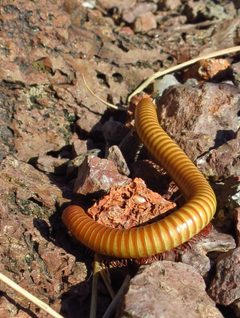
Cylindrical body form with numerous segments, each bearing two pairs of legs. Orthoporus ornatus, a representative , exhibits yellow-gold banding on a dark background, earning it the "Texas Gold-Banded millipede." Body coloration varies among species. Slow-moving relative to centipedes. Non-venomous, lacking the forcipules (venomous claws) characteristic of centipedes.
Habitat
varies by . Orthoporus ornatus inhabits desert environments including sandy desert, rocky hillside, and grassland associations. Burrows in soil at depths ranging from 2–5 cm during cool months to 15–25 cm during hot months to escape high surface temperatures.
Distribution
distributed from the southern United States (Arizona, Texas, New Mexico) through Mexico and Central America to Brazil and Argentina. GBIF records also indicate presence in southern Africa, though this may represent introduced or data artifacts requiring verification.
Seasonality
Surface activity primarily and associated with rainfall. Activity ceases when soil surface temperatures exceed 40°C. Seasonal variation in burrowing depth corresponds to temperature regimes: shallow burrows in cool months, deeper burrows in hot months.
Diet
Detritivorous, feeding on decaying plant material including rotting vegetation and wood.
Behavior
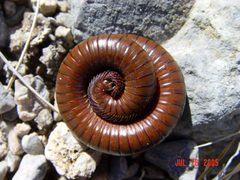
Exhibits behavioral : maintains mean body temperature near 32°C across different desert by adjusting burrowing depth and, to a minor extent, body orientation relative to sun and shade. Coils into defensive posture when disturbed. Docile temperament makes some suitable for handling in educational settings.
Ecological Role
Decomposer; contributes to nutrient cycling through consumption and breakdown of dead plant material.
Human Relevance
Orthoporus ornatus maintained in educational collections and museum petting zoos due to docile nature, distinctive coloration, and utility for demonstrating locomotion and distinguishing millipedes from centipedes. Some secrete defensive compounds including cyanide derivatives when distressed; consumption is toxic though they are not venomous.
Similar Taxa
- Centipedes (class Chilopoda)Often confused due to shared vernacular names; centipedes have one pair of legs per segment, flattened bodies, fast movement, and venomous forcipules
- Other Spirostreptidae generaRequire examination of and body proportions for definitive separation; many share similar overall body plans
Misconceptions
Frequently confused with centipedes in public perception, though the two groups differ fundamentally in leg number per segment, body shape, speed, diet, and defensive capabilities. Millipedes are not venomous, though some secrete toxic defensive compounds.
More Details
Defensive Secretions
Some secrete hydrogen cyanide or other toxic compounds when distressed; this is a chemical defense rather than venom
Thermoregulation Research
Orthoporus ornatus was subject of classic behavioral study demonstrating precise behavioral in desert environments