
Orthoporus ornatus
(Girard, 1853)
Desert Millipede, Texas Gold-Banded Millipede
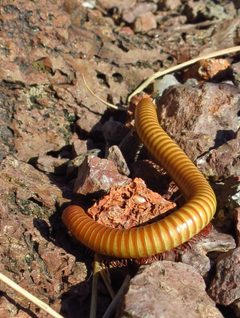
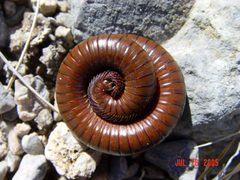
Orthoporus ornatus is a large native to the Chihuahuan and Sonoran deserts of the southwestern United States and northern Mexico. typically reach 4 inches (10 cm) in length, with exceptional individuals exceeding 9 inches (23 cm). The exhibits behavioral , spending most of its life in deep, damp soil burrows and emerging primarily after summer rains to feed and reproduce. It is popular in the pet trade and has been introduced to European collections through captive breeding programs.

Pronunciation
How to pronounce Orthoporus ornatus: /ɔrˈθɒpɔrəs ɔrˈneɪtəs/
These audio files are automatically generated. While they are not always 100% accurate, they are a good starting point.
Identification
Distinguished from other desert millipedes by its large size, geographic range, and association with Chihuahuan/Sonoran desert . The Organ of Tömösváry, located near the antennal bases, is a key diagnostic feature of the . Color variation between can complicate identification; dark brown to black forms are most common, but yellow morphs occur. Differs from centipedes (class Chilopoda) in having two leg pairs per body segment versus one, and in its slow, non-venomous nature. Similar large spirostreptids in the region require geographic and subtle morphological comparison for definitive identification.
Images
Habitat
Deep, damp soil of desert , residing in self-dug burrows and small channels within the soil profile. Surface activity occurs in rocky areas, beneath shrubs, and on damp ground following rainfall. Requires moist soil conditions for feeding; cannot feed in dry substrates. Microhabitat selection is actively modulated for temperature regulation.
Distribution
United States: Arizona, New Mexico, Texas. Mexico: San Luis Potosí and northern Mexican states. Core range encompasses the Chihuahuan and Sonoran deserts.
Seasonality
Surface activity primarily restricted to summer rainy periods. Emerges after rainfall when soil moisture is elevated, typically in early morning hours. surface activity pattern: single major period per year for feeding. Subsurface activity continues year-round in suitable soil microhabitats.
Diet
: feeds on dead plant material including tissues of dead shrubs (cholla, creosote bush, ocotillo), surface litter, and bark of mesquite and Ephedra. Consumes living and dead organic material, bacteria, and small . Has been observed feeding on Salsola in Albuquerque and Ephedra in Jornada del Muerto.
Host Associations
- Ephedra - food sourceShrubs in Jornada del Muerto
- Salsola - food sourceGrows in Albuquerque
- Cylindropuntia imbricata - food sourceTree cholla, dead tissues
- Larrea tridentata - food sourceCreosote bush, dead tissues
- Fouquieria splendens - food sourceOcotillo, dead tissues
- Prosopis glandulosa - food sourceMesquite, bark
Life Cycle
occur throughout life, with new body segments added at each molt. Longevity exceeds ten years in captivity and likely in wild . Reproductive details not well documented in available sources.
Behavior
Slow-moving and primarily . Exhibits behavioral : activity peaks during early morning hours and ceases when surface temperatures exceed 35°C. During high temperatures, seeks under rocks or on aerial portions of shrubs (observed at air temperatures of 35.5°C). When disturbed, curls into a tight defensive coil and may release a noxious, toxic secretion from lateral glands. This secretion is irritating to skin and of humans. Spends majority of life in deep soil burrows, emerging only annually for surface feeding.
Ecological Role
Contributes to desert nutrient cycling through consumption and breakdown of dead plant material, which decays slowly in arid environments. Facilitates decomposition of woody and herbaceous detritus, reducing accumulation of organic matter. Serves as prey for approximately thirteen documented ; subterranean habit provides primary defense against .
Human Relevance
Popular in the pet trade; exported extensively to Western Europe with established captive breeding programs (first European breeders: Brian Van Der Kieft and Max Prins). Used in educational settings to demonstrate anatomy, locomotion, and differences from centipedes. Defensive secretions can cause skin and irritation; handling should be followed by hand washing. Benefits desert through decomposition services.
Similar Taxa
- Centipedes (class Chilopoda)Often confused due to public conflation of '' and ''; distinguished by two leg pairs per body segment (vs. one), slow movement (vs. fast), herbivorous/detritivorous diet (vs. ), and non-venomous nature (vs. venomous fangs)
- Other Orthoporus speciesRequire geographic and subtle morphological comparison; O. ornatus distinguished by range and specificity within Chihuahuan/Sonoran deserts
Misconceptions
Frequently confused with centipedes in public perception, though the two groups differ fundamentally in anatomy, , and . Not dangerous to humans despite toxic defensive secretions; secretions cause irritation but are not life-threatening. Not venomous and does not bite.
More Details
Thermoregulatory Behavior
Documented to cease surface activity when soil surface temperature reaches 35°C and resume when temperatures drop to this threshold. During extreme heat, individuals position themselves under rocks or on shrub branches to avoid lethal ground temperatures.
Pet Trade History
Became popular in European pet trade with first successful breeding in Europe by Brian Van Der Kieft and Max Prins. Texas Gold-Banded morph particularly sought after in hobbyist collections.
Soil Dependence
Strictly dependent on moist soil conditions for feeding; surface feeding only observed when soil moisture is adequate. feeding binge on surface following summer rains stores energy for year-long subterranean period.