
Scolopendra heros
Girard, 1853
Giant Desert Centipede, Giant Sonoran Centipede, Texas Redheaded Centipede, Giant Redheaded Centipede, Arizona Desert Centipede, Texas Black-tailed Centipede, Giant North American Centipede
Scolopendra heros is the largest in North America, reaching up to 8 inches (200 mm) in length. This inhabits arid and semi-arid regions of the southwestern United States and northern Mexico, though it also occurs in rocky woodland areas. It possesses potent venom delivered through modified front legs called toxicognaths, used to subdue prey ranging from insects to small vertebrates. The exhibits striking aposematic coloration with multiple regional variants, most notably the red-headed, black-bodied castaneiceps form.
Pronunciation
How to pronounce Scolopendra heros: //skɔloˈpɛndra ˈhɛroʊs//
These audio files are automatically generated. While they are not always 100% accurate, they are a good starting point.
Identification
Distinguished from other North American by its exceptional size—no other native approaches 8 inches in length. Among scolopendromorphs, the combination of large size and distinctive coloration separates it from smaller . The 21 or 23 leg pairs (versus 15 in Scutigeromorpha and Lithobiomorpha) place it in Scolopendromorpha. The presence of ocelli (simple ) distinguishes it from eyeless Geophilomorpha. Regional color variants can cause confusion, but the overall large size and robust build are consistent identifiers.
Images
Appearance
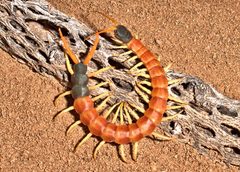
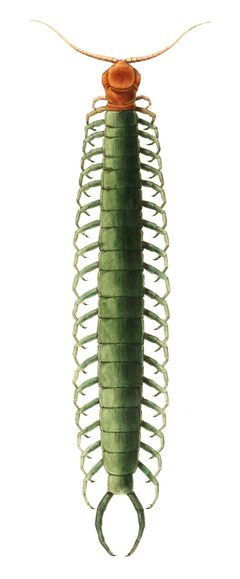
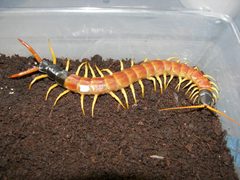
Large, elongate with 21 or 23 pairs of legs on the trunk. Average length 6.5 inches (170 mm), with wild specimens reaching 8 inches (200 mm); captivity specimens may grow larger. Body distinctly segmented with one pair of legs per segment. bears four small individual ocelli on each side. Coloration highly variable across range: castaneiceps variant has red head and first trunk segments with greenish-black body and yellow legs; arizonensis variant has red body with black head; other forms show brown, black, or dark green coloration with contrasting leg colors. Terminal legs may be modified and can be autotomized (shed) when threatened.
Habitat
Primarily inhabits arid and semi-arid environments including Sonoran and Chihuahuan Desert regions. Also occurs in rocky woodland areas, such as dolomite glades in Arkansas and Missouri. Found in mixed-grass prairie, desert scrub, and rocky slopes. Remains underground in burrows or beneath cover objects during warm days, emerging in cloudy weather or at night. Requires access to moisture; desiccation is a significant threat in captivity.
Distribution
Southwestern United States and northern Mexico. In the U.S., ranges from New Mexico and Arizona westward to Arkansas, Missouri, and Louisiana eastward. Northeastern limit in southwestern Missouri, northwestern Oklahoma, and Arkansas. Mexican distribution includes northern states adjacent to the U.S. border.
Seasonality
Active year-round in warmer portions of range; activity peaks during warmer months. , with surface activity concentrated at night. Emerges from underground retreats during cloudy weather regardless of season.
Diet
feeding on and small vertebrates. Prey includes insects (crickets, grasshoppers, flying insects snatched from air), spiders, scorpions, rodents, reptiles, and amphibians. In captivity, accepts large insect larvae (Manduca), frozen/thawed mice, and pinky rats. Venom used to subdue prey rapidly—rodents may succumb within seconds of envenomation.
Life Cycle
Hatches from . Development through multiple instars with molting of ; segment number remains constant throughout life (anamorphic development not occurring in this order). Slow-growing with lifespan exceeding one decade in captivity. Sexual maturity reached after multiple years and . Detailed egg-laying and early instar poorly documented.
Behavior
that hunts actively on the surface at night. Capable of rapid, fluid movement; strikes quickly to seize prey. When threatened, prefers over fight; will attempt to escape rapidly. Bites only when handled or cornered. Can climb vertical surfaces and navigate varied terrain. In captivity, exhibits persistent escape and can chew through inadequate containers including Ziploc bags. Becomes lethargic at low temperatures.
Ecological Role
Apex in many arid and semi-arid . Controls of insects, other arthropods, and small vertebrates. Serves as prey for larger vertebrates despite aposematic coloration and defensive venom. Contributes to nutrient cycling through and carcass processing.
Human Relevance
Bites cause intense local pain, swelling, and occasional including nausea, headache, and localized skin . No confirmed human fatalities attributed to this , though severe symptoms including rhabdomyolysis and cardiac effects have been reported from Scolopendra bites generally. Popular in live displays and pet trade due to impressive size and coloration; captive care requires secure containment and humidity management. Occasionally enters buildings accidentally, causing alarm but not establishing indoor .
Similar Taxa
- Scolopendra giganteaSouth American reaching 12 inches; not naturally sympatric but may be confused in pet trade or general reference. Larger maximum size and tropical distribution distinguish it.
- Scolopendra polymorphaSmaller North American with more uniform coloration; typically under 4 inches, lacking the striking red/black or red/yellow contrast of S. heros.
- Scolopendra viridisSmaller southwestern with greenish coloration; distinguished by smaller size and different preferences.
- Scutigera coleoptrataHouse centipede with 15 leg pairs, , and much smaller size; harmless to humans and .
Misconceptions
Claims of 2-foot specimens are demonstrably false; maximum documented size is approximately 8 inches in wild specimens, with unverified reports of 10-11 inches in exceptional captivity specimens. The invalid name 'Scolopendra Caribiaenensis' has been propagated by livestock dealers, likely referring to S. gigantea. Despite fearsome appearance and painful bite, the is not aggressive toward humans and avoids confrontation when possible.
More Details
Venoms and toxins
Venom contains serotonin, histamine, lipids, proteins including cardiotoxic components and hemolytic phospholipase A. Acts as cytolysin, compromising cellular . Contains prey-specific toxins: one numbs insect , another targets vertebrate autonomic nervous systems. Venom difficult to extract in quantity and deteriorates rapidly when processed, limiting pharmacological study.
Taxonomic notes
Three color variants (castaneiceps, arizonensis, and nominate heros) have been treated as , but these are likely taxonomically meaningless ecological variants. Color variation appears clinal across the range rather than representing distinct evolutionary lineages.
Captive longevity
Slow growth rate and extended lifespan present challenges for long-term captive maintenance. Moisture availability critical—desiccation a common cause of death in captivity. Requires secure, escape-proof enclosure due to chewing capability and strength.
Sources and further reading
- BugGuide
- Wikipedia
- GBIF taxonomy match
- iNaturalist taxon
- NCBI Taxonomy
- Catalogue of Life
- North America’s largest centipede | Beetles In The Bush
- North America’s largest centipede | Beetles In The Bush
- Recyclers of the rainforest: Bornean myriapods, millipedes (Diplopoda), and their nemesis, giant centipedes (Chilipoda) — Bug of the Week