
Scutigera coleoptrata
Linnaeus, 1758
House Centipede, Thousand-legger
Scutigera coleoptrata, commonly known as the house centipede, is a fast-moving predatory native to the Mediterranean region that has become through human commerce. possess 15 pairs of extremely long, delicate legs and well-developed faceted —unusual traits among centipedes. They are , thriving in human dwellings where they hunt household arthropods. Despite their alarming appearance and speed, they pose minimal threat to humans and are considered beneficial of pests.
Pronunciation
How to pronounce Scutigera coleoptrata: //skjuːˈtɪɡərə ˌkɒliˈɒptrətə//
These audio files are automatically generated. While they are not always 100% accurate, they are a good starting point.
Identification
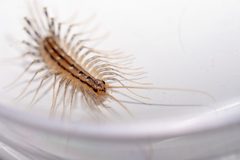
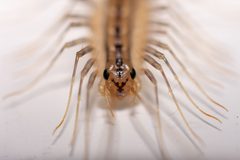
Distinguished from other centipedes by: extremely long legs and relative to body size; well-developed faceted (most centipedes have simple eyes or none); yellowish-gray coloration with three dark stripes; 15 pairs of legs in ; ability to run at speeds up to 0.4 m/s on floors, walls, and ceilings. Automimicry of hind legs resembling antennae creates confusion about which end is when at rest. Unlike silverfish, has distinct body segments with one pair of legs per segment. Unlike spiders, has many legs and long antennae.
Images
Habitat
; primarily inhabits human dwellings. Indoors: basements, garages, bathrooms, kitchens, offices, bedrooms—preferring humid areas but tolerating drier spaces. Outdoors: cool, damp microhabitats under rocks, woodpiles, bark, leaf litter, compost piles. Requires environments that prevent dehydration due to inability to close . Often emerges during garden watering or when seeking shelter from temperature extremes.
Distribution
Native to Mediterranean region. Introduced and established across Europe, Asia, North America, South America, Australia, and recently confirmed in Western Siberia and Middle Urals (Russia). distribution due to international commerce.
Seasonality
Active year-round indoors. Greatest likelihood of encounter in spring ( with warmer weather) and autumn (seeking shelter from cooling temperatures). hunters.
Diet
Strictly insectivorous. Preys on spiders, bed bugs, , , silverfish, ants, and other household arthropods. Administers venom via forcipules to subdue prey. Has been observed to distinguish between prey types and adjust hunting tactics accordingly—retreating after envenomating dangerous prey like to allow venom to take effect.
Life Cycle
Anamorphic development with incomplete . laid in spring; average 63 eggs per clutch (maximum 151 observed). Hatching with 4 leg pairs; leg number increases through molting until reaching 15 pairs. retain 15 pairs through 3 additional molting stages. Lifespan 3–7 years depending on environment. Sexual maturity reached in third year.
Behavior
relying primarily on for chemosensory and mechanosensory detection despite well-developed . Uses multiple hunting techniques: jumping onto prey, "lassoing" with legs, beating prey with legs. Can stridulate. When threatened, can autotomize trapped legs. observed: curls body to clean legs with forcipules. Extremely rapid locomotion (up to 0.4 m/s) on horizontal and vertical surfaces; capable of sudden stops followed by motionless periods, then rapid resumption of movement.
Ecological Role
Beneficial in human-modified environments. Controls of household pests including , silverfish, bed bugs, and spiders. Serves as prey for larger predators in outdoor .
Human Relevance
Frequently evokes fear due to speed and appearance, but poses minimal threat. Venom not dangerous to humans; forcipules rarely penetrate skin. Stings produce mild localized pain and swelling comparable to stings; allergic reactions rare. Generally non-aggressive, fleeing when disturbed. Ecologically beneficial as agent for household pests. Often killed unnecessarily due to aesthetic aversion.
Similar Taxa
- Other centipede species (various Chilopoda)Shorter legs, simpler or eyelessness, different body proportions, slower movement
- Silverfish (Lepismatidae)Lacks distinct segmentation with one leg pair per segment; has three tail-like appendages; moves more slowly
- Spiders (Araneae)Eight legs, no , two body regions, different locomotion
Misconceptions
Often mistakenly believed dangerous or venomous to humans; actually harmless. Name "thousand-legger" is inaccurate—maximum 15 leg pairs (30 legs), not 1000. Frequently confused with millipedes, which have two leg pairs per segment and are generally slower, detritivorous, and less associated with human dwellings.
More Details
Sensory Biology
Possesses unique antennal scape organ with cone-shaped hypothesized to function as hygroreceptors—critical for detecting humid microhabitats given rapid water loss through unclosable . equipped with five sensillum types including novel beak-like sensilla and scolopidial components for mechanoreception.
Regeneration
Capable of explosive leg following ; anamorphic development allows continued leg addition through molting even in .
Historical Taxonomy
Originally described as Scolopendra coleoptrata by Linnaeus in 1758; separated into Scutigera by Lamarck in 1801. Generic name derives from Latin 'shield' and gerere 'to bear', referring to plate shapes on the back.
Sources and further reading
- BugGuide
- Wikipedia
- GBIF taxonomy match
- iNaturalist taxon
- NCBI Taxonomy
- Catalogue of Life
- Insect FAQs | Entomology Research Museum
- scutigera-half.jpg | Entomology Research Museum
- Oh, the Bugs They Saw at the Bohart! | Bug Squad
- Bug Eric: House Centipedes
- Bug Eric: July 2009
- Archive — Bug of the Week
- FIRST RECORD OF SCUTIGERA COLEOPTRATA (LINNAEUS, 1758) IN THE SOUTH OF WESTERN SIBERIA, RUSSIA (CHILOPODA: SCUTIGEROMORPHA: SCUTIGERIDAE)
- The first record of Scutigera coleoptrata (Linnaeus, 1958) (Chilopoda: Scutigeromorpha, Scutigeridae) in the Perm Krai (Middle Urals)
- Organization of Deutocerebral Neuropils and Olfactory Behavior in the Centipede Scutigera coleoptrata (Linnaeus, 1758) (Myriapoda: Chilopoda)
- The antennal scape organ of Scutigera coleoptrata (Myriapoda) and a new type of arthropod tip-pore sensilla integrating scolopidial components
- The source of chilopod sensory information: External structure and distribution of antennal sensilla in Scutigera coleoptrata (chilopoda, Scutigeromorpha)
- Explosive regeneration and anamorphic development of legs in the house centipede Scutigera coleoptrata.