
Scolopendra viridis
Say, 1821
Florida Blue Centipede, Green Centipede
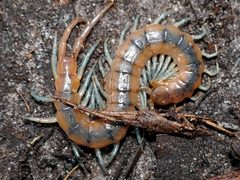
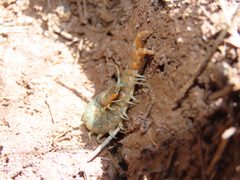
Scolopendra viridis is a medium-sized in the Scolopendridae, commonly known as the Florida Blue Centipede. It is one of 21 native North American in the order Scolopendromorpha. The species has been documented as prey for the pygmy rattlesnake (Sistrurus miliarius), indicating its role in of the southeastern United States.
Pronunciation
How to pronounce Scolopendra viridis: //ˌskɒləˈpɛndrə ˈvɪrɨdɪs//
These audio files are automatically generated. While they are not always 100% accurate, they are a good starting point.
Images
Distribution
Central America; Panama (Pearl Islands); USA; Middle America; North America. The is present in Florida and the southeastern United States, with the 'Florida Blue ' suggesting primary occurrence in that region.
Ecological Role
Prey for pygmy rattlesnakes (Sistrurus miliarius). As a scolopendromorph , it likely functions as an active of small in its , though specific dietary habits are not documented in available sources.
More Details
Taxonomic Note
Scolopendra viridis was described by Thomas Say in 1821. The specific epithet 'viridis' (Latin for 'green') and 'Florida Blue ' suggest coloration that may vary geographically or individually, though no detailed color descriptions were found in available sources.
Data Limitations
Available sources provide minimal biological information for this . Most detailed documentation of North American Scolopendra species focuses on the larger and more conspicuous S. heros (giant desert ). Field guides and natural history accounts specific to S. viridis appear scarce in the consulted literature.
Sources and further reading
- BugGuide
- GBIF taxonomy match
- iNaturalist taxon
- NCBI Taxonomy
- Catalogue of Life
- North America’s largest centipede | Beetles In The Bush
- warning coloration | Beetles In The Bush | Page 2
- centipedes | Beetles In The Bush
- fauna | Blog - Part 9
- September | 2010 | Beetles In The Bush | Page 2
- Prey Species Influences Foraging Behaviors: Rattlesnake (Sistrurus miliarius) Predation on Little Brown Skinks (Scincella lateralis) and Giant Centipedes (Scolopendra viridis)