
Scolopendra polymorpha
Wood, 1861
Common Desert Centipede, Tiger Centipede, Banded Desert Centipede, Sonoran Desert Centipede, Multicolored Centipede
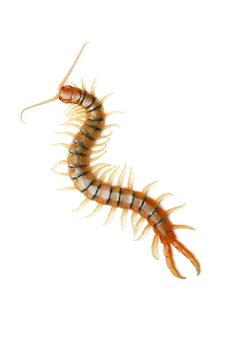
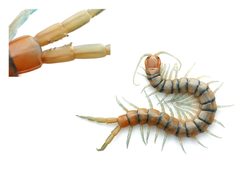
Scolopendra polymorpha is a large native to arid regions of western North America. typically measure 10–18 cm in body length. The species exhibits highly variable coloration, with common forms showing a dark brown to black body with yellow legs and orange to red , though some display entirely blue coloration with indigo stripes. It is primarily and has been documented to exhibit cannibalistic . The venom contains bioactive with demonstrated antimicrobial properties against human .
Pronunciation
How to pronounce Scolopendra polymorpha: /skɔlɔˈpɛndra pɔlɪˈmɔrfə/
These audio files are automatically generated. While they are not always 100% accurate, they are a good starting point.
Identification
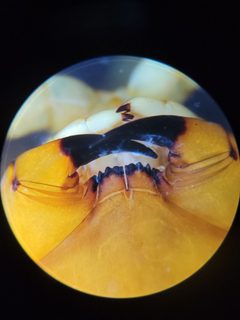
Distinguished from other Scolopendra in its range by: (1) smaller size compared to S. heros (giant desert , up to 20+ cm); (2) presence of dark lateral stripes on body segments versus more uniform coloration in some ; (3) geographic restriction to western North American arid zones. Distinguished from other scolopendromorph by 21 leg pairs and presence of ocelli. May be confused with S. heros where ranges overlap; S. polymorpha typically shows more pronounced striping and smaller maximum size.
Images
Habitat
Dry grasslands, forest edges, and desert environments. Specifically occupies: desert scrub, pinyon-juniper-oak woodlands, shortgrass prairie with rocky substrates, and mesquite grasslands. Microhabitat selection includes: spaces beneath rocks (primary daytime ), self-constructed burrows in suitable soils, and interior cavities of rotting logs. Requires access to moisture; despite xeric adaptations, shows incomplete physiological to extreme aridity.
Distribution
Southwestern United States and northern Mexico. Northern limit extends to the Pacific coast. Documented from: Texas, New Mexico, Arizona, southern California, Sonora (Mexico), Chihuahua (Mexico). Occurs from sea level to moderate elevations in mountainous desert regions.
Seasonality
Activity strongly temperature and moisture dependent. Peak surface activity occurs: (1) nocturnally throughout active periods; (2) during cool winter months; (3) occasionally during summer monsoon periods when humidity increases and temperatures moderate. Remains in subterranean refugia during hot, dry periods. Year-round presence in suitable with seasonal variation in surface detectability.
Diet
. Preys on including insects, other arthropods, and smaller . Documented on conspecifics. In captivity, accepts large insect larvae (e.g., Manduca), small vertebrates including pinky mice. Specific natural prey composition poorly documented but inferred from related and .
Life Cycle
Developmental stages include and post-embryonic instars. Direct development without ; young resemble and increase in size through successive . Juveniles observed at approximately 7.5 cm total length. Specific details of egg deposition, , and number of instars to maturity not documented in available sources.
Behavior
surface forager. Rapid, agile locomotion. Defensive includes rapid escape and venomous bite when handled. Documented : observed killing and consuming smaller conspecifics, with venomous forcipules embedded in victim's body. Limited venom capacity: 65–86% of venom volume and 29–47% of protein mass regenerated within 48 hours post-depletion; no further regeneration observed over 7 months. Venom regeneration rate negatively correlated with body size.
Ecological Role
Mesopredator in terrestrial . control of insects and other soil/ground-dwelling . may regulate . Serves as prey for larger vertebrates including birds, mammals, and reptiles in some . Contribution to nutrient cycling through and carcass processing.
Human Relevance
Medical research: venom SPC13 demonstrates antimicrobial activity against Staphylococcus aureus, Pseudomonas aeruginosa, and bacteriostatic effects against Escherichia coli. Bite painful and potentially medically significant for sensitive individuals; defensive bite requires handling or provocation. Occasionally encountered in human-modified environments. Popular in live displays and private collections due to size and coloration.
Similar Taxa
- Scolopendra herosLarger maximum size (up to 20+ cm), typically more robust build, coloration often with red and black body (S. h. castaneiceps form) versus more variable striping in S. polymorpha. Ranges overlap in southwestern US deserts.
- Scolopendra viridisSmaller with greenish coloration, different geographic distribution. Less variable color pattern.
- Other ScolopendromorphaDistinguished by 21 leg pairs, presence of ocelli, and large size relative to other orders (Geophilomorpha, Lithobiomorpha, Scutigeromorpha).
More Details
Venom Biochemistry
Venom contains SPC13 with demonstrated antimicrobial properties. Research indicates myotoxic effects in murine muscle tissue, including , fascicular structure loss, and mitochondrial . Incomplete venom suggests ecological constraints on defensive venom use.
Color Variation
epithet 'polymorpha' refers to pronounced intraspecific color variation. Blue color morph in Southern California represents striking geographic variation without taxonomic recognition as distinct .
Field Observations
Observed active on roads at night in juniper-oak-pinyon woodland , suggesting surface movement for foraging or mate location. Cool temperatures reduce activity levels, facilitating observation and photography.