
Geophilomorpha
Soil Centipedes
Family Guides
5- Geophilidae(soil centipedes)
- Himantariidae
- Linotaeniidae
- Mecistocephalidae
- Schendylidae
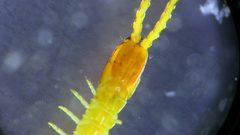
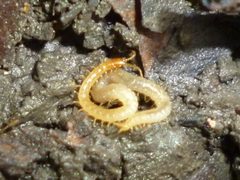
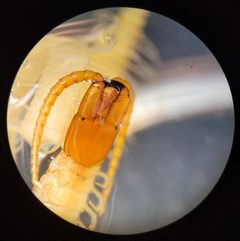
Geophilomorpha is the most diverse order of centipedes (Chilopoda), comprising approximately 230 . Members are commonly known as soil centipedes due to their primarily subterranean lifestyle. They are eyeless, with long narrow bodies and highly variable leg counts—possessing 27 to 191 pairs of legs depending on . The order exhibits nearly worldwide distribution but is absent from Antarctica and most Arctic regions. Two suborders are recognized: Placodesmata ( Mecistocephalidae) and Adesmata (superfamilies Himantarioidea and Geophiloidea).
Pronunciation
How to pronounce Geophilomorpha: /ˌdʒiːəˌfɪloʊˈmɔːrfə/
These audio files are automatically generated. While they are not always 100% accurate, they are a good starting point.
Identification
Distinguished from other orders by the combination of: complete absence of (vs. in Scutigeromorpha and Lithobiomorpha; vs. four ocelli in Scolopendromorpha), possession of 27–191 leg pairs (vs. 15 pairs in Scutigeromorpha and Lithobiomorpha; vs. 21–23 pairs in Scolopendromorpha), and epimorphic development with fixed segment numbers at hatching. Mecistocephalidae uniquely exhibits fixed segment number by , whereas other show intraspecific variation in segment count.
Images
Habitat
Soil-dwelling organisms inhabiting diverse soil types including humus, mixed dipterocarp forest soils, montane forest soils from lowland to upper elevations, and cave environments. Some occur in bat guano. Exceptionally rare cave-adapted species with complete confined to subterranean have been documented from deep cave systems (to -1100 m depth).
Distribution
Nearly worldwide distribution. Present across North America, South America, Europe, Africa, Asia, and Australia. Absent from Antarctica and most Arctic regions. Documented from specific localities including: Java and Borneo (Indonesia/Malaysia), Croatia (Velebit Mountains deep caves), Kazakhstan, and Asian Russia.
Diet
, feeding on other animals. Specific prey items not documented in available sources.
Life Cycle
Epimorphic development—juveniles hatch with the full complement of body segments rather than adding segments through . Segment number is usually variable within , except in Mecistocephalidae where segment number is fixed by species. Detailed developmental stages and reproductive not documented in available sources.
Behavior
Primarily , inhabiting soil and subterranean microhabitats. Frequently overlooked or inaccessible through hand collecting in soil-surface microhabitats; effectively collected via soil core sampling. Exceptionally rare cave-adapted exhibit troglomorphic traits including elongated , trunk segments, and leg claws. Active using powerful jaws with poison glands and curved claws to grasp prey.
Ecological Role
Principal subset of soil macrofauna across diverse types in the Indo-Malayan Region and globally. Functions as in soil . Contributes to soil biodiversity and processes including decomposition and nutrient cycling through predatory activities.
Similar Taxa
- ScolopendromorphaGiant centipedes with 21–23 leg pairs and four ocelli per side of ; distinguished from eyeless Geophilomorpha with 27–191 leg pairs
- LithobiomorphaStone centipedes with 15 leg pairs and ; distinguished from eyeless Geophilomorpha with many more leg pairs
- ScutigeromorphaHouse centipedes with 15 leg pairs, , and very long legs; distinguished from eyeless, many-legged, soil-dwelling Geophilomorpha
More Details
Etymology
Name derived from Ancient Greek γεω- (geo-, "earth"), φίλος (phílos, "lover"), and μορφή (morphḗ, "form"), referring to their soil-dwelling habit.
Systematics
Monophyletic order containing two suborders: Placodesmata ( Mecistocephalidae only) and Adesmata (superfamilies Himantarioidea and Geophiloidea with multiple families including Geophilidae, Schendylidae, Oryidae, Himantariidae, and others).
Deep Cave Adaptation
Geophilus hadesi, discovered at -1100 m in Croatian caves, represents one of only two known geophilomorph with entire confined to cave environments, exhibiting extreme troglomorphic adaptations.
Sources and further reading
- BugGuide
- Wikipedia
- GBIF taxonomy match
- iNaturalist taxon
- NCBI Taxonomy
- Catalogue of Life
- conservation | Blog - Part 18
- centipedes | Beetles In The Bush
- soil science | Blog
- РАСПРОСТРАНЕНИЕ МНОГОНОЖЕК-ГЕОФИЛОВ И МУХОЛОВОК (Chilopoda: Geophilomorpha, Scutigeromorpha) В АЗИАТСКОЙ РОССИИ
- New data on the family Himantariidae Bollman, 1893 (Chilopoda: Geophilomorpha) from Kazakhstan
- Redescription of Mesoschendylajavanica (Attems, 1907) and its first records from Borneo (Chilopoda, Geophilomorpha, Schendylidae).