
Geophilus
Compost Centipedes
Species Guides
5- Geophilus flavus(Boreal Yellow-headed Soil Centipede)
- Geophilus mordax(pitted soil centipede)
- Geophilus oweni
- Geophilus varians
- Geophilus vittatus(diamondback soil centipede)
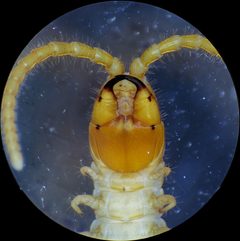
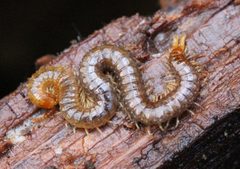
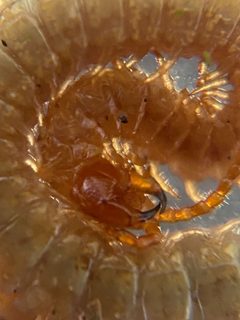
Geophilus is a large of soil centipedes in the Geophilidae, with approximately 140 . The genus has a Holarctic distribution and exhibits considerable morphological diversity, with body lengths ranging from under 1 cm to over 7 cm and leg pair counts varying from 29 to 89. Several species have adapted to specialized , including deep cave environments. The genus is characterized by distinctive structural features of the , forcipules, and trunk segments.
Pronunciation
How to pronounce Geophilus: /dʒiˈɒfɪləs/
These audio files are automatically generated. While they are not always 100% accurate, they are a good starting point.
Identification
Geophilus can be distinguished from other European Geophilidae by combinations of characters including the shape of the forcipular apparatus, arrangement and extent of sternal pore-fields, number and distribution of coxal pores, and the size and form of ultimate legs. G. pygmaeus is uniquely identified by its small size (under 2 cm), 41–47 leg pairs, and distinctive coxal pore arrangement. G. gigas exceeds 6 cm with swollen ultimate legs in both sexes, scattered coxal pores numbering in tens, and sternal pore-fields with additional pore groups. Cave-dwelling species such as G. hadesi and G. persephones exhibit elongated , trunk segments, and leg claws.
Images
Appearance
Centipedes in this have slightly elongate with on labral intermediate parts. The forcipules are usually poorly elongate with a single small tubercle at the base of each tarsungulum. The ultimate pretarsus is claw-shaped. The has complete or nearly complete coxo- , and -lines are incomplete. trunk metasternites usually feature an anterior medial socket and a transversally elongate pore-field. Body length ranges from approximately 1 cm to 8 cm. Leg pair counts vary widely: most have moderate numbers, but some have notably few (29–35 pairs) while others have many (up to 89 pairs in G. caucasicus).
Habitat
Most are soil-dwelling (epigeic or hypogeic). Some species inhabit caves, with at least two species—G. hadesi and G. persephones—having complete confined to cave environments. G. hadesi has been recorded at depths of 1,100 meters below ground, making it the deepest-dwelling known . G. serbicus is described as epigeic (surface-dwelling).
Distribution
Holarctic distribution. Specific documented ranges include: Southern Limestone Alps and northernmost Dinarides (G. pygmaeus); Iran (G. gigas); Stara Planina Mountains, Eastern Serbia, Balkan Peninsula (G. serbicus); and deep caves in the Velebit Mountains, Croatia (G. hadesi).
Diet
, feeding on other animals.
Ecological Role
in soil and cave . Cave-dwelling are among the top predators in their subterranean .
Similar Taxa
- EndogeophilusBoth are in the Geophilidae. Endogeophilus is a rare genus distinguished from Geophilus by structural features detailed in taxonomic keys.
More Details
Etymology
From Ancient Greek γεω- (geo-, "earth") and φίλος (phílos, "lover"), referring to the soil-dwelling habit. The generic name first appeared in Brewster's Edinburgh Encyclopaedia in 1814 as Geophilus electricus.
Taxonomic status
The is largely considered synonymous with Brachygeophilus. It is the largest genus in the Geophilidae.
Notable size extremes
Among the smallest are G. minimus (9.5 mm), G. pinivagus (10 mm), G. richardi (10 mm), G. pusillus (11 mm), and G. piae (11 mm). Among the largest are G. procerus (72 mm) and G. piedus (75 mm).
Cave adaptation
G. hadesi and G. persephones are the only known geophilomorphs with entire confined to cave environments. Their names reference Hades and Persephone from Greek mythology.
Sources and further reading
- BugGuide
- Wikipedia
- iNaturalist taxon
- NCBI Taxonomy
- Catalogue of Life
- conservation | Blog - Part 18
- A decade of ZooKeys: Publishing and communicating knowledge & love for zoology | Blog
- Geophilus pygmaeus (Chilopoda: Geophilidae): clarifying morphology, variation and geographic distribution
- Morphology of a neglected large-sized species of Geophilus from Iran (Chilopoda: Geophilidae)
- Geophilus serbicus sp. nov., a new species from the Balkan Peninsula (Chilopoda: Geophilomorpha: Geophilidae)
- Two Novel Bacterial Species, Rhodanobacter lycopersici sp. nov. and Rhodanobacter geophilus sp. nov., Isolated from the Rhizosphere of Solanum lycopersicum with Plant Growth-Promoting Traits.
- A new species of the rare genus Endogeophilus from southern France, with a key to the European genera of Geophilidae s.l. (Chilopoda).