
Geophilidae
soil centipedes, earth-loving centipedes
Genus Guides
8- Arctogeophilus
- Arenophilus
- Geophilus(Compost Centipedes)
- Henia
- Pachymerium
- Strigamia
- Taiyuna
- Zygona
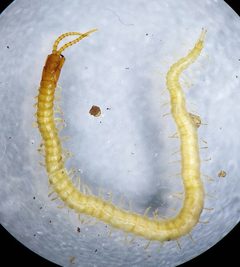
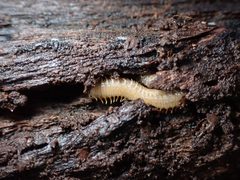
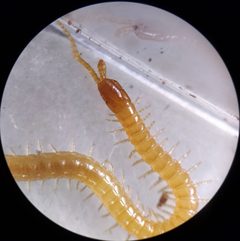
Geophilidae is a of geophilomorph , commonly known as soil centipedes, with over 650 in more than 120 . The family has a distribution with species found worldwide. In 2014, phylogenetic analysis revealed the family to be polyphyletic, leading to taxonomic revisions that synonymized several families (Aphilodontidae, Dignathodontidae, Linotaeniidae, Macronicophilidae) under Geophilidae and established the new family Zelanophildae for some transferred genera. Members are characterized by with a single pectinate , sternal pores with variable arrangements, and usually present coxal organs.
Pronunciation
How to pronounce Geophilidae: //d͡ʒiː.oʊˈfɪlɪdiː//
These audio files are automatically generated. While they are not always 100% accurate, they are a good starting point.
Identification
Distinguished from other geophilomorph by bearing a single pectinate . Sterna typically possess pore fields with variable arrangements. Coxal organs are usually present and open into pits or through distinct pores. Female are typically an undivided lamina. Compared to most other Adesmata families, Geophilidae exhibits a modest number of leg-bearing segments with limited intraspecific variation; some have notably low leg counts (29–33 pairs), though most species have more.
Images
Habitat
Soil-dwelling; occupies terrestrial including forests, grasslands, and subterranean environments. Some are exclusively cave-dwelling, completing their entire in cave systems.
Distribution
; occur on all continents except Antarctica. Documented from Europe (including Balkan Peninsula, Southern Limestone Alps, Western Mediterranean regions), Asia (Iran, Velebit Mountains of Croatia), North America, South America (Brazil), and other regions worldwide.
Diet
; preys on other animals.
Behavior
Some are exclusively subterranean or cave-dwelling, showing troglomorphic adaptations including elongated , trunk segments, and leg claws. Cave-dwelling species such as Geophilus hadesi are among the top in deep cave .
Ecological Role
in soil and cave ; contributes to decomposition and nutrient cycling through on other .
Similar Taxa
- ZelanophildaeSeparated from Geophilidae in 2014 to resolve polyphyly; contains transferred from former Geophilidae
- SchendylidaeAlso in Geophilomorpha; distinguished by different mandibular structure and some with even fewer leg pairs than Geophilidae minimums
Sources and further reading
- BugGuide
- Wikipedia
- GBIF taxonomy match
- iNaturalist taxon
- NCBI Taxonomy
- Catalogue of Life
- conservation | Blog - Part 18
- Algerophilus, a neglected lineage of Western Mediterranean centipedes (Chilopoda: Geophilidae)
- Geophilus pygmaeus (Chilopoda: Geophilidae): clarifying morphology, variation and geographic distribution
- Six new species of Aphilodon centipedes (Geophilidae: Aphilodontinae) from Brazil
- On the identity of Photophilus Folkmanová, 1928: A new generic synonymy (Chilopoda: Geophilomorpha: Geophilidae)
- Morphology of a neglected large-sized species of Geophilus from Iran (Chilopoda: Geophilidae)
- Geophilus serbicus sp. nov., a new species from the Balkan Peninsula (Chilopoda: Geophilomorpha: Geophilidae)
- A new species of Mecophilus (Geophilidae: Aphilodontinae), with the first report of the genus from the state of Rio de Janeiro, Brazil
- A new species of the rare genus Endogeophilus from southern France, with a key to the European genera of Geophilidae s.l. (Chilopoda).
- A comprehensive dataset of the geophilid centipedes of the south-eastern Alps (Chilopoda, Geophilomorpha, Geophilidae s.l.).