
Strigamia
Gray, 1843
Species Guides
6Strigamia is a of soil centipedes in the Linotaeniinae, Geophilidae. The genus comprises over 40 valid distributed across temperate regions of the Northern Hemisphere, with some species reaching into the Indochinese region. Most species inhabit forest soils, though at least one species, S. maritima, has adapted to littoral marine environments. The genus is notable for its morphological diversity in leg number, ranging from 31 to 83 pairs across species.
Pronunciation
How to pronounce Strigamia: //straɪˈɡeɪmiə//
These audio files are automatically generated. While they are not always 100% accurate, they are a good starting point.
Identification
Distinguished from similar (Agathothus, Araucania, Damothus, Zantaenia) by: conspicuous basal denticle on forcipular tarsungulum; paired pore areas on trunk segments; and markedly swollen ultimate legs in males. -level identification requires examination of forcipular tarsungulum shape and denticle , leg number, pleuropretergite structure, metasternite shape of ultimate leg-bearing segment, and coxal pore arrangement. S. maritima uniquely adapted to intertidal .
Images
Appearance
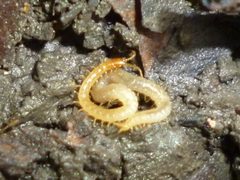
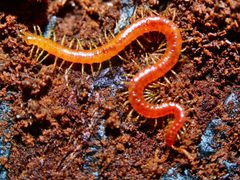
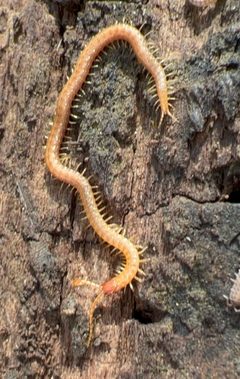
Elongated, slender with bodies tapering at both ends. approximately as long as wide. First maxillary coxosternite undivided. Forcipular sternite wider than long, lacking lines. Forcipules short with four distinct articles; large denticle present at base of ultimate article, none on first article. Sternites with paired fields of pores. Ultimate legs approximately equal in length to pair, with six articles ending in a claw; basal element with pores on side only. Males with distinctly swollen ultimate legs. Body length ranges from 15 mm (S. nana, S. korsosi) to 150 mm (S. epileptica). Leg pair count highly variable: 31–35 pairs in S. nana and S. hoffmani, 33–37 in S. korsosi, 65–83 in S. epileptica.
Habitat
Primarily forest soils in temperate regions. At least one (S. maritima) inhabits littoral/intertidal zones, tolerating periodic submersion in seawater and migrating between feeding grounds and shingle banks to avoid prolonged inundation.
Distribution
Widespread across temperate Holarctic: Europe, North America, and Eurasia. Extends southward to Indochinese region (Thailand, Taiwan, Ryukyu Islands). Major lineages segregated geographically: one in Europe, another in Eastern Asia.
Seasonality
S. maritima shows restricted -laying period in May–June, timed to minimize tidal immersion risk. General seasonality for most poorly documented.
Diet
Predatory. S. maritima feeds on small in intertidal zones. Diet of most inland assumed similar but not directly documented.
Life Cycle
Development includes stage and multiple instars before adulthood. S. maritima exhibits age-determinable growth stages and undergoes moulting. Egg-laying in S. maritima occurs in May–June. General details for most not documented.
Behavior
S. maritima exhibits tidally synchronized activity: migrates from feeding grounds to shingle bank during high tide, returning when waters recede. Inland largely undocumented; presumed to exhibit typical geophilomorph burrowing in soil.
Ecological Role
in soil and littoral . S. maritima functions as predator in intertidal .
Human Relevance
S. maritima serves as an established evo-devo model in developmental research. No documented economic or medical significance for the .
Similar Taxa
- AgathothusLacks conspicuous basal denticle on forcipular tarsungulum; pore field arrangement differs
- AraucaniaDiffers in ultimate leg and pore field patterns on trunk segments
- DamothusForcipular structure and male ultimate leg swelling pattern distinct
- ZantaeniaPore field distribution and forcipular denticle differ
Misconceptions
Formerly placed in Linotaeniidae, now synonymized with Geophilidae; Linotaeniinae retained. Some previously assigned to Scolioplanes, Korynia, Leptodampius now recombined into Strigamia.
More Details
Taxonomic History
established by Gray (1843). Linotaeniidae synonymized with Geophilidae in 2014 based on phylogenetic analysis. Multiple new combinations and synonymies established in 2013 revision.
Evolutionary History
Molecular dating indicates major lineages diverged ~60 million years ago. European and Eastern Asian lineages diversified during last 30 million years. S. maritima separated from Eastern Asian lineage ~35 million years ago.
Species Diversity
At least 32 distinct recognized with 12 provisionally accepted; 21 names synonymized. Three new species described from Eastern Asia in 2016 (S. inthanoni, S. korsosi, S. nana). identified in Europe requiring further revision.
Sources and further reading
- BugGuide
- Wikipedia
- GBIF taxonomy match
- iNaturalist taxon
- NCBI Taxonomy
- Catalogue of Life
- Species diversity of Strigamia Gray, 1843 (Chilopoda: Linotaeniidae): a preliminary synthesis
- THE LIFE HISTORY AND ECOLOGY OF THE LITTORAL CENTIPEDE STRIGAMIA (=SCOLIOPLANES) MARITIMA (LEACH)*
- Evolution of Strigamia centipedes (Chilopoda): a first molecular assessment of phylogeny and divergence times
- Towards elucidating species diversity of European inlandStrigamia(Chilopoda: Geophilomorpha): a first reassessment integrating multiple lines of evidence