
Schendylidae
Cook, 1896
Genus Guides
3Schendylidae is a of soil-dwelling in the order Geophilomorpha, characterized by a modest number of leg-bearing segments relative to other Adesmata families. The family includes at least 47 and 310 described , with representatives on every continent except Antarctica. Notable members include the smallest known epimorphic centipedes, with some species reaching only 4.5–5.5 mm in length. The family was established by O.F. Cook in 1896 and now encompasses the former family Ballophilidae following phylogenetic revision.
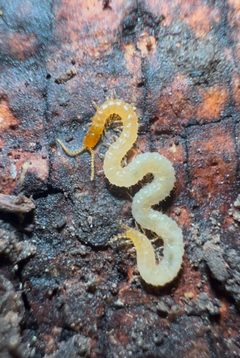
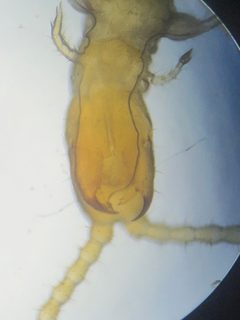
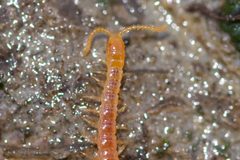
Pronunciation
How to pronounce Schendylidae: /skɛnˈdɪlɪˌdiː/
These audio files are automatically generated. While they are not always 100% accurate, they are a good starting point.
Identification
Distinguished from other Geophilomorpha by the combination of: second maxillary claws with fringed margins; sternal pores in single field; coxopleuron with 1–2 pores; and reduced leg pair counts with low intraspecific variation. Among Adesmata families, only Geophilidae (sensu lato) includes with comparably low leg counts. Schendylidae differs from Geophilidae in maxillary claw structure and pore field arrangement. The Pectiniunguis is characterized by absence of pore-field on first sternum, undivided pore-fields in uninterrupted series along trunk, thin pale parunguis on legs, and last leg praetarsus as small with numerous spines.
Images
Appearance
Second bear claws fringed by small spines or rows of filaments. Sternal pores typically present, usually in a single field. Each coxopleuron most often has one or two pores. Leg-bearing segments fewer than most other Adesmata , with limited intraspecific variation (usually no more than three or four contiguous odd numbers). Some exhibit extreme miniaturization, with measuring 4.5–5.5 mm in length.
Habitat
Soil-dwelling; found in soil cores from mixed dipterocarp forest, lower montane forest, and upper montane forest. Also recorded from sand-hill forest and bat guano deposits. Occupies soil-surface microhabitats frequently overlooked in standard surveys.
Distribution
Americas, Palearctic region, Africa, Madagascar, Australia, southeast Asia, and Pacific islands. Specific records include: Guyana (Dunoon), Brazilian Amazonia, Java, Borneo (Gunung Mulu National Park, Sarawak), and Scandinavia (Denmark, Norway, Sweden).
Ecological Role
Principal subset of soil macrofauna. Specific functions beyond general soil macrofauna status have not been documented.
Similar Taxa
- Geophilidae (sensu lato)Only other in Geophilomorpha with comparably low leg pair counts; distinguished by maxillary claw structure and pore field arrangement
- BallophilidaeFormerly recognized as separate ; now synonymized with Schendylidae based on 2014 phylogenetic analysis showing paraphyly
More Details
Taxonomic History
established by O.F. Cook in 1896. In 2014, phylogenetic analysis based on morphological and molecular data found Schendylidae with respect to Ballophilidae; authorities now treat Ballophilidae as synonym of Schendylidae.
Extreme Miniaturization
Dinogeophilus contains the smallest known epimorphic , with 4.5–5.5 mm in length—the smallest not only in Geophilomorpha but among all epimorphic centipedes.
Leg Pair Reduction
Schendylops ramirezi males have 27 leg pairs, the minimum recorded in Geophilomorpha; females have 29. Schendylops oligopus males have 27 or 29 (usually 29), females 31. Dinogeophilus oligopodus has 29 leg pairs in both sexes—one of only two in the order with this trait in females.
Sources and further reading
- BugGuide
- Wikipedia
- GBIF taxonomy match
- iNaturalist taxon
- NCBI Taxonomy
- Catalogue of Life
- Redescription of Pectiniunguis gaigei (Chamberlin, 1921) from Guyana, with new distributional data and complementary descriptive notes on similar neotropical species (Chilopoda: Geophilomorpha: Schendylidae)
- Redescription of Mesoschendylajavanica (Attems, 1907) and its first records from Borneo (Chilopoda, Geophilomorpha, Schendylidae).