
Himantariidae
Genus Guides
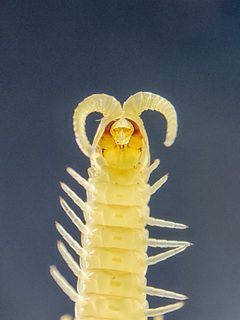
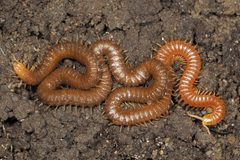
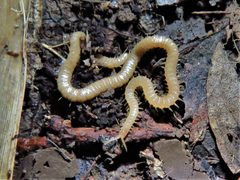
1Himantariidae is a monophyletic of soil-dwelling in the order Geophilomorpha, found almost exclusively in the Northern Hemisphere. Members are characterized by extreme elongation with high numbers of trunk segments, often exceeding 100 and ranging from 47 to 181 leg-bearing segments. The family exhibits substantial intraspecific variability in segment number. Several are recognized including Stigmatogaster, Himantariella, Bothriogaster, Polyporogaster, and others.
Pronunciation
How to pronounce Himantariidae: //ˌhɪmənˈtɛri.aɪˌdiː//
These audio files are automatically generated. While they are not always 100% accurate, they are a good starting point.
Images
Habitat
Monticolous and have been documented for at least some ; specific microhabitat preferences across the remain largely uncharacterized.
Distribution
Northern Hemisphere; documented from Western Europe (France, Spain, Corsica, Scandinavia), Central Asia (Kyrgyzstan, Kazakhstan), and other northern regions.
Behavior
activity has been observed in at least Himantariella scutellaris; broader behavioral patterns across the are not well documented.
Similar Taxa
- GeophilidaeBoth belong to Geophilomorpha and share elongated bodies with numerous segments; Himantariidae can be distinguished by the short with concave labral margin bearing denticles, specific mandibular structure (single dentate plus pectinate lamellae), and ultimate legs typically lacking pretarsus.
- MecistocephalidaeAnother geophilomorph with high segment counts; Himantariidae differs in mandibular configuration and forcipular segment (stout with short forcipules and wide tergite).
Sources and further reading
- BugGuide
- Wikipedia
- GBIF taxonomy match
- iNaturalist taxon
- NCBI Taxonomy
- Catalogue of Life
- New data on the family Himantariidae Bollman, 1893 (Chilopoda: Geophilomorpha) from Kazakhstan
- To the fauna of the family Himantariidae (Chilopoda: Geophilomorpha) of Kyrgyzstan
- Morphological and ecological revision of Himantariella scutellaris Brolemann, 1926(Chilopoda: Geophilomorpha: Himantariidae)
- Les Himantariidae ouest-européens, avec la description d’une nouvelle espèce du genre Stigmatogaster Latzel, 1880 (Chilopoda, Geophilomorpha)