
Mecistocephalidae
Genus Guides
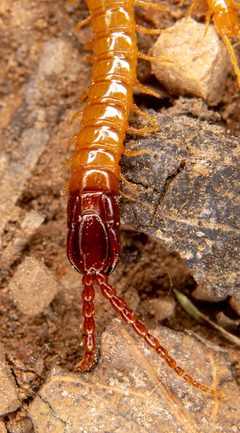
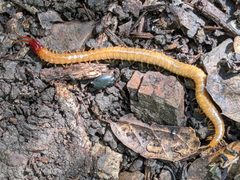
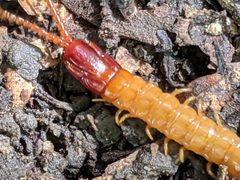
1Mecistocephalidae is a monophyletic of soil-dwelling constituting the sole family of the suborder Placodesmata. With approximately 170 across 11 , it ranks as the third most diverse family in Geophilomorpha. The family exhibits a distinctive trait among geophilomorphs: leg-bearing segment numbers are generally fixed within species and identical between sexes, ranging from 41 to 101 pairs. Most species inhabit tropical and subtropical regions, though some extend into temperate zones. The genus Mecistocephalus dominates the family with roughly 130 species, most possessing 49 leg pairs.
Pronunciation
How to pronounce Mecistocephalidae: /mɛˌsɪstoʊsɪˈfælɪdiː/
These audio files are automatically generated. While they are not always 100% accurate, they are a good starting point.
Identification
Distinguished from all other Geophilomorpha by fixed, -specific numbers of leg-bearing segments that are identical in both sexes—unusual among geophilomorphs where segment number typically varies. elongated with lateral margins converging posteriorly. First with elongate coxosternite and coxal projections wider than telopodites, both appendages ending in distinctly hyaline portions. Second maxillae bear small simple claws. Forcipular coxosternite elongate with pleurites projecting anteriorly into scapular points, displaced dorsally so coxopleural run anteriorly on surface. trunk metatergites distinctly longer than metatergites. Leg pair numbers range 41–101 (always odd), with 49 most common in Mecistocephalus, 45 in Tygarrup and related , and 41 in Agnostrup, Anarrup, Arrup, Nannarrup, and Partygarrupius.
Images
Habitat
Soil-dwelling found primarily in forested and mountainous regions. In the Northwest Himalaya, Tygarrup nepalensis occurs in moist temperate forest with optimal soil moisture 25.8–30.5%, showing higher densities on north-facing slopes with elevated soil phosphorus and organic carbon. Krateraspis occupy Middle Asian mountainous terrain from the Western Tian-Shan to western Pamir offshoots. Japanese and Taiwanese species occur across varied elevations from Tohoku to subtropical Ryukyu Islands.
Distribution
Widespread across tropical, subtropical, and temperate regions of the Old World. Documented from: Japanese archipelago (including Ryukyu Islands), Taiwan, China (including Xizang/Tibet), Nepal, Northwest Himalaya (India), Middle Asia (Kazakhstan, Kyrgyzstan, Tajikistan, Uzbekistan), and disjunct in central Europe and southwestern USA (Dicellophilus). GBIF records indicate presence in Denmark and Sweden.
Diet
Predatory on soil . Tygarrup nepalensis correlate with earthworm abundance, suggesting on or association with earthworms in moist temperate forest soils.
Ecological Role
Soil-dwelling contributing to soil dynamics. Tygarrup nepalensis distribution patterns indicate sensitivity to soil chemistry (phosphorus, organic carbon) and moisture, suggesting potential utility as bioindicators for soil health and forest management.
Similar Taxa
- GeophilidaeMost diverse geophilomorph ; distinguished by variable segment numbers within and between sexes, versus fixed numbers in Mecistocephalidae
- SchendylidaeSecond most diverse geophilomorph ; lacks the distinctive clypeal areolation and setation patterns of Krateraspis and the fixed segment number characteristic of Mecistocephalidae
- Placodesmata (other families)Mecistocephalidae is the sole in this suborder; no other families exist for comparison
Sources and further reading
- BugGuide
- Wikipedia
- GBIF taxonomy match
- iNaturalist taxon
- NCBI Taxonomy
- Catalogue of Life
- New species of Tygarrup centipedes from Xizang, China (Geophilomorpha, Mecistocephalidae)
- The Mecistocephalidae of the Japanese and Taiwanese islands (Chilopoda: Geophilomorpha)
- Morphology and distribution of the Middle Asian centipede genus Krateraspis Lignau, 1929 (Chilopoda, Geophilomorpha, Mecistocephalidae)
- A new mecistocephalid centipede from Ryukyu Islands and a revisitation of ‘Taiwanella’ (Chilopoda: Geophilomorpha: Mecistocephalidae)
- Morphology and phylogeny of Dicellophilus, a centipede genus with a highly disjunct distribution (Chilopoda: Mecistocephalidae)
- Integrative taxonomy of Dicellophilus Cook, 1896 (Chilopoda, Geophilomorpha, Mecistocephalidae) in Japan, with a description of a new species
- Distribution and abundance of a soil centipede, Tygarrup nepalensis Shinohara, 1965 (Mecistocephalidae: Geophilomorpha: Chilopoda) in a moist temperate forest in Northwest Himalaya
- Figures 15-17 from: Dyachkov YV, Bonato L (2022) Morphology and distribution of the Middle Asian centipede genus Krateraspis Lignau, 1929 (Chilopoda, Geophilomorpha, Mecistocephalidae). ZooKeys 1095: 143-164. https://doi.org/10.3897/zookeys.1095.80806
- Figure 1 from: Dyachkov YV, Bonato L (2022) Morphology and distribution of the Middle Asian centipede genus Krateraspis Lignau, 1929 (Chilopoda, Geophilomorpha, Mecistocephalidae). ZooKeys 1095: 143-164. https://doi.org/10.3897/zookeys.1095.80806
- Figures 33-35 from: Dyachkov YV, Bonato L (2022) Morphology and distribution of the Middle Asian centipede genus Krateraspis Lignau, 1929 (Chilopoda, Geophilomorpha, Mecistocephalidae). ZooKeys 1095: 143-164. https://doi.org/10.3897/zookeys.1095.80806
- Identification of two new species of Mecistocephalus (Chilopoda, Geophilomorpha, Mecistocephalidae) from southern China and the re-description of Mecistocephalussmithii Pocock, 1895.
- Two new species of the dwarf centipede genus Nannarrup Foddai, Bonato, Pereira & Minelli, 2003 (Chilopoda, Geophilomorpha, Mecistocephalidae) from Japan.