
Dicellophilus
Cook, 1896
Species Guides
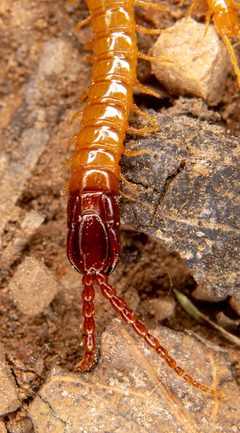
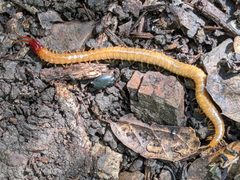
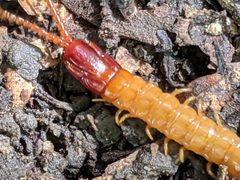
2Dicellophilus is a of soil centipedes in the Mecistocephalidae, established by O.F. Cook in 1896 with D. limatus as the type . The genus comprises five species distributed across three highly disjunct regions: central Europe, Japan (Honshu), and the western United States. No other group of or Northern Hemisphere terrestrial animals exhibits such a peculiar geographic pattern. Species range from 5–7 cm in length with 41–45 pairs of legs, the number being invariant within each species.
Pronunciation
How to pronounce Dicellophilus: /daɪˌsɛloʊˈfaɪləs/
These audio files are automatically generated. While they are not always 100% accurate, they are a good starting point.
Identification
Distinguished from congeneric Anarrup by: undivided coxosternite of second (divided in Anarrup); labral with bristles on posterior margin (absent in Anarrup); ultimate legs with macropore (absent in Anarrup). identified by leg pair count: D. anomalus, D. praetermissus, D. pulcher have 41 pairs; D. carniolensis has 43 pairs; D. limatus has 45 pairs. D. praetermissus distinguished from D. pulcher by: transverse ends not evidently convex forward; long rather than wide trochanteroprefemur; wide rather than long metasternite.
Images
Habitat
Montane forests with moderate temperatures. Soil-dwelling.
Distribution
Highly disjunct: central Europe (D. carniolensis); Honshu, Japan from Tohoku to Kansai region (D. pulcher, D. praetermissus); southwestern USA (D. anomalus, D. limatus). All ranges within 35–45°N latitude, maximally separated longitudinally; each range ≤1,300 km maximum diameter.
Behavior
Parental care has been documented in D. carniolensis, including maternal -guarding and post-embryonic care of young.
Similar Taxa
- AnarrupClose relative in Dicellophilinae; shares tuberculate ultimate legs with spines and second extending beyond first maxillae. Distinguished by divided coxosternite of second maxillae, lack of bristles on labral margin, and absence of macropores on ultimate legs.
- ProterotaiwanellaRelative in Dicellophilinae; shares tuberculate ultimate legs. Distinguished by second not extending beyond first maxillae.
More Details
Phylogenetic relationships
Molecular and morphological analyses confirm monophyly of Dicellophilus. North American (D. anomalus, D. limatus) form a clade; this clade is sister to D. pulcher, suggesting Japanese and North American lineages are more closely related to each other than to the European D. carniolensis.
Taxonomic history
Originally described to contain D. limatus only; subsequently expanded to five with description of D. praetermissus in 2024 based on integrative morphological and molecular analysis.
Sources and further reading
- BugGuide
- Wikipedia
- GBIF taxonomy match
- iNaturalist taxon
- NCBI Taxonomy
- Catalogue of Life
- Morphology and phylogeny of Dicellophilus, a centipede genus with a highly disjunct distribution (Chilopoda: Mecistocephalidae)
- Integrative taxonomy of Dicellophilus Cook, 1896 (Chilopoda, Geophilomorpha, Mecistocephalidae) in Japan, with a description of a new species
- Parental Care in Dicellophilus carniolensis (C. L. Koch, 1847): New Behavioural Evidence with Implications for the Higher Phylogeny of Centipedes (Chilopoda)