
Dicellophilus limatus
Wood, 1862
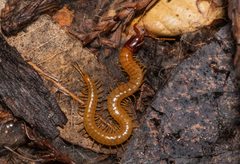
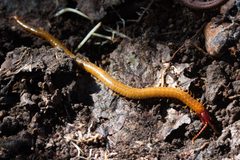
Dicellophilus limatus is a soil and the type of the Dicellophilus. It is distinguished by possessing 45 pairs of legs, the highest number in its genus, and can exceed 60 mm in length. The species is to coastal California and is one of only four Mecistocephalidae species known from North America. Originally described as Mecistocephalus limatus in 1862, it was later transferred to the new genus Dicellophilus in 1896.
Pronunciation
How to pronounce Dicellophilus limatus: //daɪˌsɛloʊˈfaɪləs laɪˈmeɪtəs//
These audio files are automatically generated. While they are not always 100% accurate, they are a good starting point.
Identification
Uniquely identified among Dicellophilus by having 45 pairs of legs (all have 41–43). Distinguished from the closely related D. anomalus by: shorter telopodites of first (length/width ratio 3.0–3.8 versus >4.0), and margin of last leg-bearing sternum forming a regular convex curve (versus a pillow-shaped posterior projection in D. anomalus). Differs from D. pulcher and D. carniolensis by leg pair count and geographic range. Shares with D. anomalus: elongate antennal setae (~300 microns), angled transverse frontal line on , and isolated pair of setae on posterior .
Images
Appearance
Elongated, cylindrical body reaching 60 mm or more in length and nearly 3 mm in width. Coloration ranges from yellow to orange-red, with the and dark red to chestnut brown. Tergites on the half of the body often have a narrow darker border on the margin. Each antenna terminates in an elongate article with length/width ratio of 2.2–2.4. Antennae bear elongate setae reaching 300 microns in length. Ultimate legs possess a pore distinctly larger than other pores and a with small spines. First have coxal projections with enlarged, subtriangular distal parts; telopodite length/width ratio ranges 3.0–3.8.
Habitat
Soil-dwelling; recorded from areas around San Francisco Bay and near Los Angeles in coastal California.
Distribution
to the Pacific Coast Ranges of central and southern California, USA. Documented localities include Sonoma, Mill Valley, Sausalito, Berkeley, Stanford, and Claremont. Records from Massachusetts (Nantucket), Tennessee (Nashville), and Florida (Miami) are considered doubtful and not accepted as valid.
Similar Taxa
- Dicellophilus anomalusOverlapping California distribution and close phylogenetic relationship; distinguished by 41 leg pairs, longer first maxillary telopodites, and pillow-shaped sternal projection on last leg-bearing segment.
- Dicellophilus carniolensisEuropean with 43 leg pairs; distinguished by geographic separation and two fewer leg pairs.
- Dicellophilus pulcherJapanese with 41 leg pairs; distinguished by geographic separation, shorter antennal setae (150–200 microns), rounded transverse frontal line, and absence of isolated clypeal setae.
More Details
Taxonomic history
Originally described by Horatio C. Wood Jr. in 1862 as Mecistocephalus limatus. Transferred to the new Dicellophilus by Orator F. Cook in 1896, with explicit designation as type . Mecistocephalus breviceps Meinert, 1886 was synonymized with D. limatus by Ralph V. Chamberlin in 1920. Syntypes from the original description were deposited at the Smithsonian Institution but may now be lost.
Phylogenetic significance
Molecular and morphological analyses place D. limatus in a clade with D. anomalus, forming a sister group to D. pulcher. The 45 leg pairs in D. limatus represent an apomorphic condition derived from an ancestral state of 41 leg pairs through the addition of four leg-bearing segments.