
Echinothrips americanus
Morgan, 1913
Poinsettia thrips, Impatiens thrips, American thrips
Echinothrips americanus is a small thrips in the Thripidae, native to eastern North America and first described from Florida in 1913. It has become an pest of global concern, spreading to Europe, Asia, Australia, and other regions since the 1990s. The species is highly , feeding on foliage of at least 48 plant families, with particular preference for Araceae and Balsaminaceae. It is primarily a greenhouse and ornamental pest, causing chlorotic damage to leaves through piercing-sucking feeding.
Pronunciation
How to pronounce Echinothrips americanus: /ɛˌkaɪnoʊˈθɹɪps əˌmɛɹɪˈkeɪnəs/
These audio files are automatically generated. While they are not always 100% accurate, they are a good starting point.
Identification
Distinguished from similar thrips by its dark brown to black body coloration with red internal pigmentation, and by its strictly leaf-dwelling habit rather than flower-dwelling . Unlike Frankliniella occidentalis or Thrips tabaci, E. americanus pupates on aboveground plant parts rather than in soil. The and size dimorphism between sexes are diagnostic features. May be confused with predatory Aeolothripidae that have banded wings, but E. americanus lacks distinct wing banding patterns.
Images
Appearance
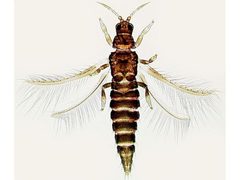
are minute, typically under 1 mm in length. Body coloration is generally brown to black with red hypodermal pigmentation visible internally. Males are smaller, more slender, and lighter in color than females. are (bead-like), with length and size corresponding to body size differences between sexes. Wings are fringed, characteristic of Thysanoptera. Prepupal stage is white in color.
Habitat
Primarily a leaf-dwelling thrips found on the upper and lower surfaces of leaves, with preference for lower leaf surfaces. Occurs in greenhouses, ornamental plantings, and agricultural settings. Thrives in controlled environments with temperatures around 23°C and moderate humidity. Pupates on aboveground plant parts rather than in soil.
Distribution
Native to eastern United States (first described from Florida). Established in Canada (British Columbia, Ontario), Mexico, Bermuda, Puerto Rico, Guadeloupe. in Europe (first recorded 1995, now in 20+ countries including UK, Germany, France, Netherlands, Italy), Asia (China, Japan, Taiwan, Thailand, Indonesia, Uzbekistan), and Australia. Documented in 10 U.S. states and District of Columbia.
Seasonality
Year-round activity in greenhouse environments; seasonal activity in outdoor correlates with plant availability and temperature. Multiple per year possible under favorable conditions.
Diet
Highly piercing-sucking herbivore feeding on leaf . Documented on at least 48 plant including Araceae (anthurium, philodendron), Balsaminaceae (Impatiens), Euphorbiaceae (poinsettia), Solanaceae (sweet pepper, eggplant), Cucurbitaceae (cucumber), Asteraceae (gerbera), and Rosaceae (rose). Causes chlorotic, shrunken leaf appearance and produces visible on leaf surfaces.
Host Associations
- Euphorbia pulcherrima - primary poinsettia, namesake
- Impatiens spp. - preferred Balsaminaceae , namesake
- Anthurium spp. - preferred Araceae
- Philodendron spp. - Araceae
- Capsicum annuum - sweet pepper
- Cucumis sativus - cucumber
- Solanum melongena - eggplant
- Rosa spp. - rose
- Gerbera spp. - gerbera daisy
- Phaseolus vulgaris - laboratory common bean, used in rearing studies
- Gossypium spp. - laboratory cotton, used in rearing studies
- Veratrum viride - original collection green false-hellebore, type locality
Life Cycle
Hemimetabolous development with : , two larval instars, two pupal instars ( and pupa), and . Eggs are inserted into plant tissue using an ovipositor. As member of suborder , has two nymphal instars followed by two pupal instars rather than three nymphal instars. Mean lifespan 10–14 days under laboratory conditions. Development time and influenced by mating status of mother.
Behavior
Exhibits assortative mating by body size. Males guard female pupae and mate immediately upon female due to strong local mate competition on leaf surfaces. Mating involves antennal contact, mounting, and stroking of female's back with mesothoracic legs; copulation lasts approximately 4 minutes. Females typically mate only once and reject remating attempts for many days. Males produce contact (dimethyl glutarate DBE-5 and dimethyl adipate DBE-6) that influence mating and signal mating status. DBE-5 induces -raising behavior; DBE-6 is avoided by males and indicates previously mated females.
Ecological Role
Phytophagous pest causing direct feeding damage to foliage. Documented or suspected of plant including Tospoviruses, Machlomovirus, Ilarvirus, Carmovirus, and Sobemovirus, as well as bacteria and fungi. Serves as prey for predatory mites (Amblyseius swirskii, Euseius ovalis) and predatory thrips (Franklinothrips vespiformis), though efficacy varies by life stage and overlap.
Human Relevance
Significant economic pest of greenhouse ornamentals and vegetables, causing millions of USD in crop losses annually. Particularly damaging to poinsettia, Impatiens, anthurium, sweet pepper, cucumber, and eggplant. Difficult to control chemically due to cryptic leaf-dwelling habit and rapid development of resistance. Subject to research using predatory mites and predatory thrips. Global spread facilitated by international plant trade; classified as 'upcoming pest' in newly invaded regions.
Similar Taxa
- Frankliniella occidentalisBoth are thrips pests, but F. occidentalis is flower-dwelling and pupates in soil, while E. americanus is strictly leaf-dwelling and pupates on plants
- Thrips tabaciSimilar size and pest status, but T. tabaci pupates in soil and has different preferences
- Aeolothrips fasciatusSimilar dark coloration but predatory, with distinct white bands on wings (humeral, , ) versus E. americanus unbanded wings; different ecological role
More Details
Reproductive system
Reproduces via (haplo- ): fertilized produce diploid females, unfertilized eggs produce haploid males. Females can reproduce without mating, producing all-male offspring. Males exhibit prospermatogeny (spermiogenesis completed before ), allowing immediate mating capability.
Pheromone biology
One of few known non-Dipteran with male-produced contact . DBE-5 and DBE-6 are used for mate recognition, mating status signaling, and potentially sex discrimination. This chemical communication system is unusual among Thysanoptera and represents a target for strategies.
Genomic associations
First known phytophagous insect associated with genomoviruses ( Genomoviridae), with four viral detected representing Gemycircularvirus, Gemyduguivirus, and Gemykibivirus.
Sources and further reading
- BugGuide
- Wikipedia
- GBIF taxonomy match
- iNaturalist taxon
- NCBI Taxonomy
- Catalogue of Life
- ID Challenge #6 | Beetles In The Bush
- Echinothrips americanus . [Distribution map].
- Reproductive Behavior of Echinothrips americanus (Thysanoptera: Thripidae)
- Male Pheromones Influence the Mating Behavior of Echinothrips americanus
- The results of a study on Echinothrips americanus Morgan
- Hosts preference ofEchinothrips americanusMorgan for different vegetables
- Genomovirus Genomes Recovered from Echinothrips americanus Sampled in Florida, USA
- Poinsettia Thrips, Impatiens Thrips (suggested common names) Echinothrips americanus Morgan (Insecta: Thysanoptera: Thripidae)
- Comparisons of Developmental and Reproductive Biology Between Parthenogenetic and SexualEchinothrips americanus(Thysanoptera: Thripidae)
- Olfactory and physical manipulation by males on life‐history traits in Echinothrips americanus MORGAN 1913 (Thysanoptera: Thripidae)
- Biological Control of Echinothrips americanus Morgan (Thysanoptera: Thripidae) in Sweet Pepper Using the Predatory Thrips Franklinothrips vespiformis Crawford (Thysanoptera: Aeolothripidae)
- Morphology, distribution, ultrastructure, and possible function of the external sensilla on antennae and mouthparts of Echinothrips americanus Morgan (Thysanoptera: Thripidae)