
Echinothrips
Moulton, 1911
Species Guides
1- Echinothrips americanus(Poinsettia thrips)
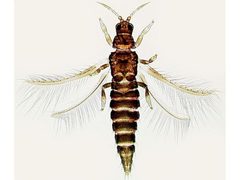
Echinothrips is a of thrips in the Thripidae containing approximately seven described . The genus is best known through Echinothrips americanus, a pest of greenhouse and agricultural crops that has spread globally from its native range in eastern North America. Species in this genus are phytophagous, feeding on leaves, flowers, and fruits by piercing and sucking plant . The genus exhibits haplo- with arrhenotokous , where unfertilized produce haploid males and fertilized eggs produce diploid females.
Pronunciation
How to pronounce Echinothrips: //ɛˌkaɪnəˈθrɪps//
These audio files are automatically generated. While they are not always 100% accurate, they are a good starting point.
Images
Habitat
Greenhouse environments and agricultural crop systems; leaf-dwelling rather than flower-dwelling. Echinothrips americanus has been reared in laboratory conditions at 23±1°C, 60±10% RH, with 16:8 L:D on plants including Phaseolus vulgaris and Gossypium sp.
Distribution
Native to eastern North America; Echinothrips americanus has spread to Canada, Europe, Asia, and Northern Australia within the last 30 years via human-mediated global trading. Documented in Europe (Austria, Belgium, Croatia, Czech Republic, Denmark, France, Germany, Hungary, Ireland, Italy, Netherlands, Norway, Poland, Russia, Serbia, Slovakia, Slovenia, Sweden, UK), Asia (China, Thailand), North America (Canada: British Columbia, Ontario; USA: District of Columbia, Florida, Georgia, Hawaii, Illinois, Iowa, Maryland, Missouri, New York, Tennessee, Virginia), and Central America and Caribbean (Puerto Rico). Records from Uzbekistan (2014) and Denmark, Norway, Sweden per GBIF.
Diet
Phytophagous; feeds on leaves, flowers, and fruits by piercing and sucking plant . Echinothrips americanus is , reported from 48 plant worldwide with preferred in Araceae and Balsaminaceae.
Host Associations
- Phaseolus vulgaris - laboratory Laboratory rearing
- Gossypium sp. - laboratory Laboratory rearing
- Euphorbia pulcherrima - First reported 1984 in Georgia; 'poinsettia thrips' derives from this association
- Impatiens spp. - preferred Balsaminaceae; suggested 'impatiens thrips'
- Gerbera - Greenhouse crop
- Rosa - Greenhouse crop
- Capsicum annuum - Sweet pepper, greenhouse crop
- Cucumis sativus - Cucumber, greenhouse crop
- Solanum melongena - Eggplant, greenhouse crop
Life Cycle
Haplo- reproductive mode with : haploid males develop from unfertilized , diploid females from fertilized eggs. Males exhibit prospermatogeny (spermiogenesis completed at ). Mean lifespan 10-14 days under laboratory conditions. Females can mature eggs throughout almost their entire adult life.
Behavior
Males produce including dimethyl glutarate (DBE-5) and dimethyl adipate (DBE-6) that influence mating . DBE-5 induces wagging and raising in both sexes; DBE-6 is present on mated females and causes males to avoid them. Mating involves three phases (precopulation, copulation, postcopulation) with antennal contact, mounting, insertion, and a calm period with no body movement. Copulation duration averages 6-10 minutes, with younger males copulating significantly shorter than older males (~403s vs ~611s). Males can inseminate up to 10 females with equal sperm quantities. Males clasp female pterothorax with legs and twist abdomen underneath female's; antennal palpation and mesothoracic leg stroking of female's back occur during copulation. Females can remate but show reduced receptivity after initial copulation. Males repeatedly attempt to mate even with unreceptive females and exhibit strong competition for virgin females.
Ecological Role
Agricultural and greenhouse pest causing crop damage through feeding. Leaf-dwelling habit distinguishes it from flower-dwelling thrips . Potential virus transmission (genomoviruses have been recovered from E. americanus). Subject to efforts using predatory thrips (Franklinothrips vespiformis) and ants (Tapinoma melanocephalum).
Human Relevance
Significant economic pest in greenhouse and agricultural systems. Echinothrips americanus has become an important pest in vegetable and ornamental crops across multiple continents. Control methods include chemical treatments and agents. Alternative pest management strategies using male-produced have been proposed.
Similar Taxa
- ThripsSame Thripidae; Echinothrips distinguished by specific antennal structure, body shape, and wing characteristics, though detailed distinguishing features require expert examination
- Frankliniella occidentalisBoth are Thripidae pests; Echinothrips is leaf-dwelling while Frankliniella is primarily flower-dwelling, affecting strategies
- AeolothripsBoth can show banded wing patterns; Aeolothrips are predatory with different ecological roles, and wing banding patterns differ (A. fasciatus has humeral, , and white bands versus Echinothrips patterns)
Sources and further reading
- BugGuide
- Wikipedia
- GBIF taxonomy match
- iNaturalist taxon
- NCBI Taxonomy
- Catalogue of Life
- ID Challenge #6 | Beetles In The Bush
- Echinothrips americanus . [Distribution map].
- Reproductive Behavior of Echinothrips americanus (Thysanoptera: Thripidae)
- Male Pheromones Influence the Mating Behavior of Echinothrips americanus
- The results of a study on Echinothrips americanus Morgan
- Hosts preference ofEchinothrips americanusMorgan for different vegetables
- Genomovirus Genomes Recovered from Echinothrips americanus Sampled in Florida, USA
- Poinsettia Thrips, Impatiens Thrips (suggested common names) Echinothrips americanus Morgan (Insecta: Thysanoptera: Thripidae)
- Comparisons of Developmental and Reproductive Biology Between Parthenogenetic and SexualEchinothrips americanus(Thysanoptera: Thripidae)
- Olfactory and physical manipulation by males on life‐history traits in Echinothrips americanus MORGAN 1913 (Thysanoptera: Thripidae)
- Biological Control of Echinothrips americanus Morgan (Thysanoptera: Thripidae) in Sweet Pepper Using the Predatory Thrips Franklinothrips vespiformis Crawford (Thysanoptera: Aeolothripidae)
- Morphology, distribution, ultrastructure, and possible function of the external sensilla on antennae and mouthparts of Echinothrips americanus Morgan (Thysanoptera: Thripidae)
- Biological control of poinsettia thrips, Echinothrips americanus (Thysanoptera: Thripidae), on lima bean using the ghost ant, Tapinoma melanocephalum (Hymenoptera: Formicidae)