
Aeolothrips
Haliday, 1836
Banded Thrips
Species Guides
3- Aeolothrips collaris
- Aeolothrips kuwanaii(banded thrips)
- Aeolothrips vittipennis(Banded Thrips)
Aeolothrips is a of predatory thrips comprising over 80 described . Members are characterized by distinctive banded forewings with alternating dark and light transverse stripes. Both and larvae are predatory, feeding on small including other thrips, mites, aphids, and insect . Some species are recognized as important native in agricultural and have been evaluated for programs against pest thrips such as Thrips tabaci.
Pronunciation
How to pronounce Aeolothrips: /ˌiːəloʊˈθrɪps/
These audio files are automatically generated. While they are not always 100% accurate, they are a good starting point.
Identification
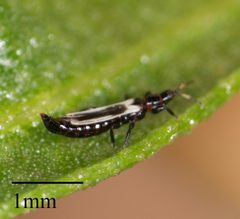
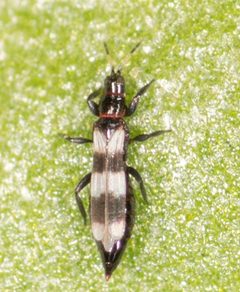
Aeolothrips are distinguished from other thrips by the presence of two dark transverse bands on the forewings, creating a characteristic black-and-white banded pattern. This contrasts with Franklinothrips vespiformis, which lacks such banding. The forewings are long and narrow with fringed margins typical of Thysanoptera. Both sexes are fully winged. Body size and specific banding patterns vary among species; for example, A. fasciatus displays humeral, , and white bands, while other species may show only humeral and post-median bands. are relatively long, with males typically having shorter antennae than females in some species.
Images
Habitat
Found in agricultural crops including soybean, pea, narrow-leafed lupine, and oilseed rape; also occurs in wild meadows, arable fields, and olive plantations. and larvae frequently inhabit flowers of plants where hunting occurs.
Distribution
Widespread across Europe, Asia, and other regions; recorded from Iran, Slovenia, Poland, and Scandinavian countries (Denmark, Norway, Sweden). Individual have more restricted ranges; for example, A. gloriosus was first recorded in Slovenia in 2011, and two new species were described from Iran in 2022.
Seasonality
active during flowering periods of plants; in Slovenia, A. gloriosus females were recorded in olive blossoms in May.
Diet
Both larvae and prey on small including other thrips (at least 44 documented), mite larvae (Tetranychus urticae, Panonychus ulmi, Cenopalpus pulcher), aphids (Aphis fabae, Aphis craccivora, Acyrthosiphon pisum, Myzus persicae), and and larvae of small insects. Adults supplement their predatory diet with pollen of plants.
Host Associations
- Glycine max - soybean
- Pisum sativum - pea
- Lupinus angustifolius - narrow-leafed lupine
- Brassica napus - oilseed rape
- Olea europaea - olive tree
- Allium species - onion and related crops, associated with prey Thrips tabaci
Life Cycle
Both larval and stages are predatory. Larvae often hunt in flowers of plants. Specific details of , pupal, and developmental stages vary by and are not comprehensively documented for the .
Behavior
Larvae actively hunt prey in flowers; typically begins after approximately 23 minutes of searching, with capture and subduing of prey taking approximately 26 minutes. A single larva can kill up to eight Thrips tabaci in 12 hours under laboratory conditions. Adults exhibit phenotypic plasticity in body size and morphometric traits in response to geographic locality and plant .
Ecological Role
controlling of phytophagous thrips and other small pests in agricultural . Recognized as a native agent with potential for management of thrips pests including Thrips tabaci, Frankliniella occidentalis, and mites. Contributes to natural pest suppression in crops such as soybean, pea, and onion.
Human Relevance
Evaluated as a agent for agricultural pest thrips. Some may have economic importance in olive production and other cropping systems through on plant pests. Not known to cause direct damage to crops or transmit plant .
Similar Taxa
- Franklinothrips vespiformisAlso predatory but lacks the characteristic banded wing pattern of Aeolothrips; has different body shape and coloration
- ThripsPhytophagous in Thripidae with unbanded wings and different ecological role; lacks predatory
- Echinothrips americanusHas banded wings but only a distinct white band at wing base rather than alternating transverse bands; phytophagous rather than predatory
More Details
Phenotypic plasticity
Aeolothrips intermedius exhibits significant morphological variability in response to environmental conditions. Body length shows the strongest response to locality and plant, with females more responsive to host plant effects than males. This plasticity may reflect to variable agricultural environments.
Etymology
The prefix 'Aeolo-' in both the and names likely derives from Aeolus, the Roman king of the winds, referencing the wind- of winged thrips forms.
Sources and further reading
- BugGuide
- Wikipedia
- GBIF taxonomy match
- iNaturalist taxon
- NCBI Taxonomy
- Catalogue of Life
- ID Challenge #6 | Beetles In The Bush
- First record of Aeolothrips gloriosus Bagnall (Thysanoptera: Aeolothripidae) in Slovenia
- Two new species of the genus Aeolothrips (Thysanoptera: Aeolothripidae) from Iran
- The Effects of Locality and Host Plant on the Body Size of Aeolothrips intermedius (Thysanoptera: Aeolothripidae) in the Southwest of Poland
- Predation Capacity of the Banded Thrips Aeolothrips intermedius for the Biological Control of the Onion Thrips Thrips tabaci
- Distribution of Aeolothrips intermedius Bagnall (Thysanoptera: Aeolothripidae) and its potential prey Thysanoptera species on different cultivated host plants