
Franklinothrips vespiformis
(D.L. Crawford, 1909)
Vespiform Thrips, Vespiform Thrip
Franklinothrips vespiformis is a predatory thrips in the Aeolothripidae, notable for its -mimicking and distinctive red, humped-back larvae. It is widely distributed across tropical and subtropical regions worldwide and has been extensively studied as a agent for various agricultural and greenhouse pests. The species exhibits myrmecomorphy—mimicking ants in appearance and fast, erratic movement —which likely serves as a defense against . It is primarily parthenogenetic, with males being rare.
Pronunciation
How to pronounce Franklinothrips vespiformis: /ˌfraŋk.lɪ.noʊˈθrɪps ˌvɛs.pɪˈfɔːr.mɪs/
These audio files are automatically generated. While they are not always 100% accurate, they are a good starting point.
Identification
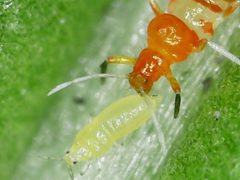
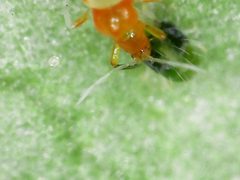
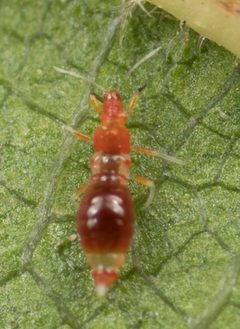
Distinguished from other predatory thrips by pronounced -mimicking : highly constricted waist, fast erratic running , and antennal palpation when on the ground. Larvae uniquely identified by bright red coloration and humped-back profile. Differs from Aeolothrips (also banded predatory thrips) by lacking the alternating black-and-white wing banding pattern; F. vespiformis has more uniform dark coloration. Differs from phytophagous thrips in Thripidae by predatory habits and associated morphological adaptations. Cocoon-spinning behavior for is diagnostic within Aeolothripidae.
Images
Appearance
are -mimicking with a highly constricted waist (petiole-like), dark coloration, and fast-running habit. Body form resembles small ants, particularly in the narrow connection between and . Larvae are distinctive: bright red with a humped-back (humped profile) appearance, making them easily recognizable. Wings have fringed margins typical of Thysanoptera. Adults possess long, slender with characteristic segmentation.
Habitat
Occurs in diverse tropical and subtropical environments including rainforests, agricultural orchards (citrus, avocado), field crops, roadsides, and greenhouse systems. Found in both natural and artificial settings: gardens, zoos, interior landscapes, research greenhouses, and nurseries with ornamental plants. Occupies leaf surfaces and plant where prey arthropods are abundant.
Distribution
Pantropical distribution with records from: North America (USA, Mexico), Central America (native range presumed), South America (Brazil, Peru, Nicaragua), Caribbean, Africa, Southeast Asia (Taiwan, India, Thailand, Japan, mainland China), Oceania (Fiji, New Caledonia, eastern Australia), and Europe (commercial introductions).
Seasonality
Active at temperatures above 18°C; no reported . Development from to requires approximately 3 weeks at 27°C. Adults survive up to 60 days. Continuous possible in suitable warm conditions; activity patterns tied to temperature rather than .
Diet
of small arthropods. Prey includes: thrips (Selenothrips rubrocinctus, Dinurothrips hookeri, Caliothrips insularis, Thrips tabaci, , Frankliniella occidentalis, Frankliniella intonsa, Heliothrips haemorrhoidalis, Leucothrips furcatus, Parthenothrips dracaenae, Scirtothrips dorsalis, Scirtothrips bispinosus, Echinothrips americanus, Caliothrips phaseoli), spider mites (Oligonychus yothersi, Tetranychus urticae, Tetranychus neocaledonicus), leafhoppers (Idona minuenda), whiteflies (Trialeurodes floridensis, Bemisia tabaci), and leafminers (Liriomyza trifolii). Can subsist on pollen and plant sap; becomes cannibalistic under crowded conditions.
Life Cycle
with six life stages: , two larval instars, three pupal stages (pre-pupal, pupal stage 1, pupal stage 2), and . Eggs laid singly into plant tissue (stems, leaf , soft tissue) with yellow-green projections and covered by yellowish protective secretion. Larvae develop red coloration after feeding. occurs within white silken cocoon (approximately 2.7 mm × 1.3 mm) constructed by larva twisting , typically on undersides of leaves. Developmental rate: egg to adult in ~3 weeks at 27°C.
Behavior
-mimicking (myrmecomorphy): fast, erratic running pattern, antennal palpation on substrate, and narrow waist create ant-like appearance to escape . Cocoon spinning: larvae actively construct white silken cocoons by abdominal twisting movements for pupal protection. Predatory behavior: uses forelegs to seize and hold prey. are fast-moving and easily mistaken for ants. observed under crowded rearing conditions.
Ecological Role
natural enemy and agent. Contributes to pest suppression in agroecosystems, particularly in avocado orchards, citrus plantations, tea plantations, and greenhouse crop systems. Commercially produced and released for biocontrol of thrips, mites, whiteflies, and other small pests in protected . increases coincide with prey population increases in field observations.
Human Relevance
Commercially available agent used in Europe, China, and other regions for greenhouse thrips management. Applied in gardens, zoos, interior landscapes, research facilities, nurseries, and subtropical outdoor agriculture. Effective against Echinothrips americanus in sweet pepper (93% reduction demonstrated). Sold for management of thrips, spider mites, whiteflies, and leafminers in ornamental and vegetable production. Cold storage protocols developed for shipping and release programs.
Similar Taxa
- Aeolothrips fasciatusBoth are predatory Aeolothripidae with banded appearance, but A. fasciatus has distinct alternating black-and-white wing bands (humeral, , and white bands) versus F. vespiformis uniform dark coloration; A. fasciatus lacks strong -mimicry
- Frankliniella occidentalisBoth Thysanoptera but F. occidentalis is phytophagous pest in Thripidae with fringed wings and different body form; lacks -mimicry, red larvae, and cocoon-spinning
- Other Franklinothrips speciesF. vespiformis distinguished by being usually unisexual (parthenogenetic) with wide distribution; most other Franklinothrips are bisexual and geographically localized
Misconceptions
Often mistaken for ants due to myrmecomorphy, leading to potential underestimation of its presence in surveys. May be confused with phytophagous thrips pests, though it is beneficial; proper identification is essential for conservation in programs.
Sources and further reading
- BugGuide
- Wikipedia
- GBIF taxonomy match
- iNaturalist taxon
- NCBI Taxonomy
- Catalogue of Life
- ID Challenge #6 | Beetles In The Bush
- Vespiform Thrips Franklinothrips vespiformis Crawford (Insecta:Thysanoptera: Aeolothripidae)
- Effect of cold storage on survival, reproduction and development of adults and eggs of Franklinothrips vespiformis (Crawford)
- A Review of Franklinothrips vespiformis (Thysanoptera: Aeolothripidae): Life History, Distribution, and Prospects as a Biological Control Agent
- Franklinothrips vespiformis Crawford (Thysanoptera: Aeolothripidae), a potential predator of the tea thrips, Scirtothrips bispinosus Bagnall in south Indian tea plantations
- Biological Control of Echinothrips americanus Morgan (Thysanoptera: Thripidae) in Sweet Pepper Using the Predatory Thrips Franklinothrips vespiformis Crawford (Thysanoptera: Aeolothripidae)
- Franklinothrips; a pantropical Thysanoptera genus of ant-mimicking obligate predators (Aeolothripidae)
- Functional response of Franklinothrips vespiformis (Thysanoptera: Aeolothripidae) to eggs and nymphs of Bemisia tabaci (Hemiptera: Aleyrodidae).