
Franklinothrips
Back, 1912
Species Guides
1- Franklinothrips vespiformis(Vespiform Thrips)
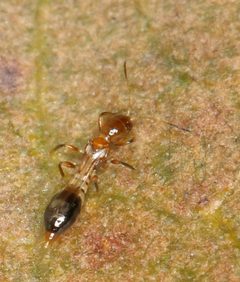
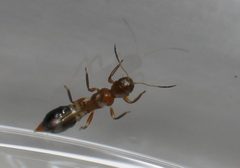
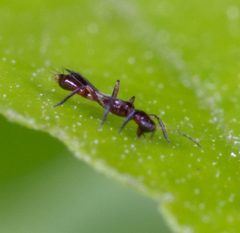
Franklinothrips is a pantropical of predatory thrips in the Aeolothripidae, comprising 14 recognized . The genus is distinguished by striking -mimicry, particularly in females, which exhibit fast-running and body forms resembling ants or bethylid . Most species are bisexual with localized distributions, though F. vespiformis is notably unisexual and widespread. Several species have been developed as agents against pest thrips in greenhouses and agricultural systems.
Pronunciation
How to pronounce Franklinothrips: /fræŋˈklɪnoʊˌθrɪps/
These audio files are automatically generated. While they are not always 100% accurate, they are a good starting point.
Identification
-mimicking females can be distinguished from actual ants (Hymenoptera: Formicidae) and bethylid (Chrysidoidea) by fringed wings characteristic of Thysanoptera. Males are less ant-like and may be confused with other Aeolothripidae; they are identified by longer and reduced waist constriction compared to females. Separation from the related Corynothripoides (African) requires examination of detailed morphological characters. -level identification relies on keys to the 14 recognized species, with F. vespiformis distinguished by its unisexual and widespread distribution.
Images
Appearance
females exhibit pronounced -mimicry with a constricted waist (petiole-like structure), compact body, and relatively short . Males are smaller with longer antennae and a less constricted waist, appearing less ant-like. Larvae of F. vespiformis are distinctive: red in color with a humped-back profile. Body size is minute, consistent with thrips . Wing structure typical of Thysanoptera with fringed margins, though specific wing patterns vary among .
Habitat
Native to tropical and subtropical regions worldwide. In managed systems, occurs in greenhouses, gardens, zoos, interior landscapes, research facilities, and ornamental nurseries. Natural include diverse tropical vegetation where prey thrips establish. F. orizabensis specifically associated with avocado orchards in California.
Distribution
Pantropical distribution. F. vespiformis recorded across many tropical countries including Australia (first record), with broad range expansion potentially facilitated by horticultural trade. Neotropical (F. orizabensis, F. tenuicornis, F. vespiformis) closely related. Old World from Africa to Australia includes F. megalops, F. rarosae, and F. variegatus. F. brunneicornis described from New Caledonia; F. strasseni from Nepal.
Diet
Obligate . F. orizabensis unable to survive on plant food alone; requires prey. Documented prey includes thrips (Scirtothrips perseae, Heliothrips haemorrhoidalis, Echinothrips americanus, Scirtothrips bispinosus), mites (Tetranychus pacificus), whitefly nymphs (Bemisia tabaci), and agromyzid fly larvae. Laboratory rearing successful on irradiated Ephestia kuehniella and Tetranychus pacificus eggs. All active life stages predatory except non-feeding pupal stage.
Life Cycle
Six life stages: , two larval instars, , pupa, and . occurs within a silken cocoon constructed by the larva. Development and optimized at 25°C for F. vespiformis. Development time and vary with diet quality; poor diets result in male-biased sex ratios. Incorporation of avocado pollen into diets has demonstrated adverse effects on demographic parameters in F. orizabensis.
Behavior
Females are fast-running and exhibit behavioral mimicry of ants, including rapid, erratic movement patterns. -mimicry serves as protective resemblance against . and larvae are active predators with Type II to prey . Prey consumption varies by life stage: F. vespiformis adults consume more prey per lifetime than larvae, but second instar larvae show highest per-day consumption rate. Predators prefer first instar prey larvae, followed by second instar. declines with increasing environmental complexity, supporting fractal foraging model predictions.
Ecological Role
of small arthropods in tropical . agent against pest thrips in agricultural and ornamental systems; F. orizabensis and F. vespiformis marketed in Europe for greenhouse thrips control. F. vespiformis demonstrated 93% reduction in Echinothrips americanus in sweet pepper, with 98% reduction when supplemented with Artemia franciscana cysts. F. megalops used for thrips control in interior landscapes. Population increases coincide with prey population increases in field conditions.
Human Relevance
Commercial agent for in greenhouses, nurseries, gardens, zoos, and subtropical outdoor agriculture. used commercially include F. orizabensis (avocado thrips control), F. vespiformis (greenhouse and field crops), and F. megalops (interior landscapes). Cold storage protocols developed for shipping and release programs. Potential for expanded use in China and other regions for management of economically significant pests.
Similar Taxa
- Corynothripoides marginipennisOnly closely related to Franklinothrips; C. marginipennis from Africa may belong to Franklinothrips based on morphological similarity. Distinguished by geographic restriction to Africa and subtle morphological differences requiring expert examination.
- AeolothripsBoth Aeolothripidae with predatory habits, but Aeolothrips lack -mimicry, have different body proportions, and exhibit banded wing patterns (black-and-white alternating bands) not seen in Franklinothrips. Aeolothrips also feed on wind-blown pollen, unlike the apparently obligate of Franklinothrips.
- Frankliniella named after same entomologist (H.J. Franklin) but belongs to Thripidae, not Aeolothripidae. Frankliniella are primarily phytophagous (plant-feeding) pests, not predatory, and lack -mimicry. F. occidentalis (western flower thrips) is a major agricultural pest rather than agent.
More Details
Etymology
name derived from surname of entomologist H.J. Franklin, who described thrips in the early 1900s while working at the University of Massachusetts Amherst. Frankliniella, a major thrips genus, is also named after him.
Reproductive systems
Most Franklinothrips are bisexual with both males and females present, but restricted to small geographic areas. F. vespiformis is exceptional in being usually unisexual (predominantly females) with males rare; this reproductive mode correlates with its broad geographic distribution across tropical countries.
Taxonomic uncertainty
F. caballeroi and F. suzukii may represent the same , with distribution patterns potentially explained by horticultural trade rather than natural range. The only species in the related Corynothripoides (C. marginipennis) could potentially be transferred to Franklinothrips.
Sources and further reading
- BugGuide
- Wikipedia
- GBIF taxonomy match
- iNaturalist taxon
- NCBI Taxonomy
- Catalogue of Life
- ID Challenge #6 | Beetles In The Bush
- Vespiform Thrips Franklinothrips vespiformis Crawford (Insecta:Thysanoptera: Aeolothripidae)
- Franklinothrips; a pantropical Thysanoptera genus of ant-mimicking obligate predators (Aeolothripidae)
- Developmental and Reproductive Biology of a Predatory Franklinothrips n. sp. (Thysanoptera: Aeolothripidae)
- Pupation Biology of Franklinothrips orizabensis (Thysanoptera: Aeolothripidae) and Harvesting and Shipping of This Predator
- Predation behaviors of Franklinothrips orizabensis (Thysanoptera: Aeolothripidae) towards Scirtothrips perseae and Heliothrips haemorrhoidalis (Thysanoptera: Thripidae)
- Franklinothrips vespiformis Crawford (Thysanoptera: Aeolothripidae), a potential predator of the tea thrips, Scirtothrips bispinosus Bagnall in south Indian tea plantations
- Effect of cold storage on survival, reproduction and development of adults and eggs of Franklinothrips vespiformis (Crawford)
- The effect of prey species and environmental complexity on the functional response of Franklinothrips orizabensis : a test of the fractal foraging model
- Evaluation of diets for the development and reproduction ofFranklinothrips orizabensis(Thysanoptera: Aeolothripidae)
- Biological Control of Echinothrips americanus Morgan (Thysanoptera: Thripidae) in Sweet Pepper Using the Predatory Thrips Franklinothrips vespiformis Crawford (Thysanoptera: Aeolothripidae)
- A Review of Franklinothrips vespiformis (Thysanoptera: Aeolothripidae): Life History, Distribution, and Prospects as a Biological Control Agent
- Functional response of Franklinothrips vespiformis (Thysanoptera: Aeolothripidae) to eggs and nymphs of Bemisia tabaci (Hemiptera: Aleyrodidae).