
Thrips tabaci
Lindeman, 1889
onion thrips, potato thrips, tobacco thrips, cotton seedling thrips, tomato thrips
Thrips tabaci is a minute agricultural pest thrips known by multiple reflecting its broad range. measure 1–1.3 mm and exhibit highly female-biased sex ratios in many , with primarily by . The species causes direct damage through rasping-sucking feeding and serves as a for multiple plant viruses including tomato spotted wilt virus and iris yellow spot virus. It is considered the most serious insect pest of onion crops in tropical regions and has achieved global distribution.
Pronunciation
How to pronounce Thrips tabaci: /θrɪps təˈbɑːsaɪ/
These audio files are automatically generated. While they are not always 100% accurate, they are a good starting point.
Identification
Distinguished from other thrips by its small size, yellow to brown coloration, and seven-segmented . The extreme rarity of males in most is a notable population-level characteristic. Microscopic examination of antennal segmentation and body coloration separates it from similar such as Frankliniella occidentalis (western flower thrips), which typically has eight antennal segments and more variable coloration. Confirmation often requires slide-mounted specimens and reference to plant association.
Images
Appearance
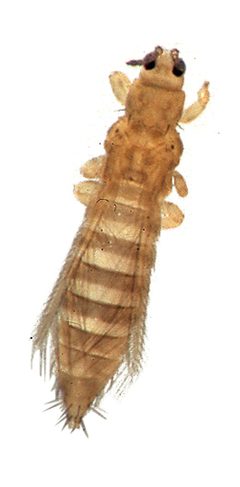
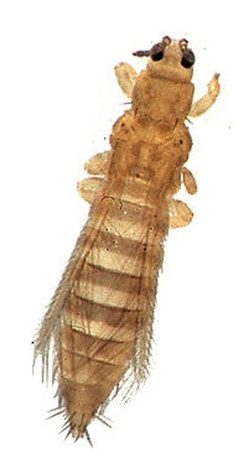
are 1–1.3 mm long with slender bodies ranging from yellow to yellowish-brown or brown. possess seven segments. Wings are well-developed with fringed margins typical of Thysanoptera. Females bear a saw-like ovipositor at the abdominal tip. Larvae are white or yellowish.
Habitat
Associated with cultivated and wild plants across diverse agricultural systems. Found on herbaceous vegetation including onion, leek, garlic, brassicaceous crops, cucurbits, strawberries, potatoes, tobacco, cotton, and numerous ornamental plants. In cooler climates, overwinters in plant debris. Thrives in both field and protected settings.
Distribution
Thought to have originated in the Mediterranean region; now present on all continents except Antarctica. Established across Europe, Asia, Africa, Australasia, Pacific Islands, North America, Central America, Caribbean, and South America. Documented in countries including Albania, Austria, Belgium, Britain, Bulgaria, China, India, Japan, Australia, USA, Brazil, and many others.
Seasonality
In tropical and subtropical regions such as Hawaii, breeds year-round. In temperate regions, overwinters in plant debris and becomes active in spring. Development from to takes 2–3 weeks under favorable conditions. Activity peaks during periods of rapid plant growth.
Diet
Phytophagous; feeds by rasping plant surface tissues with mouthparts, introducing digestive , and sucking exuded fluids. Targets young plant growth preferentially. Documented include onion, leek, garlic, cabbage, cauliflower, broccoli, asparagus, sugar beet, melon, pumpkin, cucumber, strawberry, potato, tobacco, cotton, and various fruiting and ornamental plants. Some may consume prey, though significance of in diet requires further study.
Host Associations
- Allium cepa - primary Most serious pest of onion crops in tropics
- Nicotiana tabacum - Known as
- Solanum lycopersicum - Known as tomato thrips; of tomato spotted wilt virus
- Solanum tuberosum - Known as potato thrips
- Gossypium hirsutum - Known as cotton seedling thrips
- Cannabis sativa - Documented pest in indoor production
- Iris yellow spot virus - Infected thrips live 22% longer than uninfected
- Tomato spotted wilt virus - First identified, 1927; some now non-transmitting
- Strawberry necrotic shock virus -
- Tobacco streak virus -
- Alternaria porri - Fungal agent of purple blotch
Life Cycle
are inserted under plant using saw-like ovipositor; white initially, turning orange, hatching in 4–5 days. Two larval stages follow, lasting approximately nine days total, during which larvae suck plant sap. Non-feeding prepupal and pupal stages last 4–7 days. survive 2–3 weeks; females lay approximately 80 eggs, mostly unfertilized via . Males are extremely rare in most (ratios from 1:300 to 1:5000 recorded), though higher male frequencies occur in some Western Hemisphere populations.
Behavior
are capable of but are weak fliers; long-distance occurs primarily via wind drifting. Females preferentially oviposit in young plant tissues. Aggregates on new growth and in concealed locations such as leaf axils. In response to disturbance, individuals may hide in tight spaces. can increase rapidly through in-field . from adjacent drying crops or weeds can cause sudden localized .
Ecological Role
Herbivore and agricultural pest causing direct feeding damage and vectoring plant . Feeding reduces photosynthetic area, increases water , and creates entry points for secondary pathogens. Virus transmission links it epidemiologically to in multiple cropping systems. Serves as target organism for research using fungi.
Human Relevance
Major economic pest of global significance. Causes millions of dollars in crop losses annually through direct damage and virus transmission. Primary pest of onion production in tropics; significant pest of cotton, tobacco, tomato, and other crops. Management relies on , insecticides, and scouting-based decision thresholds. Resistance to neonicotinoids has been confirmed in some . RNAi and other biotechnological approaches under investigation for management.
Similar Taxa
- Frankliniella occidentalisWestern flower thrips; larger, typically eight antennal segments, more variable coloration including darker forms
- Frankliniella schultzeiCommon blossom thrips; similar size range, overlapping plants, distinguished by antennal and color patterns
More Details
Parthenogenesis and sex ratio variation
exhibit extraordinary variation in male frequency, from complete absence of males in some collections (France, Japan, Taiwan, India) to ratios of 1:2 in Central Spain. A 1990 study suggested correlation between longitude and male abundance, with higher male counts in the Western hemisphere. Mechanism behind this geographic pattern remains unresolved.
Virus-vector interactions
with iris yellow spot virus increases longevity by 3.6 days (22%) but does not significantly affect . This extended lifespan enhances both direct feeding damage and virus transmission potential. Only 77% of thrips exposed to infected plants acquire the virus, possibly due to uneven viral distribution within plant tissues.
Biological control potential
Susceptible to fungi including bassiana isolate Bb111, which showed LC50 of 1.6 × 10⁵ spores/mL and LT50 of 104.91 hours, indicating potential for field- biocontrol exploitation.
Sources and further reading
- BugGuide
- Wikipedia
- GBIF taxonomy match
- iNaturalist taxon
- NCBI Taxonomy
- Catalogue of Life
- Early-Season Pests (Emergence to the first one-thirdgrown square–about 1/4 inch in diameter) - AgriLife Extension Entomology
- Targeting Thrips | Bug Squad
- Research Entomologist Daniel Hasegawa Targets Thrips | Bug Squad
- Virus Helps Onion Thrips Live Longer, Do More Damage
- How One Entomologist is Breaking Barriers in Crop Protection
- Rice Root Aphid: An Insect Surprise on Indoor-Grown Cannabis
- Thrips tabaci . [Distribution map].
- EVALUATION OF ENTOMOPATHOGENIC FUNGI AGAINST TOMATO THRIPS, THRIPS TABACI LINDEMAN
- Biological, Ecological and Behavioural Aspects of Onion thrips (Thrips tabaci Lindeman, 1889) Species Complex
- Host plant relationships and significance of prey in the diet of two phytophagous thrips species, Frankliniella schultzei and Thrips tabaci (Thysanoptera: Thripidae)
- BIOLOGY AND LIFE HABITS OF THE ONION THRIPS (THRIPS TABACI LINDEMAN)