
Timema boharti
Tinkham, 1942
Bohart's timema
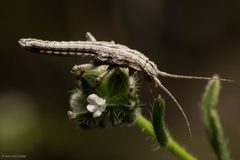
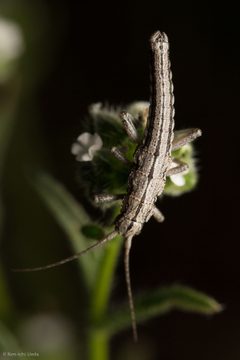
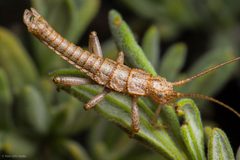
Timema boharti is a small walkingstick in the Timematidae, to California. It inhabits xeric pinyon-juniper woodland with chaparral intrusions at elevations around 915 m. The species exhibits two distinct colour morphs—greyish and green—with assortative mating by colour phase. It is and has been collected in late April, with both mating pairs and late-instar nymphs observed. Like other Timema species, it is wingless and feeds on plants within its specialized .
Pronunciation
How to pronounce Timema boharti: /tɪˈmiːmə boʊˈhɑːrti/
These audio files are automatically generated. While they are not always 100% accurate, they are a good starting point.
Identification
Timema boharti can be distinguished from other Timema by its geographic restriction to the Pinon Flats region of Riverside County, California, and its occurrence in xeric pinyon-juniper . It exhibits two discrete colour phases (greyish and green) that do not intergrade, with mating pairs segregated by colour. Post-mortem, specimens fade to brownish tones, making original colour determination impossible in preserved material. As a member of the relictual Timematidae, it is wingless and morphologically conservative compared to more derived .
Images
Habitat
Xeric pinyon-juniper woodland with chaparral intrusions, at approximately 915 m elevation. activity pattern observed.
Distribution
to California, United States. Documented from Pinon Flats, Riverside County, California. GBIF records indicate presence in California broadly.
Seasonality
and late-instar nymphs active in late April. collection records from this period.
Life Cycle
Last-instar nymphs observed in late April, with some individuals moulting. Mating pairs present at this time. Specific oviposition sites and not documented.
Behavior
. Exhibits colour-based assortative mating: greyish and green morphs mate only with like-coloured individuals. Two distinct colour phases present with no intergradation.
Ecological Role
Herbivore in xeric woodland . Specific plant associations not reported. As a member of the basal Timematidae, represents an evolutionarily significant lineage within .
Human Relevance
Named in honor of entomologist Richard M. Bohart (1913–2007), founder of the Bohart Museum of Entomology at UC Davis. The serves as a namesake for a major entomological institution and contributes to understanding of walkingstick evolution and .
Similar Taxa
- Timema cristinaeAlso exhibits distinct colour morphs (green and striped) with plant-associated mating, but occurs in coastal California chaparral on Adenostoma fasciculatum rather than inland pinyon-juniper woodland.
- Timema poppensisAnother California Timema with similar wingless , but restricted to different geographic region and type.
- Other Timema speciesAll Timema are wingless, , and morphologically conservative; identification relies on geographic distribution, specificity, and in this case, the distinctive colour with assortative mating.
Sources and further reading
- BugGuide
- Wikipedia
- GBIF taxonomy match
- iNaturalist taxon
- NCBI Taxonomy
- Catalogue of Life
- Bembicid Holdings | Entomology Research Museum
- A Story No One Is Letting Robert Washino Forget | Bug Squad
- Eating Insects at the Bohart Museum of Entomology | Bug Squad
- Parasitoid Palooza! Or What Ate My Caterpillar or Chrysalis | Bug Squad
- What's It Like to Be Parasitized? | Bug Squad
- Encyrtid Holdings | Entomology Research Museum
- ADDITIONAL INFORMATION ON TIMEMA SPECIES