
Timema cristinae
Vickery, 1993
Cristina's Timema
Timema cristinae is a small, flightless to a restricted region of southern California chaparral. The exhibits striking color-pattern with green, striped, and melanic morphs that provide differential camouflage on two plants: Adenostoma fasciculatum (chamise) and Ceanothus spinosus. It has become a prominent model system for studying ecological speciation, host , and the interplay between and . The species reproduces sexually with females laying single coated in ingested soil, which require soil contact for successful development.
Pronunciation
How to pronounce Timema cristinae: /tɪˈmiːmə ˈkɹɪstɪniː/
These audio files are automatically generated. While they are not always 100% accurate, they are a good starting point.
Identification
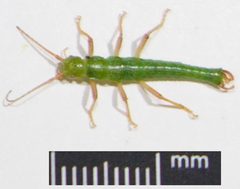
Distinguished from other Timema by its extremely small size (2–3 cm ) and restricted geographic range in southern California Coast Range chaparral. The only Timema species present in its . is marked: males have red legs and smaller , females have larger bodies and elongated mandibles. Color morphs (green, striped, grey, red, melanistic) can cause confusion, but the combination of small size, winglessness, and specific plant association (Adenostoma fasciculatum or Ceanothus spinosus) is diagnostic. The striped morph with white stripe is particularly distinctive.
Images
Appearance
reach 2–3 cm in length, making this one of the smallest . Body is rounded with an elongated ; completely wingless. is pronounced: males are smaller (~2 cm), thinner, and possess red legs; females are larger (~3 cm) with longer, more prominent . Body coloration is highly variable with at least four described morphs: green (uniform green), red (uniform red), grey (uniform grey), and striped (green with white stripe). A melanistic morph (dark brownish-grey, unstriped) has also been reported.
Habitat
Restricted to chaparral shrubland in the Coast Range of southern California. Specifically inhabits two plant : Adenostoma fasciculatum (chamise, Rosaceae) with small needle-like leaves in crowded bundles, and Ceanothus spinosus (greenbark ceanothus, Rhamnaceae) with wide oval leaves. Occupies the foliage and stems of these shrubs, with microhabitat use varying by color morph.
Distribution
Seasonality
with one per year. present in spring; peak laying occurs April–May. Eggs enter for approximately 8 months. Hatching occurs December–January, with some eggs remaining for an additional year.
Diet
Folivorous; feeds on leaves of shrubs Adenostoma fasciculatum and Ceanothus spinosus.
Host Associations
- Adenostoma fasciculatum - plantChamise; striped morph best camouflaged on needle-like leaves
- Ceanothus spinosus - plantGreenbark ceanothus; green morph best camouflaged on oval leaves
Life Cycle
. Females lay single coated with ingested soil; soil contact is obligate for egg development. Eggs undergo (~8 months) before hatching in December–January. Some eggs exhibit extended diapause, hatching the following year. Nymphs develop on plants, reaching adulthood by spring.
Behavior
Strictly : remains motionless on plants during daylight, feeds and moves at night. When disturbed, individuals frequently drop from vegetation to the ground. Exhibits death-feigning () when threatened, remaining completely immobile; this is more common in smaller individuals. Males engage in courtship involving leg and waving, followed by extended copulation lasting several hours. Post-copulatory mate guarding occurs, with males remaining on females for hours to days to prevent rival matings, though females still practice .
Ecological Role
Often the herbivore in its , with densities regularly equaling those of all lepidopteran larvae combined. Serves as prey for visual , particularly birds and lizards, with differential on color morphs driving eco-evolutionary dynamics. Coexists with a of at least 150 morphospecies. Camouflage maladaptation has been linked to increased abundance and of cohabitating arthropods and altered plant foliar nitrogen.
Human Relevance
Prominent research model for ecological speciation, , and evolutionary dynamics. Studies of its color morphs and host-plant relationships have provided key insights into how and interact during the early stages of speciation. The system demonstrates how combining natural history observation with modern advances understanding of evolution in nature.
Similar Taxa
- Other Timema speciesT. cristinae is distinguished by its smaller size, geographic restriction to southern California chaparral, and specific plant associations; other Timema occur in different regions and
More Details
Research significance
T. cristinae is one of the best-studied systems for ongoing ecological speciation. Research has demonstrated that green and striped morphs represent incipient speciation driven by divergent selection for camouflage on different plants, while melanic morphs act as a genetic bridge that impedes complete divergence through .
Fire ecology
can survive wildfires, likely facilitated by the soil-coating of -laying females which protects eggs from heat damage.
Sensory biology
Possesses enhanced olfactory capability relative to other studied phasmids, evidenced by elevated numbers of olfactory proteins.
Sources and further reading
- BugGuide
- Wikipedia
- GBIF taxonomy match
- iNaturalist taxon
- NCBI Taxonomy
- Catalogue of Life
- Timema-cristinae - Entomology Today
- Natural Selection Can Advance Evolution, But Can Also Impede It
- Timema cristinae Archives - Entomology Today
- Differential visual predation on morphs of Timema cristinae (Phasmatodeae:Timemidae) and its consequences for host range
- Exploring context dependency in eco‐evolutionary patterns with the stick insect Timema cristinae
- Divergent Host Plant Adaptation and Reproductive Isolation between Ecotypes of Timema Cristinae Walking Sticks
- Body size, not maladaptive gene flow, explains death-feigning behaviour in Timema cristinae stick insects
- Differential visual predation on morphs of Timema cristinae (Phasmatodeae:Timemidae) and its consequences for host range
- Divergent Host Plant Adaptation and Reproductive Isolation between Ecotypes of Timema cristinae Walking Sticks
- Density-dependent selection closes an eco-evolutionary feedback loop in the stick insect Timema cristinae
- The evolution of host preference in allopatric vs. parapatric populations of Timema cristinae walking-sticks
- The role of structural genomic variants in population differentiation and ecotype formation in Timema cristinae walking sticks
- Linking DNA Methylation to Localised Genetic Differentiation in Timema cristinae Stick Insects
- De novo characterization of the Timema cristinae transcriptome facilitates marker discovery and inference of genetic divergence