
Timema
Scudder, 1895
Timemas
Species Guides
11- Timema bartmani(Bartman's Timema)
- Timema boharti(Bohart's timema)
- Timema californicum(California timema)
- Timema chumash(Chumash Timema)
- Timema cristinae(Cristina's Timema)
- Timema genevievae(Genevieve's Timema)
- Timema knulli(Knull's Timema)
- Timema nevadense(Nevada Timema)
- Timema podura(Sierra Nevada timema)
Timema is a of small, wingless stick insects representing the sole extant member of the Timematidae and suborder . Native to mountainous regions of western North America, these insects are considered the sister group to all other stick insects, making them evolutionarily significant as a basal lineage. The genus exhibits remarkable diversity in reproductive mode, with five of twenty-one being parthenogenetic, including two species that have reproduced asexually for over one million years—the longest known period for any insect. Timema species display sophisticated cryptic coloration matching their plants, with color morphs including green, gray, brown, and striped variants that have been extensively studied as models for ecological speciation and .
Pronunciation
How to pronounce Timema: /tɪˈmiːmə/
These audio files are automatically generated. While they are not always 100% accurate, they are a good starting point.
Identification
Distinguished from all other stick insects by three-segmented (vs. five-segmented). Small, stout, wingless body form unlike the elongated, often winged bodies of . Coloration and pattern can indicate association: stripes associated with needle-leaved host plants (Adenostoma, junipers, conifers), unstriped green morphs with broad-leaved hosts, brown/gray/tan morphs with trunk-resting . T. cristinae specifically shows striped, unstriped, and melanistic color . Parthenogenetic may lack males entirely or have rare males; sexual species show consistent male courtship behavior.
Images
Appearance
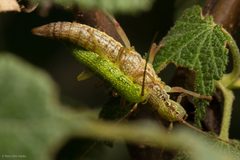
Small, stout-bodied stick insects with relatively short bodies compared to other . Wingless in all . possess three segments rather than the five segments typical of other stick insects. Body form somewhat resembles earwigs (order Dermaptera) due to compact build. Coloration highly variable: green, gray, brown, or tan base colors with patterns including stripes, , or dots. Striped morphs display white dorsal stripes. Melanistic (dark) morphs occur in some species. Body size and proportions vary between , with Adenostoma-associated ecotypes being smaller with wider and shorter legs compared to Ceanothus-associated ecotypes.
Habitat
Mountainous regions of western North America between 30° and 42° N latitude, primarily in California with extensions into Oregon, Nevada, Arizona, and northern Mexico. Associated with chaparral vegetation . Specific include: xeric pinyon-juniper with chaparral intrusions (elevations around 915 m), mixed coniferous and hardwood forests, and coastal scrub. activity pattern; individuals rest on plant leaves or bark during daytime.
Distribution
to far western United States and northern Mexico. Core range in California. Peripheral records from Oregon, Nevada, Arizona. Northern Mexico. Geographic pattern observed: exhibit more northerly distributions than sexual species, attributed to historical range expansion.
Seasonality
Activity observed in April based on collection records. feeding activity. Specific seasonal patterns for most not documented in available sources.
Diet
Herbivorous. plants include: Pseudotsuga menziesii (Douglas fir), Sequoia sempervirens (coast redwood), Arctostaphylos spp. (manzanita), Ceanothus spp., Adenostoma fasciculatum (chamise), Abies concolor (white fir), Quercus spp. (oak), Heteromeles arbutifolia (toyon), Cercocarpus spp. (mountain-mahogany), Eriogonum spp. (buckwheat), and Juniperus spp. (juniper). Some are host-plant feeding on multiple ; others are .
Host Associations
- Adenostoma fasciculatum - plantchamise; needle-like leaves; associated with striped of T. cristinae
- Ceanothus spp. - plantbroad leaves; associated with unstriped of T. cristinae
- Pseudotsuga menziesii - plantDouglas fir
- Sequoia sempervirens - plantcoast redwood
- Arctostaphylos spp. - plantmanzanita
- Abies concolor - plantwhite fir
- Quercus spp. - plantoak
- Heteromeles arbutifolia - planttoyon
- Cercocarpus spp. - plantmountain-mahogany
- Eriogonum spp. - plantbuckwheat
- Juniperus spp. - plantjuniper
Life Cycle
soft, ellipsoidal, approximately 2 mm long, with (lid-like structure) at one end for nymph . Females coat eggs with ingested dirt particles. Eggs attractive to ants, which carry them to burrows and feed on capitulum while leaving egg intact to hatch—potential mechanism. Nymphs pass through six or seven instars before adulthood. Last-instar nymphs observed molting in at least T. boharti.
Behavior
feeding; daytime resting on plant leaves or bark. Cryptic coloration functions as camouflage against visually searching . Some rest on leaves, others on trunks. Male courtship in sexual species: male climbs onto female's back, performs vibrating and waving display, then mates; rejection by female possible but uncommon. Post-copulatory mate guarding: male rides on female's back for up to five days. Assortative mating by color morph observed in T. boharti (grey pairs with grey, green with green).
Ecological Role
Herbivore in chaparral and forest understory . Prey for avian ; subject to strong selection for . exploited by ants for lipid-rich capitulum, with potential mutualistic benefit. Part of documented eco-evolutionary feedback loop involving -dependent selection: predator satiation at high densities reduces per-capita on conspicuous morphs.
Human Relevance
Important model system for evolutionary research, particularly regarding: ecological speciation, and , evolution of , cryptic coloration and camouflage, -plant specialization, and between . T. cristinae specifically cited as exemplary case for studying how natural selection can both promote and impede speciation. No documented economic or medical significance.
Similar Taxa
- Euphasmatodea (all other stick insects)Timema distinguished by three-segmented (vs. five), small stout wingless bodies (vs. typically elongated, often winged forms), and basal phylogenetic position
- Dermaptera (earwigs)Timema body form superficially resembles earwigs due to compact build; distinguished by tarsal segmentation, structure, and lack of forceps-like
More Details
Evolutionary significance
Timema is the sister group to all other stick insects, making it the most basal extant lineage of . This phylogenetic position has led to the designation '' for all other stick insects. Two fossil from Cenomanian-aged Burmese amber (99 million years old) described in 2019 represent extinct relatives, establishing deep temporal roots for the lineage.
Parthenogenesis
Five of 21 are parthenogenetic: T. douglasi, T. monikense, T. shepardi, T. tahoe, and T. genevievae. T. tahoe and T. genevievae have reproduced asexually for over one million years, the longest known period for any insect. Recent genetic evidence (2023) indicates rare males in some parthenogenetic engage in cryptic , potentially explaining the persistence of these ancient asexual lineages.
Color polymorphism and speciation
T. cristinae exhibits striped, unstriped, and melanistic morphs associated with different plants, representing an active case of ecological speciation. Two (Adenostoma-associated striped vs. Ceanothus-associated unstriped) show genetically inherited differences in size, width, leg length, and host preference, interpreted as incipient speciation with ongoing . A third brown morph acts as a genetic bridge between green , impeding divergence through gene flow.
Sources and further reading
- BugGuide
- Wikipedia
- GBIF taxonomy match
- iNaturalist taxon
- NCBI Taxonomy
- Catalogue of Life
- Timema-cristinae - Entomology Today
- Timema cristinae Archives - Entomology Today
- Natural Selection Can Advance Evolution, But Can Also Impede It
- ADDITIONAL INFORMATION ON TIMEMA SPECIES
- Adaptive evolution of cryptic coloration: the shape of host plants and dorsal stripes in Timema walking-sticks
- Evidence for cryptic gene flow in parthenogenetic stick insects of the genus Timema
- Phylogenetic evidence for the evolution of ecological specialization in Timema walking-sticks
- Divergent Host Plant Adaptation and Reproductive Isolation between Ecotypes of Timema Cristinae Walking Sticks
- Differential visual predation on morphs of Timema cristinae (Phasmatodeae:Timemidae) and its consequences for host range
- MULTIPLE DIRECT TRANSITIONS FROM SEXUAL REPRODUCTION TO APOMICTIC PARTHENOGENESIS INTIMEMASTICK INSECTS
- The evolution of geographic parthenogenesis in Timema walking‐sticks
- Differential visual predation on morphs of Timema cristinae (Phasmatodeae:Timemidae) and its consequences for host range
- Disruptive selection and the evolution of discrete color morphs in Timema stick insects
- Density-dependent selection closes an eco-evolutionary feedback loop in the stick insect Timema cristinae
- Divergent Host Plant Adaptation and Reproductive Isolation between Ecotypes of Timema cristinae Walking Sticks
- The evolution of host preference in allopatric vs. parapatric populations of Timema cristinae walking-sticks