
Anabrus simplex
Haldeman, 1852
Mormon Cricket
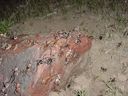
, commonly known as the Mormon cricket, is a large flightless shieldbacked ( Tettigoniidae, Decticinae) native to western North America. Despite its , it is not a true . The is notable for its periodic that form large migratory bands, causing significant damage to rangeland forage and cultivated crops. It exhibits a sex-role reversed mating system where males provide and females compete for mates. The species has been documented from low-elevation sagebrush steppe to alpine tundra above 11,000 feet.
Pronunciation
How to pronounce Anabrus simplex: //ˈænəˌbrʊs ˈsɪmplɛks//
These audio files are automatically generated. While they are not always 100% accurate, they are a good starting point.
Identification
Distinguished from other western North American shieldbacked katydids by its ground-dwelling, rangeland and large size. Most other shieldbacked katydids in the region inhabit shrubs and bushes rather than open sagebrush-grass . The bifurcated male is diagnostic for identification; this structure begins developing as a black bump in the fifth instar. The gently upward-curved ovipositor and smooth, shiny separate it from rougher or more spiny tettigoniids. When compared to grasshoppers (Acrididae), the extremely long and shield-backed body form are distinctive.
Images
Appearance
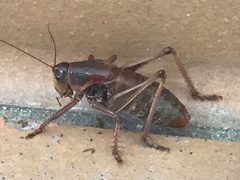
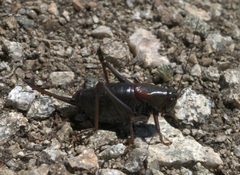
Large, robust insect reaching up to 8 cm (3 inches) in length. have a smooth, shiny with long characteristic of katydids. Wings are short and non-functional for . is pronounced: males average 3,400 mg live weight (960 mg dry weight), females average 4,100 mg live weight (1,330 mg dry weight). Adult males possess diagnostic bifurcated with a distinct shape, with bifurcation becoming evident in the fifth instar as a black bump on the inner surface; female cercus remains small and cone-shaped. The ovipositor curves gently upward. Coloration varies but generally matches the drab tones of sagebrush .
Habitat
Occupies rangelands dominated by sagebrush (Artemisia spp.) and forbs, particularly in the Great Basin and intermountain mountain ranges. Found in open sagebrush-grass associations where large develop. In the Rocky Mountains, occurs from 6,500 feet in forest openings to above 11,000 feet in alpine tundra. Utilizes big sagebrush, other sagebrush , and saltbush as critical shelter and basking structures. Oviposits in bare ground, often in western harvester ant mounds.
Distribution
Western North America, ranging from British Columbia and Alberta in Canada south through Washington, Oregon, Idaho, Montana, Wyoming, Nevada, Utah, Colorado, and California in the United States. Distribution has expanded in some areas; notable increase in Saskatchewan, Canada documented in 1938. concentrated in the Great Basin and intermountain west, with populations historically recorded across 11 western states.
Seasonality
laid in summer undergo embryonic development through fall, entering for winter dormancy. Hatching begins when soil temperatures reach 40°F, typically in spring, at lower temperatures than most grasshoppers. Nymphal development spans 60-90 days through seven instars. present from mid-summer; in high mountain , two years may be required to complete one . Migratory bands most active during daytime when air temperatures range 65-95°F.
Diet
herbivore with documented feeding on over 400 plant . Preferred forbs include milkvetches (Astragalus), penstemon, arrowleaf balsamroot (Balsamorhiza sagittata), dandelion, and mustards (wild mustard, tumble mustard, pepperweed). Feeds on shrubs including saltbush (Atriplex) and sagebrush species (big sagebrush, budsage, fringed sagebrush). During seed development, climbs plants to feed preferentially on nutritious kernels. Consumes cultivated plants voraciously: wheat, barley, alfalfa, sweetclover, truck crops, and garden vegetables. Will also consume fungi and arthropods. Protein-seeking drives migratory band movement.
Life Cycle
Hemimetabolous development with one annually (two years in high mountain ). laid singly in bare ground, often in mounds; female covers exit hole with soil using ovipositor. Eggs 7-8 mm long, dark brown when laid, turning white then gray during development. Embryonic growth begins at oviposition, completes by fall, through winter. Seven nymphal instars; molting occurs on vegetation with insect hanging - or back-downward, completed in 10-20 minutes, followed by consumption of shed . live approximately 20 days after reaching maturity. Female averages 86 eggs, with maximum recorded 160 eggs; oviposition occurs in bouts at approximately 7-day intervals.
Behavior
Forms large cohesive migratory bands at high densities, traveling 0.5-1 mile per day and 25-50 miles per season despite flightlessness. Locomotion limited to crawling and hopping. primarily under clear skies and favorable temperatures (65-95°F). Bands may coalesce or flow through each other when meeting. Exhibits thermoregulatory basking: nymphs emerge after sunrise to bask on east side of shrubs, shifting to west side before sunset. Seeks shelter under shrub , in soil cracks, under clods, or beneath during cold, wet, or windy conditions. Sex-role reversed mating system: males produce calling songs, are choosy of mates, and provide large ( up to 27% of male body weight) that females consume for production. Females compete aggressively for access to males and nutritious gifts.
Ecological Role
Significant consumer of in sagebrush ; at one individual per square yard, consumes forage equivalent to 38 pounds dry weight per acre. Migratory bands redistribute nutrients across landscapes. Serves as prey for diverse including California gulls, hawks, crows, rodents, and the digger wasp Palmodes laeviventris. Gut microbiome dominated by Lactobacillaceae, Enterobacteriaceae, and Streptococcaceae contributes to nutrition, , and potentially social ; bacteria likely exchanged with environment. Susceptible to microsporidian Vairimorpha and fungi Metarhizium spp.
Human Relevance
Major agricultural pest with long history of economic damage in western North America. have persisted 5-21 years; 1931-1948 outbreak peaked at 19 million acres in 11 states. Crop damage in 1937 reached $500,000 in Montana and $383,000 in Wyoming. Damages rangeland forage and destroys cultivated crops in paths, particularly sugarbeets, small grains, and alfalfa. Subject to extensive survey and control programs by USDA-APHIS. peoples historically harvested as food source; archaeological evidence from Wyoming cave dates to 222 ± 150 years BC. Investigated as potential high-protein poultry feed. Management includes chemical , poisoned baits (historically), and using Metarhizium fungi.
Similar Taxa
- Brachystola magnaLubber grasshopper, also large and flightless with periodic in western rangelands, but belongs to Romaleidae, has much shorter , and different body proportions.
- Other Decticinae (shieldbacked katydids)Most western shieldbacked katydids inhabit shrubs and bushes rather than ground-dwelling sagebrush ; differ in size, coloration, and association.
- True crickets (Gryllidae)True crickets have different body form, are generally smaller, and do not form large migratory bands in sagebrush rangelands.
Misconceptions
Despite 'Mormon cricket,' this is not a true ( Gryllidae) but a in family Tettigoniidae. The name originated from early Mormon settlers in Utah who experienced devastating . Also frequently misidentified as a due to its rangeland and pest status, but distinguished by extremely long and shield-backed .
More Details
Gut Microbiome
Harbor distinct bacterial across gut regions: Lactobacillaceae (particularly Lactobacillus) dominate , Pediococcus in , and Pantoea agglomerans (Enterobacteriaceae) in . Predicted gene content indicates metabolism and defense functions.
Population Dynamics
can reach densities of 100 per square yard. Natural control factors poorly understood; weather variations, , and (particularly microsporidian Vairimorpha) contribute to population crashes. -dependent phase changes in , physiology, and have been documented.
Sexual Selection
Males invest heavily in offspring through , making this one of the few insects with substantial male . Female-female competition for mates is intense, with selection favoring reduced width and length rather than larger body size as predicted by conventional theory.
Sources and further reading
- BugGuide
- GBIF taxonomy match
- iNaturalist taxon
- NCBI Taxonomy
- Catalogue of Life
- Mormon Cricket
- List of Species Fact Sheets| Grasshoppers of Wyoming and the West
- Grasshoppers of Colorado
- Species Records and Accounts
- Grasshoppers of Colorado
- Wyoming Distribution Atlas
- THE DISTRIBUTION OF THE MORMON CRICKET, ANABRUS SIMPLEX HALDEMAN, IN SASKATCHEWAN
- Structure, culture, and predicted function of the gut microbiome of the Mormon cricket Anabrus simplex (Orthoptera: Tettigoniidae)
- Measuring sexual selection on females in sex‐role‐reversed Mormon crickets (Anabrus simplex, Orthoptera: Tettigoniidae)
- Immediate protein dietary effects on movement and the generalised immunocompetence of migrating Mormon crickets Anabrus simplex (Orthoptera: Tettigoniidae)
- Virulence of the insect-pathogenic fungiMetarhiziumspp. to Mormon crickets,Anabrus simplex(Orthoptera: Tettigoniidae)
- Sexual size and shape dimorphism are consistent with predictions that both natural and sexual selection are driving the evolution of sexual dimorphism in Mormon crickets, Anabrus simplex.