
Anabrus
Haldeman, 1852
Mormon cricket
Species Guides
3- Anabrus cerciata(Big-tooth Anabrus)
- Anabrus longipes(long-legged anabrus)
- Anabrus simplex(Mormon Cricket)
Anabrus is a of shield-backed katydids in the Tettigoniidae, comprising four described including the extinct Anabrus caudelli. The genus is best known for , commonly called the , a large flightless insect famous for forming massive migratory bands that cause significant agricultural damage in western North America. Despite the , these insects are not true crickets but katydids characterized by their gregarious , distinctive , and periodic .
Pronunciation
How to pronounce Anabrus: /ˈænəˌbrʌs/
These audio files are automatically generated. While they are not always 100% accurate, they are a good starting point.
Identification
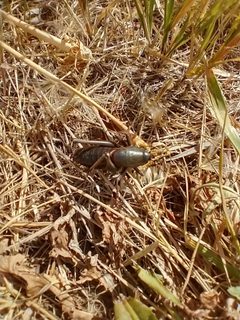
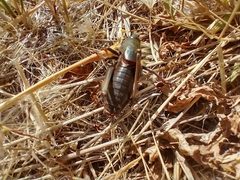
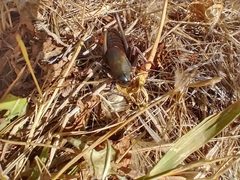
Anabrus are large, flightless katydids with a distinctive shield-shaped pronotum that extends backward over the , giving the 'shield-backed' appearance. Members of this possess long , a smooth and shiny , and short wings unsuited for . males of can be distinguished by the bifurcated , which appears as a black bump on the inner surface beginning in the fifth instar; female cerci remain small and cone-shaped. The ovipositor curves gently upward. These features separate Anabrus from other ground-dwelling shield-backed katydids in western North America, most of which inhabit shrubs rather than open rangeland.
Images
Habitat
of Anabrus inhabit rangelands dominated by sagebrush and forbs, particularly in the Great Basin and associated mountain ranges. develop in open sagebrush-grass associations, with resident populations in the Rocky Mountains occurring from 6,500 feet in forest openings to above 11,000 feet in alpine tundra. Nymphs and seek shelter under shrub , in soil cracks, under soil clods, and beneath livestock during cold or inclement weather.
Distribution
Western North America, including the western United States and Canada. Specific distribution records include Alberta, British Columbia, California, Colorado, and Idaho. The has shown range expansion in some areas, with increased abundance in Saskatchewan documented as early as 1938.
Seasonality
and likely are , early-season insects. hatch in spring when soil temperatures reach 40°F, with nymphal development occurring through spring and summer. are present from mid-summer through fall. At high mountain altitudes, embryonic development may be delayed, potentially requiring two years to complete a single .
Life Cycle
are laid singly in bare ground during summer, often utilizing mounds of the western harvester ant. Embryonic growth begins immediately, with complete development by fall followed by and winter dormancy. Nymphs pass through seven instars over 60 to 90 days before reaching adulthood. The total lifespan is approximately 100 days. Females deposit approximately 86 eggs on average, with oviposition occurring in bouts at intervals of roughly seven days.
Behavior
exhibits pronounced gregarious , forming cohesive migratory bands that can cover half to one mile per day and travel 25 to 50 miles in a season. occurs primarily during daytime when temperatures range from 65° to 95°F, with individuals crawling and hopping as their primary locomotion. Bands may coalesce when meeting or maintain separate directions. Daily activity includes basking behavior: nymphs emerge after sunrise to warm on the east side of shrubs, then disperse to feed and migrate; evening basking occurs on west-facing surfaces before retreating to shelters at sunset.
Human Relevance
is a significant agricultural pest, with causing damage to rangeland forage and cultivated crops including wheat, barley, alfalfa, sugar beets, and garden vegetables. During the 1937 outbreak, crop damage reached $500,000 in Montana and $383,000 in Wyoming. The has been harvested as a food source by peoples for millennia, with archaeological evidence of cooked remains in Wyoming dating to approximately 222 ± 150 years BC. Modern research has explored its potential as a high-protein feed for poultry. Control efforts historically relied on chemical , though using fungi (particularly Metarhizium species) is being investigated.
Similar Taxa
- CeuthophilusCamel crickets in this share large size and wing reduction but differ in preference (caves, forest litter) and lack the shield-backed pronotum shape of Anabrus.
- Brachystola magnaThe plains lubber grasshopper is similarly large and flightless but belongs to Romaleidae, has a different body plan with enlarged hind legs for jumping, and lacks the long and shield-shaped pronotum of Anabrus.
Misconceptions
The '' is misleading in two ways: is not a true ( Gryllidae) but a in family Tettigoniidae, and the name has been applied to multiple Anabrus despite originally referring specifically to A. simplex. The flightless condition and ground-dwelling habit of Anabrus also cause confusion with grasshoppers (family Acrididae), though katydids can be distinguished by their extremely long and different wing structure.
More Details
Gut Microbiome
The gut microbiome of is dominated by eleven bacterial from Lactobacillaceae, Enterobacteriaceae, and Streptococcaceae. structure varies spatially along the gut, with lactic acid bacteria more prevalent in the and and bacteria concentrated in the . These microbes likely contribute to metabolism, defense, and potentially modulate social .
Sexual Selection and Sex Roles
exhibits sex-role reversal, with males producing large, protein-rich (up to 27% of male body weight) that females consume during mating. This provides nutrients for production, making males the choosier sex and females the competitors for mates. Male choice and female-female competition for access to protein-rich spermatophores drive in this system.
Population Dynamics
can reach densities of 100 individuals per square yard, with major historical outbreaks lasting 5 to 21 years. The 1931-1948 outbreak peaked in 1938 with 19 million acres infested across 11 states. involves weather mortality (cold, wet conditions), by birds and rodents, by digger wasps, and from microsporidian .
Sources and further reading
- BugGuide
- Wikipedia
- GBIF taxonomy match
- iNaturalist taxon
- NCBI Taxonomy
- Catalogue of Life
- List of Species Fact Sheets| Grasshoppers of Wyoming and the West
- Grasshoppers of Colorado
- Grasshoppers of Colorado
- Grasshoppers of Colorado
- Mormon Cricket
- Grasshoppers of Colorado
- The Species of Anabrus and Their Distribution
- Ecology and Management of Mormon Cricket, Anabrus simpled Haldeman
- THE DISTRIBUTION OF THE MORMON CRICKET, ANABRUS SIMPLEX HALDEMAN, IN SASKATCHEWAN
- Structure, culture, and predicted function of the gut microbiome of the Mormon cricket Anabrus simplex (Orthoptera: Tettigoniidae)
- Measuring sexual selection on females in sex‐role‐reversed Mormon crickets (Anabrus simplex, Orthoptera: Tettigoniidae)
- Immediate protein dietary effects on movement and the generalised immunocompetence of migrating Mormon crickets Anabrus simplex (Orthoptera: Tettigoniidae)
- Virulence of the insect-pathogenic fungiMetarhiziumspp. to Mormon crickets,Anabrus simplex(Orthoptera: Tettigoniidae)
- Sexual size and shape dimorphism are consistent with predictions that both natural and sexual selection are driving the evolution of sexual dimorphism in Mormon crickets, Anabrus simplex.