
Brachystola magna
(Girard, 1854)
Plains Lubber Grasshopper, Western Lubber Grasshopper, Homesteader
Brachystola magna is one of the largest grasshoppers in North America, a flightless inhabiting the Great Plains from the Canadian border to central Mexico. reach 4–6 cm in length, with females substantially larger and heavier than males. The species exhibits a two-year , with twice before hatching. Though primarily herbivorous, adults display notable omnivory including scavenging and on other insects. The species has historical scientific significance as the subject of Walter Sutton's pioneering work on reduction division and theory.
Pronunciation
How to pronounce Brachystola magna: /ˌbrækɪˈstoʊlə ˈmæɡnə/
These audio files are automatically generated. While they are not always 100% accurate, they are a good starting point.
Identification
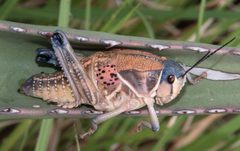
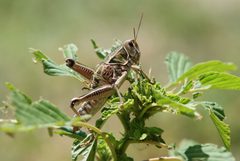
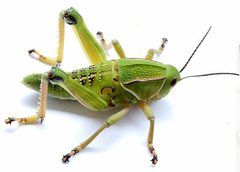
Distinguished from all other North by its combination of large size (exceeding 4 cm), flightlessness with reduced wing pads, and strikingly banded coloration. Separated from Brachystola virescens by longer and more brownish-buff coloration (versus green in virescens). The trapezoidal pronotum with dense knobs and the distinctive pink tegmina with black dots are diagnostic. Nymphs identifiable by black antennae with ivory annuli, banded pronotum with cut lateral carinae, and smooth shiny black visible in early instars.
Images
Habitat
Occupies open and semi-open of the Great Plains including shortgrass, mixedgrass, tallgrass, sand, and desert prairies. Strongly associated with disturbed sites, roadsides, field margins, and gravelly ground. Dependent on patches of forbs, particularly common sunflower (Helianthus annuus), for sustenance. In Wyoming, found specifically on gravelly ground in the southwest of the state. Avoids dense vegetation; requires bare, sandy loam areas for oviposition.
Distribution
Native to central and southern United States and northern Mexico. Ranges from the Canadian border south to central Mexico, and from the Rocky Mountain foothills eastward across the Great Plains. Documented in Montana, Wyoming, Colorado, Nebraska, Kansas, Oklahoma, Texas, New Mexico, Arizona, and Mexican states of Chihuahua, Coahuila, Nuevo León, and Tamaulipas. Distribution is patchy; concentrated where forbs occur.
Seasonality
hatch in mid-May to mid-June depending on latitude and elevation: mid-May in eastern Kansas, early June in northern Colorado and Wyoming, mid-June in Montana. In southeastern Arizona, hatching is delayed until summer monsoon rains wet the soil, sometimes as late as early July. Nymphal development lasts approximately 45 days in nature (27 days under laboratory conditions). appear from late June through July depending on location: late June in eastern Kansas, mid-July in northern Colorado, late July in Wyoming and Montana. Adults persist into fall, with some surviving into early November in milder climates. Oviposition occurs from early August through September, lasting approximately 60 days for surviving females.
Diet
herbivore with broad plant diet and notable omnivory. Crop analysis reveals consumption of at least 16 forb , 4 grass species, and parts. Most frequently consumed plants are common sunflower (Helianthus annuus, present in 35% of crops) and hoary vervain (Verbena stricta, 19%). Other recorded foods include western wheatgrass, kochia, prickly lettuce, scarlet globemallow, breadroot scurfpea, Missouri milkvetch, wavyleaf thistle, hoary puccoon, upright prairie coneflower, downy brome, cudweed sagewort, Indian paintbrush, horseweed fleabane, foothill bladderpod, low lupine, dandelion, sowthistle, prairie sunflower, and cotton seedlings. actively forage on the ground for animal matter: observed consuming incapacitated insects, scavenging road-killed conspecifics, capturing and eating smaller melanopline grasshoppers, and predating other arthropods. Laboratory studies confirm preference for common sunflower, western ragweed, and cotton seedlings.
Host Associations
- Helianthus annuus - food plantCommon sunflower; most important , found in 35% of crop contents and supporting dense
- Helianthus pumilus - food plantLittle sunflower; supports near Boulder, Colorado
- Helianthus petiolaris - suspected food plantPrairie sunflower; observed defoliation in Wyoming
- Oxyspirura petrowi - intermediate Eyeworm ; 37.9% of field-collected grasshoppers harbored L3 larvae, confirmed as potential intermediate for in northern bobwhites
- Colinus virginianus - definitive of Northern bobwhite; experimental confirmed B. magna can transmit O. petrowi to this game bird
Life Cycle
Two-year (semivoltine). are deposited in gourd-shaped pods in bare, sandy loam during summer and early fall. Each pod contains 20–35 large eggs. Eggs undergo two winters of and incubation before hatching; this extended dormancy allows survival through drought periods. Hatching occurs in spring when soil conditions permit. Nymphs pass through five instars over approximately 45 days. reach sexual maturity in about 23 days, with mating observed in late July and oviposition beginning in early August. fluctuations observed in field populations support the two-year cycle interpretation.
Behavior
activity pattern centered on and feeding. Morning basking ( basking perpendicular to sun rays, occasional flank basking) lasts approximately two hours after sunrise. Post-basking rest followed by movement, feeding, and crawling down plants to ground. Midday heat avoidance: when ground temperatures exceed 110°F and air temperatures reach 93–100°F, individuals move to shade of vegetation or climb 20+ inches on host plants; stilting observed on ground. Afternoon return to host plants for resting on stems and leaves. Evening and early morning roosting on vertical stems or horizontal leaves at 8–41 inch heights. Strong tendency through prairie vegetation in consistent direction at rapid speed. Dispersal by crawling and hopping: unflushed hops of 3–4 inches, flushed hops of 14 inches (females); males capable of 9-foot leaps when disturbed. Regularly observed crossing highways and roads. Mating occurs on ground; oviposition also on ground in bare soil patches. and scavenging common in , particularly females.
Ecological Role
Herbivore and occasional in prairie . Functions as agent of weeds in sunflower patches, but can become pest of cotton and other crops when . Serves as prey for birds, rodents, and ; swift fox scat has contained remains. Documented intermediate for eyeworm Oxyspirura petrowi, linking it to parasite transmission in galliform game birds. Large (one equals 11 Melanoplus sanguinipes in biomass) makes it significant food source when abundant. Contributes to nutrient cycling through herbivory and as prey.
Human Relevance
Occasional agricultural pest, particularly of young cotton plants in Texas, Oklahoma, and western plains; have completely destroyed cotton stands, though damage more commonly limited to marginal rows. Economic damage threshold: one per 3 feet of row in cotton, or two per square yard in field margin vegetation. Outbreak years recorded in Texas: 1954, 1959, 1977, 1979. Generally prefers coarse broadleaved weeds to crops; does not cause significant damage to most crops. Subject of foundational cytogenetic research: Walter Sutton's 1902 description of reduction division () based on B. magna was critical to development of theory of inheritance. Sometimes kept as pet. Edible for humans; consumed by some and rural .
Similar Taxa
- Brachystola virescensSimilar large lubber grasshopper; distinguished by shorter and predominantly green coloration versus longer antennae and brownish-buff tones in B. magna
- Melanoplus sanguinipesLesser migratory grasshopper overlaps in range and ; much smaller (typically under 3 cm), fully winged and capable of , lacks bold banded coloration
- Romalea micropteraEastern lubber grasshopper; similarly flightless and large, but ranges east of the Mississippi River and displays different color patterns (often yellow with black markings in northern form, solid black with red/yellow stripes in southern form)
More Details
Scientific Significance
Walter Sutton's 1902 study of reduction division in Brachystola magna provided critical evidence for the theory of inheritance, establishing that chromosomes carry genetic material and undergo meiotic reduction. This work, conducted at Columbia University, was foundational to modern genetics.
Population Dynamics
exhibit fluctuations correlating with two-year . populations can reach densities of 10 young per square yard in cotton field margins. No sustained long-term population studies have documented outbreak duration or crash factors. One adult per square yard considered high ; equivalent to 11 Melanoplus sanguinipes adults.
Thermoregulation Research
Subject of behavioral studies on body temperature control through posture, orientation, and microhabitat selection in variable thermal environments of the Great Plains.
Sources and further reading
- BugGuide
- Wikipedia
- GBIF taxonomy match
- iNaturalist taxon
- NCBI Taxonomy
- Catalogue of Life
- Plains Lubber Grasshopper
- Grasshoppers of Colorado
- List of Species Fact Sheets| Grasshoppers of Wyoming and the West
- Grasshoppers of Colorado
- Grasshoppers of Colorado
- Bug Eric: The Homesteader (Plains Lubber grasshopper)
- A Two-Year Life Cycle in Brachystola magna (Orthoptera: Acrididae) with Notes on Rearing and Food Preference2
- Plains lubber grasshopper (Brachystola magna) as a potential intermediate host for Oxyspirura petrowi in northern bobwhites (Colinus virginianus)
- Plains Lubber Grasshopper (Brachystola magna) as a Potential Intermediate Host for Oxyspirura petrowi in Northern Bobwhites (Colinus virginianus) – CORRIGENDUM