
Brachystola
Scudder, 1876
grassland lubbers
Species Guides
1- Brachystola magna(Plains Lubber Grasshopper)
Brachystola is a of large, flightless grassland lubber grasshoppers in the Romaleidae, distributed across the western United States and Mexico. Members are among the largest grasshoppers in North America, with robust bodies, short non-functional wings, and striking coloration. The genus includes six recognized , with Brachystola magna (plains lubber grasshopper) being the most studied due to its use in early genetic research and its status as an occasional agricultural pest.
Pronunciation
How to pronounce Brachystola: //ˌbrækɪˈstoʊlə//
These audio files are automatically generated. While they are not always 100% accurate, they are a good starting point.
Identification
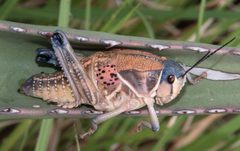
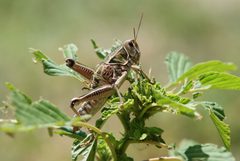
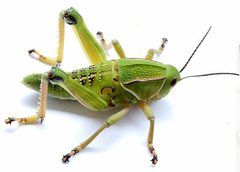
are distinguished from other grasshoppers by their large size, flightlessness (short, rounded non-functional wings), and distinctive color patterns combining green, brown, and pink with black markings. The pronotum is trapezoidal with a dense covering of small knobs and short wrinkles. Tegmina are pink with conspicuous black dots. Hind are large and multicolored; males have noticeably larger hind femora than females. Nymphs display green, tan, or fuscous with bearing ivory annuli, trapezoidal pronota with distinct black carinae, and patterned hind femora. Unlike Acrididae grasshoppers, Brachystola have reduced wings incapable of and move primarily by crawling and hopping.
Images
Habitat
Grassland prairies including shortgrass, mixedgrass, tallgrass, sand, and desert prairie types. are patchy and concentrated in disturbed sites with abundant forbs, particularly along roadsides, field margins, and rangeland with plant patches. Presence depends on availability of specific forbs, especially sunflowers (Helianthus spp.).
Distribution
Western plains of the United States and northern Mexico. Documented from Nebraska, Texas, Colorado, Wyoming, Montana, Kansas, Iowa, Oklahoma, Arizona, and New Mexico. Distribution is widespread but patchy, with localized to areas supporting forbs.
Seasonality
Hatching occurs from mid-May in eastern Kansas to mid-June in northern Colorado and Wyoming, and mid-June in Montana. In southeast Arizona, hatching is delayed until summer monsoon rains wet the soil. appear from late June in Kansas to late July in Montana. laying begins approximately 23 days after adult and continues for about 60 days, typically through September. Some adults survive into November in milder climates.
Diet
, feeding on diverse forbs and grasses. Crop content analysis reveals consumption of at least 16 forb , 4 grass species, and parts. Common sunflower (Helianthus annuus) is a preferred , found in 35% of crops examined. Other frequent plants include hoary vervain (Verbena stricta, 19%), western wheatgrass (11%), kochia (9%), and prickly lettuce (9%). Laboratory studies indicate preferences for common sunflower, western ragweed, cotton seedlings, dandelion, prairie sunflower, and sowthistle. Observed omnivory includes on incapacitated insects and smaller grasshoppers.
Life Cycle
Two-year requiring two growing seasons for completion. undergo two years of incubation and before hatching. Nymphs develop through five instars over approximately 45 days in nature (27 days under laboratory conditions: 14 hours light at 87.8°F, 10 hours dark at 78.8°F). reach sexual maturity in about 23 days. Females deposit eggs in large gourd-shaped pods (1.75–2 inches long, 0.75 inch diameter) containing 20–35 eggs (10.1–10.8 mm long, dark reddish brown) in bare sandy loam areas. Oviposition continues for approximately 60 days. fluctuations with higher densities in alternate years support the two-year cycle.
Behavior
Flightless; disperses by crawling and hopping. Unflushed hops of females measure 3–4 inches; flushed hops reach 14 inches. Males have been observed to jump up to 9 feet. Adults frequently cross highways and roads. Daily activities include morning basking ( or flank basking) for approximately two hours after sunrise, followed by feeding and movement. During midday heat (ground temperatures 110–140°F, air temperatures 93–100°F), individuals seek shade on vegetation or adopt postural responses facing the sun to shield the body. Evening and early morning roosting occurs vertically on stems or horizontally on leaves at heights of 8–41 inches. Strong tendency through prairie vegetation in consistent direction at relatively rapid speed.
Ecological Role
Herbivore and occasional in prairie . Serves as prey for birds, rodents, and including swift foxes. Functions as intermediate for the eyeworm Oxyspirura petrowi, a affecting northern bobwhites and other galliform birds. In sunflower patches, provides limited of weeds; however, can cause significant agricultural damage.
Human Relevance
Occasional agricultural pest, particularly of cotton in Texas, Oklahoma, and western plains. have destroyed young cotton stands entirely, consuming all foliage and leaving only stems. Economic damage thresholds: one per 3 feet of cotton row, or two per square yard in field margin vegetation. Documented outbreak years in Texas include 1954, 1959, 1977, and 1979. Brachystola magna was used in early genetic studies due to its large, easily visible meiotic . Serves as intermediate for Oxyspirura petrowi, a of game birds of concern to wildlife management.
Similar Taxa
- DissosteiraBoth are large, flightless grasshoppers with reduced wings; Dissosteira (Carolina grasshopper, high plains grasshopper) differs in having more elongate wings and different coloration (typically gray-brown with black hindwings), and occupies different including bare ground and disturbed areas rather than dense forb patches.
- RomaleaBoth are large lubber grasshoppers in Romaleidae with aposematic coloration and flightlessness; Romalea microptera (eastern lubber grasshopper) is restricted to the southeastern United States, has different color patterns (often yellow, orange, and black), and lacks the pink tegmina with black dots characteristic of Brachystola.
- MelanoplusSome Melanoplus are large and share grassland , but all have functional wings capable of , more slender bodies, and different pronotal structure without the dense knobbing seen in Brachystola; most are in Acrididae rather than Romaleidae.
More Details
Chromosome Research
Brachystola magna possesses relatively large meiotic that are easily visible, making it valuable for early genetic and cytological studies.
Population Dynamics
fluctuations with higher densities in alternate years reflect the two-year development period. One per square yard represents high , with equivalent to 11 Melanoplus sanguinipes adults. populations near cotton fields may reach 10 young adults per square yard.
Thermoregulation
Exhibits sophisticated behavioral including basking (back perpendicular to sun), flank basking (exposing side with lowered hindleg), postural orientation to shade leaves, and stilting (elevating body on legs) when ground temperatures become excessive.
Sources and further reading
- BugGuide
- Wikipedia
- GBIF taxonomy match
- iNaturalist taxon
- NCBI Taxonomy
- Catalogue of Life
- Grasshoppers of Colorado
- List of Species Fact Sheets| Grasshoppers of Wyoming and the West
- Plains Lubber Grasshopper
- Grasshoppers of Colorado
- Grasshoppers of Colorado
- Grasshoppers of Colorado
- A Two-Year Life Cycle in Brachystola magna (Orthoptera: Acrididae) with Notes on Rearing and Food Preference2
- Plains Lubber Grasshopper (Brachystola magna) as a Potential Intermediate Host for Oxyspirura petrowi in Northern Bobwhites (Colinus virginianus) – CORRIGENDUM
- Plains lubber grasshopper (Brachystola magna) as a potential intermediate host for Oxyspirura petrowi in northern bobwhites (Colinus virginianus)