
Romalea
Serville, 1831
Horse Lubbers, Lubber Grasshoppers
Species Guides
1- Romalea microptera(Eastern Lubber Grasshopper)
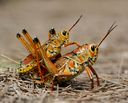
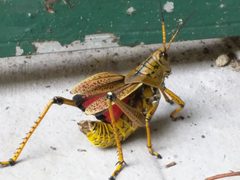
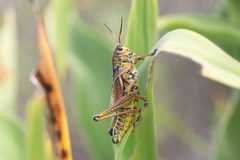
Romalea is a of large, flightless lubber grasshoppers in the Romaleidae. Traditionally containing a single , R. microptera (), recent taxonomic revisions have synonymized Taeniopoda with Romalea, expanding the genus to approximately 12 species distributed from the southern United States through Mexico and Central America to Panama. These grasshoppers are among the largest in North America, characterized by aposematic coloration, chemical defenses, and reduced wings that render them incapable of .
Pronunciation
How to pronounce Romalea: /roʊˈmeɪliə/
These audio files are automatically generated. While they are not always 100% accurate, they are a good starting point.
Identification
Romalea are distinguished from other grasshoppers by their exceptionally large size ( 5–9 cm), robust bodies, and conspicuously reduced wings (tegmina and hindwings much shorter than , non-functional for ). The is characterized by heavy chitinous body armor, spiny hind legs, and bold aposematic coloration patterns (black with yellow, orange, or red markings). The pronotum is trapezoidal with distinct carinae. Romalea differs from the historically separated genus Taeniopoda by genetic and comprehensive morphological data; the two were previously distinguished primarily by color patterns and pronotal shape, but these characters do not reflect actual phylogenetic relationships. Species within Romalea are distinguished by details of coloration, pronotal structure, and geographic distribution.
Images
Habitat
Open pinewoods, weedy vegetation, weedy fields, roadsides, and disturbed rangeland. In western portions of the range, inhabits desert scrub and prairie including shortgrass, mixedgrass, tallgrass, sand, and desert prairies. Often associated with patches of forbs, particularly sunflowers (Helianthus spp.).
Distribution
Southeastern and south-central United States (North Carolina, Tennessee, Georgia, Alabama, Mississippi, Louisiana, Arkansas, Texas, Florida) extending west to Arizona, New Mexico, and north to Wyoming and Montana. Following taxonomic revision including Taeniopoda as a junior synonym, the now extends through Mexico and Central America to Panama.
Seasonality
Nymphs hatch in spring (mid-May to mid-June depending on latitude and elevation). appear in early summer (late June through July) and persist until fall. In milder climates, adults may survive into November. require two years of incubation before hatching, resulting in cycles with higher densities in alternate years.
Diet
, feeding primarily on forbs and various plant . R. microptera consumes a wide variety of vegetation including hairy beggar ticks and other broadleaf plants. R. eques feeds on desert annuals, various shrubs, and scavenges carcasses. The plains lubber grasshopper (B. magna, historically related) shows strong association with common sunflower (Helianthus annuus) and other forbs.
Life Cycle
are deposited in large pods (1.75–2 inches long, gourd-shaped) in bare, sandy loam areas, with 20–35 eggs per pod. Eggs undergo two years of incubation and before hatching. Nymphs develop through five instars over approximately 45 days in nature (27 days under laboratory conditions). reach sexual maturity after approximately 3 weeks, with egg laying continuing for about 60 days until late September.
Behavior
and gregarious, especially in nymphal stages. Flightless, moving by and hopping. When threatened, employs multiple defense mechanisms: (1) regurgitation of noxious gut contents (
Ecological Role
Herbivore and occasional scavenger. Serves as prey for birds, rodents, , and despite chemical defenses. Acts as agent of weeds in some by feeding on forbs. for parasitic organisms including sarcophagid fly larvae and gregarine (Boliviana floridensis).
Human Relevance
Occasional agricultural pest, particularly of seedling cotton and other crops when . Damage typically localized to field margins. Chemical defenses make difficult to control with ; management focuses on hand-picking or treating nymphs with toxic baits. Popular subject for entomological study and education due to large size, striking appearance, and remarkable defenses. Harmless to humans despite defensive .
Similar Taxa
- BrachystolaLarge flightless lubber grasshoppers with reduced wings and similar body plan; historically confused with Romalea but distinguished by geographic distribution (western plains) and details of pronotal structure and coloration.
- TaeniopodaNow synonymized with Romalea based on genetic and comprehensive morphological data; previously distinguished by color patterns and pronotal shape, but these characters are not phylogenetically informative and the two groups produce fertile hybrids in captivity.
- Differential grasshopper (Melanoplus differentialis)Common pest in similar agricultural , but fully winged, capable of , smaller, and lacks aposematic coloration and chemical defenses of Romalea.
More Details
Taxonomic Revision
A 2023 taxonomic revision (Revista Mexicana de Biodiversidad 94: 5023) formally synonymized Taeniopoda with Romalea, recognizing 12 Romalea : R. auricornis, R. citricornis, R. centurio, R. eques, R. gutturosa, R. microptera, R. obscura, R. picticornis, R. reticulata, R. tamaulipensis, R. varipennis, and the newly described R. guatemalensis.
Nomenclatural Note
The name Romalea guttata has been proposed as valid for R. microptera, but microptera has been designated a nomen protectum by the ICZN, rendering guttata a synonym.
Research Significance
R. microptera has been used extensively in physiological research, including studies of neuropeptide storage and release from the corpus cardiacum, and as a for describing new .
Sources and further reading
- BugGuide
- Wikipedia
- GBIF taxonomy match
- iNaturalist taxon
- NCBI Taxonomy
- Catalogue of Life
- Plains Lubber Grasshopper
- Occasional Pests - AgriLife Extension Entomology
- Destination Corkscrew Swamp Sanctuary, Florida: Mighty defenses of the eastern lubber grasshopper, 'Romalea microptera' — Bug of the Week
- Destination Big Cypress National Preserve and Corkscrew Swamp Sanctuary, Florida to meet the mighty eastern lubber grasshopper, Romalea microptera — Bug of the Week
- Archive — Bug of the Week
- Romalea microptera Archives - Entomology Today
- Host Plant Selection byRomalea microptera(Orthoptera: Romaleidae)
- Notes on Sarcophagids from the New Host Romalea microptera, and from Terrapene carolina carolina
- Storage and release of neuropeptides from the corpus cardiacum of the Eastern lubber grasshopper, Romalea microptera
- Taxonomic revision of the transitional Nearctic-Neotropical lubber grasshopper genus Romalea (Orthoptera: Romaleidae)
- Biology and management of Romalea eques (Orthoptera: Acrididae)
- Description and Laboratory Biology of Boliviana floridensis n. sp. (Apicomplexa: Eugregarinida) Parasitizing the Eastern Lubber Grasshopper, Romalea microptera (Orthoptera: Romalidae), from Florida, U.S.A