
Taeniopoda eques
Burmeister, 1838
western horse lubber grasshopper, horse lubber
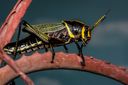
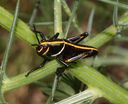
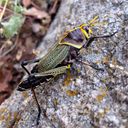
Taeniopoda eques is a large, flightless lubber grasshopper to the Chihuahuan Desert and adjacent arid regions of the southwestern United States and Mexico. are notable for their aposematic black coloration with yellow markings, though color morphs vary geographically. The is chemically defended against vertebrate and uses behavioral to accelerate development in its short growing season. It is , with undergoing through winter before hatching with summer rains.
Pronunciation
How to pronounce Taeniopoda eques: //ˌtiːniːəˈpoʊdə ˈɛkwiːz//
These audio files are automatically generated. While they are not always 100% accurate, they are a good starting point.
Identification
Distinguished from all other grasshoppers in its range by its combination of large size, aposematic black-and-yellow coloration, and red hindwings. Most similar to Romalea microptera (eastern lubber grasshopper), with which it can interbreed in captivity; however, their natural ranges do not overlap. R. microptera occupies eastern Texas and the southeastern United States, while T. eques occurs in western Texas, Arizona, New Mexico, and Mexico. Where ranges approach in southern Texas, R. microptera has an eastern distribution and T. eques a western distribution. Dark and nymphs of R. microptera are frequently confused with T. eques but can be separated by geographic origin. No other western approaches T. eques in size or conspicuous aposematic coloration.
Images
Habitat
Arid and semi-arid brush and grassland, including Chihuahuan Desert scrub. Also occurs in oak savanna and woodland at higher elevations. Found among shrubs including Acacia, Mimosa, Ephedra, and Yucca. Requires summer precipitation for development. Occurs at elevations up to >2,150 m above sea level.
Distribution
to the United States and Mexico. In the United States: southeastern Arizona, southern New Mexico, and southwestern Texas (Big Bend region). In Mexico: from the U.S. border south through the Mexican Plateau, Sierra Madre Oriental, Transvolcanic Belt, and Pacific coastal region to Guerrero. Reports from Central America south of Mexico involve misidentifications of other Taeniopoda .
Seasonality
active from approximately July through November. hatch synchronously with onset of summer rainy season in July. Nymphs develop rapidly, reaching adulthood in about 40 days. Mating begins ~12 days after maturity. Females oviposit from approximately October until killed by winter freeze in November. : one per year.
Diet
herbivore feeding primarily on foliage, flowers, and seed pods of low-growing summer desert annuals. Does not feed on the shrubs it roosts upon (Acacia, Mimosa). Forages only during daylight hours. Consumes free-standing water from raindrops. Opportunistic : scavenges insect and vertebrate carrion, detects odors to locate mammal and insect carcasses. Also consumes spider silk and . Females engage more frequently in necrophagy than males, likely due to greater protein requirements for production. observed on molting or incapacitated conspecifics.
Life Cycle
with . Females deposit egg pods (~50 eggs each) 4–8 cm deep in soil at base of shrubs or large rocks, accompanied by a liquid that dries to form a hard protective case. Eggs laid in October in the United States. Number of egg pods depends on rate of development and time before frost. Eggs overwinter, hatching synchronously with summer rains in July. Nymphs undergo five instars over ~40 days. Newly hatched nymphs are reddish, turning black within two hours. Recently molted individuals are brown, darkening within two hours at warm temperatures. Molting requires temperatures between 25–36°C; below 25°C molting is not initiated, above 36°C individuals may become trapped in . occasionally occurs in unmated females, producing female offspring.
Behavior
forager that roosts conspicuously on shrub tops at night to avoid ground . Descends to desert floor at dawn to feed. Behavioral includes flanking (orienting body perpendicular to sunlight with sun-side hindleg lowered, shade-side hindleg raised, and lowered to reduce wing shading) and seeking shade in bush centers at midday to prevent overheating. Multi-sensory defense system: when attacked, sprays odorous secretion (coffee-vanilla scent) from metathoracic while producing hissing noise, creating noxious deterrent cloud. Displays bright red hindwings, waves orange , and raises spiny hindlegs in threatening posture. Gregarious in first instar: pod mates aggregate, move and feed together for a few days before dispersing. solitary but attracted to largest bush at dusk, creating appearance of clumping. Males stridulate by expanding hindwings against closed forewings, flashing red hindwings. Males promiscuous and sexually aggressive, mounting females, males, and even other and lizard . Females react violently to mounting attempts (jumping, kicking, running, rotating). Post-copulation, females become docile and carry males on their backs. Copulation may last up to 24 hours with continuous transfer. Female releases eliciting male attraction over short distance; is component of defensive secretion. Males detect pheromone via antennae.
Ecological Role
Herbivore consuming desert vegetation; nutrient cycling through consumption of carrion and . Chemically defended aposematic that serves as model for learning. Large size and flightlessness may reduce competition with smaller, more mobile grasshoppers for resources. and molting nymphs vulnerable to predatory ants; largely protected from vertebrate by chemical defenses. for nutrients from carrion into detrital .
Human Relevance
Occasional pest in young citrus orchards and ornamental plantings near natural . Defensive secretions can cause vomiting in but are not dangerous to humans. Large numbers of dead individuals on roads can create hazardous conditions. Subject of scientific study for chemical defense, , and behavioral . Sometimes used in educational dissections.
Similar Taxa
- Romalea micropteraEastern lubber grasshopper; closely related (can interbreed in captivity), similar large size and aposematic coloration, but natural ranges do not overlap. R. microptera occurs in eastern Texas and southeastern U.S.; T. eques in western Texas, Arizona, New Mexico, and Mexico. R. microptera has more variable color patterns including more extensive yellow and orange in eastern .
- Brachystola magnaPlains lubber; also large, flightless, and aposematic, but occurs in Great Plains grasslands rather than Chihuahuan Desert. Wingless in all life stages, more variable in color (green, brown, pinkish, bluish), and has two-year with passing through two winters.
- Dactylotum bicolorRainbow grasshopper; smaller (24–32 mm), aposematically colored with red, white, and blue pattern, also flightless and occurs in Great Plains, but distinguished by much smaller size and striking multicolored pattern rather than black-and-yellow.
Misconceptions
Occasionally reported from Central American countries south of Mexico, but these records involve misidentifications of other Taeniopoda . Some sources list Geotrupes miarophagus as a synonym of G. splendidus, but this subspecific distinction remains debated.
More Details
Chemical defense and pheromone dual function
The defensive secretion of T. eques contains a complex mixture of synthesized phenolics and plant toxins sequestered from diet. This secretion has a strong coffee-vanilla odor. Remarkably, the female's defensive secretion also functions as a , with males detecting it via their . Females become chemically attractive to males approximately 16–18 days after , and feeding upon natural plants is not required for production.
Thermoregulation and trait integration
T. eques exhibits a unique integration of traits: chemical defense from vertebrates permits conspicuousness, which enables solar basking and black coloration for , which accelerates development in a short growing season, which allows large body size for increased and defense against . This trait complex results in a flightless, sluggish, aposematic insect that allocates resources to rather than muscles.
Laboratory culture
Can be maintained in continuous culture with approximately 40% hatch and 65% larval survival, with an eight-month time at 30°C on regular or lettuce-oatmeal diets. Complete mortality occurs on artificial diet lacking plant material.
Sources and further reading
- BugGuide
- Wikipedia
- GBIF taxonomy match
- NCBI Taxonomy
- Field Guide Selected References
- The Eastern Lubber Grasshopper: Hard to Miss, But Only an Occasional Pest
- Bug Eric: Summer 'hoppers Part II
- Papua New Guinea | Blog
- You know what bugs me about dung beetles?… | Beetles In The Bush
- Behold the Hippoboscidae: Bizarre Biting Flies that Give Live Birth!
- LABORATORY BIOLOGY OF TAENIOPODA EQUES (ORTHOPTERA: ACRIDIDAE)
- Biology of Taeniopoda eques (Orthoptera: Acrididae) in Southeastern Arizona
- Observations on the behaviour of the grasshopper Taeniopoda eques (Burmeister), Orthoptera, Acrididae
- Grasshopper sexual pheromone: a component of the defensive secretion in Taeniopoda eques