
Taeniopoda
Stål, 1873
horse lubbers
Species Guides
1- Taeniopoda eques(western horse lubber grasshopper)
Taeniopoda is a of large, flightless grasshoppers commonly known as horse lubbers, native to the southwestern United States, Mexico, and Central America. The genus contains approximately 12 described , characterized by bold aposematic coloration that serves as warning signals to . Taeniopoda is closely related to Romalea, with which it can produce fertile hybrids in captivity; some authorities consider Taeniopoda a junior synonym of Romalea. Species in this genus exhibit striking defensive including hissing, secretion of foul-smelling froth, and vomiting.
Pronunciation
How to pronounce Taeniopoda: /ˌtiːniˈoʊpədə/
These audio files are automatically generated. While they are not always 100% accurate, they are a good starting point.
Identification
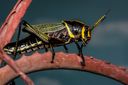
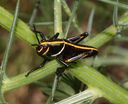
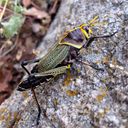
Taeniopoda are distinguished from other grasshoppers by their large size ( approximately 2-3.5 inches in length), flightlessness, and bold aposematic coloration typically involving black with red, yellow, or orange markings. Taeniopoda eques specifically displays black and yellow/orange warning patterns. The is distinguished from the closely related Romalea primarily by geographic distribution and subtle morphological differences; the two genera are so similar that they produce fertile hybrids in captivity. Specific species identification requires examination of genitalic structures and detailed color pattern analysis.
Images
Habitat
Semi-arid grasslands, desert scrub, and areas with summer monsoon rainfall. Taeniopoda eques in southeastern Arizona inhabits the Chiricahua Mountains and surrounding areas. Taeniopoda reticulata in Rica occurs in banana plantations on the Caribbean slope.
Distribution
Southwestern United States (including southeastern Arizona), Mexico, Central America ( Rica, El Salvador, Guatemala, Honduras).
Seasonality
active during summer monsoon season (July-September) in southeastern Arizona. In Rica, Taeniopoda reticulata observed from early June to July, from nymphal stage to fully matured adults.
Diet
Herbivorous; feeds on various plants including forbs and shrubs. Taeniopoda eques shows preference for certain plant in field conditions. Taeniopoda reticulata observed in banana plantations. Specific plant associations vary by species and require further documentation.
Life Cycle
One-year () with . Eggs hatch following summer rains. Nymphal development progresses through summer. present July-September in Arizona . Laboratory rearing at 30°C required approximately 35.5 days for larval development, followed by 9.8-11.9 days to mating, with oviposition occurring approximately day 25 of adult life. occasionally occurs in unmated females, producing female offspring.
Behavior
activity. Gregarious tendencies with locally high densities. Defensive include hissing by expelling air from , secreting foul-smelling froth, vomiting, and spreading wings to display bright coloration. Aposematic coloration serves as warning to . Mature females emit defensive secretion that functions as , eliciting mating behavior in males; females become chemically attractive 16-18 days after . Males detect via .
Ecological Role
Herbivore contributing to nutrient cycling through herbivory and decomposition. Prey for insectivorous vertebrates, though protected by chemical from plants that renders individuals distasteful and unpalatable. Serves as host for eugregarine (first record for Romaleidae: Amoebogregarina taeniopoda and Quadruspinospora mexicana in Taeniopoda centurio).
Human Relevance
Occasional pest of young citrus orchards and landscape plants. Large size renders most chemical ineffective; management relies on mowing bordering vegetation, selecting unpalatable ornamental plants, hand-picking, and insecticide baits. Harmless to humans despite frightening defensive displays. Used in laboratory research for studies of chemical , , and reproductive .
Similar Taxa
Misconceptions
Despite large size and ostentatious defensive (hissing, foaming, vomiting), Taeniopoda are harmless to humans. The defenses target insectivorous vertebrates, not people. Only rarely a significant agricultural pest.
More Details
Taxonomic Status
Catalogue of Life lists Taeniopoda as a synonym of Romalea, while GBIF and NCBI maintain it as an accepted . The close relationship and hybridization potential between the two genera complicates taxonomic classification.
Chemical Ecology
Taeniopoda eques sequesters and synthesizes chemicals from plants into toxic secretions. The defensive secretion doubles as a sexual in mature females, representing a dual-function chemical signal.
Laboratory Culture
Taeniopoda eques can be maintained in continuous laboratory culture with approximately 40% hatch and 65% larval survival, with an eight-month time. Successful rearing requires natural plant material or lettuce-oatmeal diet; complete mortality occurs on fully artificial diets.
Sources and further reading
- BugGuide
- Wikipedia
- GBIF taxonomy match
- NCBI Taxonomy
- Catalogue of Life
- Field Guide Selected References
- The Eastern Lubber Grasshopper: Hard to Miss, But Only an Occasional Pest
- LABORATORY BIOLOGY OF TAENIOPODA EQUES (ORTHOPTERA: ACRIDIDAE)
- Biology of Taeniopoda eques (Orthoptera: Acrididae) in Southeastern Arizona
- Observations on the behaviour of the grasshopper Taeniopoda eques (Burmeister), Orthoptera, Acrididae
- Grasshopper sexual pheromone: a component of the defensive secretion in Taeniopoda eques
- Morphology and Phylogenetic Position of Two New Gregarine Species (Apicomplexa: Eugregarinorida) Parasitizing the Lubber Grasshopper Taeniopoda centurio (Drury, 1770) (Insecta: Orthoptera: Romaleidae) in Mexico