
Romalea microptera
(Palisot de Beauvois, 1817)
Eastern Lubber Grasshopper, Lubber Grasshopper
is a large, flightless native to the southeastern United States, reaching up to 3.5 inches in length. Its aposematic coloration—yellow with black markings in eastern , black with red or yellow markings in western populations—serves as a warning to . Despite its formidable defensive arsenal including spines, body armor, chemical secretions, and threat displays, it is harmless to humans and rarely causes significant agricultural damage.
Pronunciation
How to pronounce Romalea microptera: //ˌroʊˈmɑːliə ˌmaɪˈkrɒptərə//
These audio files are automatically generated. While they are not always 100% accurate, they are a good starting point.
Identification
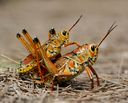
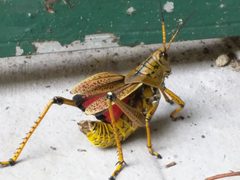
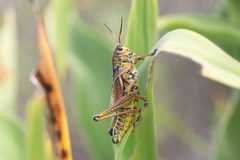
The is the largest in North America, with females reaching up to 3.5 inches. are flightless, possessing only small, non-functional wings (the epithet 'microptera' means 'small wing'). Coloration varies geographically: eastern are predominantly yellow with black markings, while western populations are mostly black with red or yellow markings. The hind wings, though non-functional for , display brilliant scarlet coloration visible when wings are spread. Legs bear rows of strong spines capable of piercing skin. Nymphs are gregarious and display bright orange stripes on a black background.
Images
Habitat
Found in swamps, woodlands, fields, and ditches throughout the southeastern United States. In Florida, occurs in cypress glades and Everglades .
Distribution
Southeastern and south-central United States, including Florida, Georgia, South Carolina, and Missouri.
Seasonality
deposited in soil overwinter and hatch in spring. active during warmer months; accelerated in response to shortening in northern .
Diet
Feeds on a wide range of plants. Documented feeding on hairy beggar ticks (Bidens pilosa) and other vegetation. Young citrus orchards can be vulnerable to damage.
Life Cycle
Females oviposit pods in soil at depths varying by —western populations oviposit shallowest, eastern populations deepest. Development includes five instars before reaching adulthood. Exhibits -dependent : higher densities produce larger but lower .
Behavior
Gregarious, especially in nymphal stages. When threatened, performs elaborate defensive displays: spreads wings to expose scarlet hind wings, hisses by expelling air from , secretes foul-smelling frothy foam from spiracles, and regurgitates noxious gut contents ('tobacco juice'). These defenses target insectivorous vertebrates. Flightless; moves exclusively by . Boldly forages and mates in open, showing little fear of or humans.
Ecological Role
Serves as prey for various despite chemical defenses. Documented for sarcophagid fly larvae and eugregarine (Boliviana floridensis). Contributes to nutrient cycling through herbivory in wetland and woodland .
Human Relevance
Occasional pest of young citrus orchards and landscape plants; management typically involves physical removal or modification rather than , as standard chemical treatments are ineffective due to the 's large size. Frequently encountered by the public, generating calls to extension services due to its alarming appearance. Commonly used in educational settings as a dissection specimen.
Similar Taxa
- Taeniopoda equesBlack and red horse lubber occurring in Arizona and Central America; similar aposematic coloration and defensive ; may represent western continuation of a historical interrupted by geographic barriers.
Sources and further reading
- BugGuide
- GBIF taxonomy match
- iNaturalist taxon
- NCBI Taxonomy
- Catalogue of Life
- The Eastern Lubber Grasshopper: Hard to Miss, But Only an Occasional Pest
- eastern lubber grasshopper - Entomology Today
- Archive — Bug of the Week
- Destination Big Cypress National Preserve and Corkscrew Swamp Sanctuary, Florida to meet the mighty eastern lubber grasshopper, Romalea microptera — Bug of the Week
- Destination Corkscrew Swamp Sanctuary, Florida: Mighty defenses of the eastern lubber grasshopper, 'Romalea microptera' — Bug of the Week
- Romalea microptera Archives - Entomology Today
- Host Plant Selection byRomalea microptera(Orthoptera: Romaleidae)
- ARE REPRODUCTIVE TACTICS DETERMINED BY LOCAL ECOLOGY IN ROMALEA MICROPTERA (ORTHOPTERA: ACRIDIDAE)?
- Notes on Sarcophagids from the New Host Romalea microptera, and from Terrapene carolina carolina
- Storage and release of neuropeptides from the corpus cardiacum of the Eastern lubber grasshopper, Romalea microptera
- Description and Laboratory Biology of Boliviana floridensis n. sp. (Apicomplexa: Eugregarinida) Parasitizing the Eastern Lubber Grasshopper, Romalea microptera (Orthoptera: Romalidae), from Florida, U.S.A
- Geographic Variation in Size and Oviposition Depths ofRomalea microptera(Orthoptera: Acrididae) is Associated with Different Soil Conditions
- Developmental response to a seasonal time constraint: the effects of photoperiod on reproduction in the grasshopper Romalea microptera
- Density‐dependent polyphenism and geographic variation in size among two populations of lubber grasshoppers ( Romalea microptera )