
Coenagrion
Kirby, 1890
Eurasian Bluets, Northern Bluets
Species Guides
3- Coenagrion angulatum(Prairie Bluet)
- Coenagrion interrogatum(Subarctic Bluet)
- Coenagrion resolutum(taiga bluet)
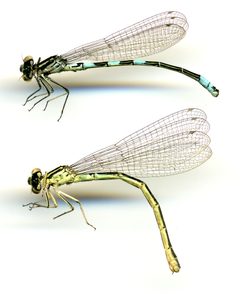
Coenagrion is a of in the Coenagrionidae, commonly called Eurasian Bluets or Northern Bluets. are generally medium-sized with bright coloration. While predominantly Eurasian in distribution, three species occur in North America: C. angulatum, C. interrogatum, and C. resolutum. The genus exhibits phenotypic plasticity in thermal , with high-latitude showing significant thermal adaptation capacity.
Pronunciation
How to pronounce Coenagrion: //sɪˈnæɡriən//
These audio files are automatically generated. While they are not always 100% accurate, they are a good starting point.
Identification
Males can be identified using characters of the genital ligula and caudal appendages; specific identification often requires examination of these structures under magnification. within Coenagrion and related such as Enallagma can be difficult to distinguish without close examination.
Images
Habitat
Associated with freshwater including ponds, lakes, rivers, marshes, and bogs. Some show specific habitat associations: C. mercuriale is dependent on watercourse topography, and C. ornatum is highly local with declining northwestern European .
Distribution
Primarily Eurasian; extends from northwestern Europe to southwestern Asia. Three North American : C. angulatum, C. interrogatum, and C. resolutum. Chinese fauna includes multiple species with ongoing taxonomic revision. C. ornatum is nearly extinct in Italy with only recent record from Apulia in 2005.
Life Cycle
Aquatic nymph stage in freshwater ; to terrestrial stage. Thermal environment affects development rate: warmer temperatures accelerate ontogenetic development while potentially reducing survival at extreme temperatures.
Behavior
are predatory, capturing flying insects on the wing. occurs between watercourse ; some demonstrate recolonization capacity following restoration.
Human Relevance
C. mercuriale is protected under the European Union Directive. C. ornatum is listed as Near Threatened in Europe due to habitat loss. Thermal studies in the provide indicators for climate change effects on aquatic . Highway construction and urbanization have been studied for impacts on genetic structure and .
Similar Taxa
- EnallagmaBoth contain bluet with similar blue and black coloration; Enallagma are predominantly North American and can be difficult to distinguish from Coenagrion without examination of genital structures
- ParacercionFormerly included now transferred to Paracercion; historically confused with Coenagrion requiring taxonomic revision to separate
- IschnuraForktail in the same Coenagrionidae with similar size and preferences; distinguished by abdominal appendage shape and thoracic pattern
More Details
Thermal Adaptation
High-latitude show high degrees of thermal with phenotypic plasticity in response to surface air temperature. This plasticity has been observed across sympatric at the same locations despite variable weather conditions. These thermal responses are significant for predicting species' range shifts under climate change.
Population Genetics
Studies of C. mercuriale demonstrate that urban agglomeration negatively affects genetic diversity and between . Highway A355 near Strasbourg did not appear to act as a major barrier. Populations in central distribution areas (Alsace) maintain higher genetic diversity and lower differentiation than range-edge populations (Hauts-de-France).
Sources and further reading
- BugGuide
- Wikipedia
- GBIF taxonomy match
- iNaturalist taxon
- NCBI Taxonomy
- Catalogue of Life
- The Day That Bugs Ruled | Bug Squad
- A Damsel, But Not in Distress | Bug Squad
- Quick! Find the Damselfly! | Bug Squad
- Blue as Blue Can Be | Bug Squad
- Bug Eric: Another Odonata Record
- Rising Temperatures Could Stunt Growth, Threaten Survival of Common Damselfly
- Structure génétique spatiale, flux de gènes et tailles efficaces des populations chez l'Agrion de Mercure (Coenagrion mercuriale, Zygoptera)
- Chinese damselflies of the genus Coenagrion (Zygoptera: Coenagrionidae)
- Review for "Contrasting patterns of spatial genetic structure in endangered southern damselfly (<i>Coenagrion mercuriale</i>) populations facing habitat fragmentation and urbanisation"
- Review for "Contrasting patterns of spatial genetic structure in endangered southern damselfly (<i>Coenagrion mercuriale</i>) populations facing habitat fragmentation and urbanisation"
- New records of Coenagrion ornatum in Italy (Odonata: Coenagrionidae)
- Review for "Contrasting patterns of spatial genetic structure in endangered southern damselfly (<i>Coenagrion mercuriale</i>) populations facing habitat fragmentation and urbanisation"