
Enallagma
Charpentier, 1840
bluets
Species Guides
37- Enallagma anna(River Bluet)
- Enallagma annexum(Northern Bluet)
- Enallagma antennatum(Rainbow Bluet)
- Enallagma aspersum(Azure Bluet)
- Enallagma basidens(Double-striped Bluet)
- Enallagma boreale(Boreal Bluet)
- Enallagma cardenium(purple bluet)
- Enallagma carunculatum(Tule Bluet)
- Enallagma civile(Familiar Bluet)
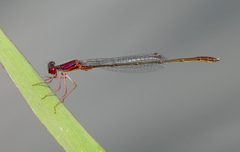
Enallagma is a of in the Coenagrionidae, commonly known as bluets. range from 28 to 40 mm in length. Males typically display bright blue and black coloration, while female coloration varies by . The genus underwent taxonomic revision by Rosser Garrison in 1984. Several species have been studied for their responses to climate change and range expansion dynamics.

Pronunciation
How to pronounce Enallagma: /ɛnˈæləɡmə/
These audio files are automatically generated. While they are not always 100% accurate, they are a good starting point.
Identification
Distinguished from other by combination of small to medium size (28–40 mm), narrow wings, and male blue-and-black color pattern. Females require -level identification due to variable coloration. Separation from similar genera such as Coenagrion and Ischnura relies on detailed examination of abdominal appendages and thoracic patterning.
Images
Habitat
Standing water including ponds, lakes, cattle dugouts, irrigation canals, waterfowl projects, and playas. Larvae are aquatic and typically found submerged, often at distance from shore. found in vegetation near water bodies.
Distribution
Widespread across North America with ranging from Maine to California and northward into Canada. Some species such as E. clausum are expanding westward into Alberta. The occurs in the Great Plains, eastern North America, and western regions.
Diet
Predatory; capture small insect prey on the wing. Larvae are aquatic .
Host Associations
- Arrenurus - Water mites that parasitize
- Gregarine parasites - Protozoan infecting gut
Life Cycle
do not and hatch after approximately two weeks. Larvae are aquatic with multiple stadia. Development time from egg to varies with temperature; at 26°C occurs around 33 days after hatching, while at 32°C emergence occurs around 26 days. Warmer temperatures accelerate ontogenetic development but increase mortality.
Behavior
hunt by sight and seize prey on the wing. Mating pairs fly in tandem; males release females when females submerge to oviposit on aquatic vegetation. Females may submerge completely to deposit .
Ecological Role
in aquatic and terrestrial as both larvae and . Serve as for water mites and gregarine . Range expansion of some may alter parasite dynamics for sympatric through apparent competition.
Human Relevance
Studied as for climate change effects, particularly regarding temperature impacts on development and survival. E. civile has been proposed as an umbrella for monitoring wetland health in the Great Plains.
Similar Taxa
- CoenagrionSimilar small with blue coloration; distinguished by abdominal appendage structure
- IschnuraSimilar size and ; Ischnura often show different thoracic stripe patterns and abdominal tip coloration
More Details
Climate Sensitivity
Research on E. civile demonstrates that water temperature significantly affects survival and development. drops to 25% at 41°C compared to 60–65% at lower temperatures. Nymphs show 100% mortality by day 4 at 41°C. These findings suggest vulnerability to rapid climate warming in prairie wetland .
Evolutionary History
North American Enallagma radiated during the Pleistocene. Species differentiation is primarily driven by reproductive structures rather than ecological divergence, as seen in the closely related but morphologically distinct E. hageni and E. ebrium, which maintain mosaic distributions with limited sympatry.
Sources and further reading
- BugGuide
- Wikipedia
- iNaturalist taxon
- NCBI Taxonomy
- Catalogue of Life
- Dragonfly Enthusiasts, Unite! Open House Set Nov. 6 at Bohart Museum | Bug Squad
- Know Your Dragonflies! | Bug Squad
- Dragonflies! Who Isn't Fascinated by Dragonflies? | Bug Squad
- Bohart Museum Open House: Dragonflies Rule! | Bug Squad
- Hooray for the red, white, and blue! Milkweed longhorned beetle, Tetraopes tetraophthalmus; dogbane tiger moth, Cycnia tenera; and familiar bluet, Enallagma civile — Bug of the Week
- Rising Temperatures Could Stunt Growth, Threaten Survival of Common Damselfly
- Regional divergence and mosaic spatial distribution of two closely related damselfly species (Enallagma hageniandEnallagma ebrium)
- Table 3: Results of two-way ANOVA testing for differences between host species and site (Old vs. New) for (A) gregarine prevalence and (B) gregarine intensity infections in Enallagma clausum , a native species whose range is expanding in western Canada, and Enallagma boreale , a closely related long-established species.
- Table 2: Results of two-way ANOVA testing for differences between host species and site (Old vs. New) for (A) Arrenurus prevalence and (B) Arrenurus intensity infections in Enallagma clausum , a native species whose range is expanding in western Canada, and Enallagma boreale , a closely related long-established species.