
Coenagrionidae
Kirby, 1890
Narrow-winged Damselflies, Pond Damselflies
Genus Guides
13- Amphiagrion(Red Damsels)
- Apanisagrion
- Argia(Dancers)
- Chromagrion(aurora damsels)
- Coenagrion(Eurasian Bluets)
- Enallagma(bluets)
- Hesperagrion(painted damsels)
- Ischnura(forktails)
- Leptobasis(swampdamsels)
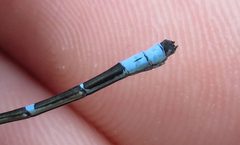
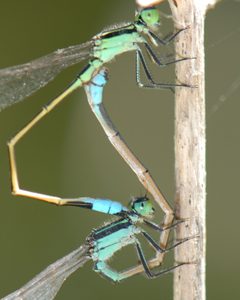
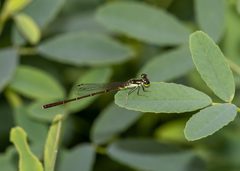
is the largest of , comprising over 1,300 across more than 110 . Members are commonly known as narrow-winged or pond damselflies. They are distinguished from other damselfly families by wing venation characters, including two antenodal cross and the position of vein M3 relative to the nodus and . The family has a worldwide distribution and is divided into six : Agriocnemidinae, Argiinae, Coenagrioninae, Ischnurinae, Leptobasinae, and Pseudagrioninae.
Pronunciation
How to pronounce Coenagrionidae: //siˌnæɡriˈɒnɪdiː//
These audio files are automatically generated. While they are not always 100% accurate, they are a good starting point.
Identification
Key -level characters include: two antenodal cross in the wing; vein M3 arising closer to the nodus than to the ; narrow, stalked wings that are typically clear and colorless. These venation characters distinguish from other families. Within the family, identification to and requires examination of abdominal appendages, genital ligula structure, and color pattern details.
Images
Habitat
are found around various freshwater including ponds, wetlands, lakes, rivers, marshes, and bogs. Nymphs develop in aquatic environments, typically in debris or among submerged living or dead plant material. Some inhabit springs, both hot and cold, and slow-moving stream stretches.
Distribution
Worldwide distribution; present on all continents except Antarctica. Particularly diverse and abundant in temperate and tropical regions.
Seasonality
activity varies by and latitude. In temperate regions, most species are active from spring through fall (approximately April to October). Some species in southern portions of their range may be active year-round.
Diet
Life Cycle
Hemimetabolous development with , nymph, and stages. Females lay eggs among submerged living or dead vegetation; some crawl underwater to deposit eggs. Nymphs develop in aquatic , typically among debris or submerged plant material. Adults of some species are relatively long-lived, persisting up to six weeks or more.
Behavior
are aerial that capture flying insects. Perching varies: some (such as Argia, the "dancers") perch flat on ground, logs, and rocks with wings slightly raised, and exhibit a distinctive jerky pattern; others (such as bluets and forktails) fly more directly and forage among vegetation. Some are known for strong territorial behavior.
Ecological Role
Human Relevance
Used as indicators of freshwater health due to specific requirements and sensitivity to water quality. Some are subjects of citizen science and odonatological study. Nymphs help control mosquito . are observed and photographed by nature enthusiasts; some species have extended their ranges northward, potentially in response to climate change.
Similar Taxa
- Lestidae (spreadwings)Lestidae hold their wings spread at rest rather than folded together above the body; have different wing venation with more antenodal cross
- Platycnemididae (white-legged damselflies)Platycnemididae typically have pale, white or cream-colored legs and different wing venation patterns
- Calopterygidae (broad-winged damselflies)Calopterygidae have broader, often colored or metallic wings, and more robust bodies
More Details
Etymology
The name may be derived from Greek 'coen' meaning shared or common, and 'agrio' meaning fields or wild.
Taxonomic diversity
With over 1,300 and more than 110 accepted , represents the most species-rich of . The six reflect substantial morphological and ecological diversification.
Research significance
are frequently used in environmental modeling studies due to their abundance, ease of recognition, and extensive occurrence data records spanning more than a century.
Sources and further reading
- BugGuide
- Wikipedia
- GBIF taxonomy match
- iNaturalist taxon
- NCBI Taxonomy
- Catalogue of Life
- A Damsel, But Not in Distress | Bug Squad
- The Day That Bugs Ruled | Bug Squad
- Quick! Find the Damselfly! | Bug Squad
- Blue as Blue Can Be | Bug Squad
- Coenagrionidae Archives - Entomology Today
- Bug Eric: Another Odonata Record
- Nikoulabasis roseosticta, sp. nov. from Fiji (Odonata: Coenagrionidae)
- Nikoulabasis dalingarum, sp. nov. from Fiji (Odonata: Coenagrionidae)
- Chinese damselflies of the genus Coenagrion (Zygoptera: Coenagrionidae)
- A synopsis of the Neotropical genus Protoneura (Odonata: Coenagrionidae)
- Temporal differentiation in environmental niche modeling of Nearctic narrow-winged damselflies (Odonata: Coenagrionidae)
- Acanthagrion hildegarda Gloger, 1967 (Odonata: Zygoptera: Coenagrionidae): new records and geographic distribution map