
Ischnura
Charpentier, 1840
forktails, bluetails
Species Guides
14- Ischnura barberi(Desert Forktail)
- Ischnura cervula(Pacific Forktail)
- Ischnura damula(Plains Forktail)
- Ischnura demorsa(Mexican Forktail)
- Ischnura denticollis(Black-fronted Forktail)
- Ischnura erratica(Swift Forktail)
- Ischnura gemina(San Francisco Forktail)
- Ischnura hastata(Citrine Forktail)
- Ischnura kellicotti(Lilypad Forktail)
Ischnura is a of small to very small in the Coenagrionidae, commonly known as forktails or bluetails. The genus has a worldwide distribution, including oceanic islands. Males are distinguished by a forked projection and blue segments at the tip of the . Females of some exhibit color , with some individuals being orangish and darkening with age while others resemble males.
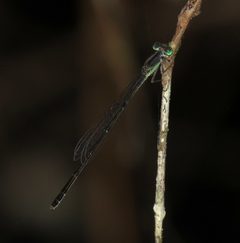
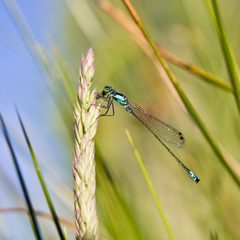
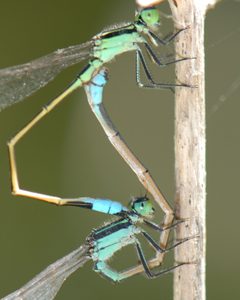
Pronunciation
How to pronounce Ischnura: /ˈɪs.k.nʊr.ə/
These audio files are automatically generated. While they are not always 100% accurate, they are a good starting point.
Identification
Males are readily identified by the combination of a forked projection at the abdominal tip and blue terminal segments. The dark upper and contrasting lower regions of the are distinctive. Females can be challenging to identify to , as they often resemble other forktail species; some lack the pale thoracic markings seen in related . The small body size (some species 22-26 mm) and association with vegetated freshwater help distinguish the genus from larger pond damselflies.
Images
Appearance
Small to very small . Mature individuals have with a dark upper region and contrasting lower part. The is often green and may display lateral stripes. Males have a black with a blue tip and a forked projection at the abdominal terminus. Females show variable coloration: some are orangish and darken with age, while others are male-like in appearance.
Habitat
Freshwater environments including springs (hot and cold), ponds with emergent vegetation, slow-moving stream reaches, and river backwaters. Vegetation is a consistent component of occupied , used for perching and .
Distribution
Worldwide distribution including North America, South America, Europe, Asia, Africa, and various oceanic islands. In North America, range from southern Canada through the United States into Mexico, with western species such as Ischnura denticollis occurring from Oregon and Idaho through California, Nevada, Utah, Arizona, New Mexico, and eastward to Texas, Oklahoma, and Kansas.
Seasonality
are on the wing across an extended season. In southern portions of the range, adults may be active nearly year-round. In more temperate areas, period is approximately April through October. Some individuals are unusually long-lived as adults, persisting up to six weeks with documented records of 42 days.
Behavior
Perches on vegetation, rocks, logs, and other substrates near water. Males use the forked abdominal projection in reproductive contexts. are capable of extended longevity compared to many odonates.
Ecological Role
of small insects as both aquatic nymphs and aerial . Nymphs contribute to aquatic ; adults capture flying insects.
Human Relevance
Subject of odonatological surveys and citizen science initiatives such as " blitzes." County and state records are actively documented by naturalists. Some serve as indicators of freshwater quality.
Similar Taxa
- ArgiaBoth are small in Coenagrionidae, but Argia (dancers) exhibit a distinctive jerky, bouncing pattern and typically perch flat on surfaces with wings slightly raised, whereas Ischnura has more direct flight and different perching posture. Argia males lack the forked abdominal projection.
- EnallagmaBluets in this resemble Ischnura in size and coloration but lack the forked abdominal tip characteristic of male forktails; they also typically show different thoracic patterning.
More Details
Female color polymorphism
Some Ischnura exhibit female-limited color with distinct morphs, a phenomenon that has received attention in behavioral and evolutionary studies.
Longevity
lifespan in Ischnura denticollis has been documented at up to 42 days, which is notably extended for a small and may relate to the ability to persist in variable aquatic .