
Coenagrion resolutum
(Selys, 1876)
taiga bluet
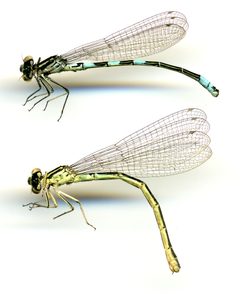
Coenagrion resolutum, commonly known as the taiga bluet, is a in the Coenagrionidae. Males exhibit blue coloration with black markings on abdominal segments 3–5, while females appear greenish-blue to yellowish-green with nearly contiguous black dorsal markings. The has been studied for its larval growth , showing slower development compared to sympatric species like Lestes disjunctus.
Pronunciation
How to pronounce Coenagrion resolutum: /sɪˈnæɡriːˌɒn rɪˈzɔljətəm/
These audio files are automatically generated. While they are not always 100% accurate, they are a good starting point.
Identification
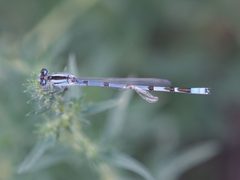
Males are distinguished by blue coloration with black markings covering approximately half the length of abdominal segments 3–5, combined with greenish lateral coloration. Females are greenish-blue or yellowish-green with black abdominal markings that are nearly contiguous. Wingspan ranges 27–33 mm; wings held behind body at rest.
Images
Habitat
forest aquatic in Alberta, Canada; specific microhabitat details not documented in available sources.
Distribution
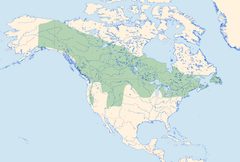
North America; specifically documented from Alberta, Canada, and Vermont, United States. iNaturalist records suggest broader presence across eastern North America.
Diet
Predatory; nymphs feed in defined feeding areas with aggressive interactions observed around food resources. Specific prey not documented in available sources.
Life Cycle
Larval development requires 10–22 months in natural , substantially longer than sympatric Lestes disjunctus. Growth rates positively related to temperature up to 22.4°C, above which growth rate decreases.
Behavior
Nymphs exhibit aggressive behavioral interactions to exclude conspecifics from feeding areas; dominance status positively associated with feeding area use. Exclusion patterns result from combination of and limited movement rather than strict territoriality. classified as , feeding/aggression, retreat, and defense.
Similar Taxa
- Lestes disjunctusSympatric with which C. resolutum is frequently compared in ecological studies; distinguished by faster larval growth rates (70 days vs. 10–22 months), higher optimal growth temperature (28.8°C vs. 22.4°C), and different hunting strategies including active search .
- Coenagrionidae (family members)Other narrow-winged damselflies share general body plan and wing posture; C. resolutum distinguished by specific abdominal marking patterns and coloration described for both sexes.
Sources and further reading
- BugGuide
- Wikipedia
- GBIF taxonomy match
- iNaturalist taxon
- NCBI Taxonomy
- Catalogue of Life
- The Day That Bugs Ruled | Bug Squad
- A Damsel, But Not in Distress | Bug Squad
- Quick! Find the Damselfly! | Bug Squad
- Blue as Blue Can Be | Bug Squad
- Bug Eric: Another Odonata Record
- Rising Temperatures Could Stunt Growth, Threaten Survival of Common Damselfly
- Behavioural interactions and use of feeding areas by nymphs of Coenagrion resolutum (Coenagrionidae: Odonata)
- Life cycles and food ofcoenagrion resolutum(coenagrionidae: odonata) andlestes disjunctus disjunctus(lestidae: Odonata) populations from the boreal forest of Alberta, Canada
- The influence of larval size, temperature, and components of the functional response to prey density on growth rates of the dragonflies Lestes disjunctus and Coenagrion resolutum (Insecta: Odonata)