
Somatochlora brevicincta
Robert, 1954
Quebec Emerald, Robert's Emerald
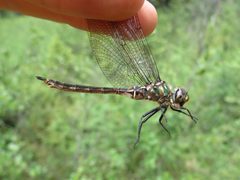
Somatochlora brevicincta is a rare in the Corduliidae, first described by Canadian entomologist Adrien Robert in 1954. It belongs to the 'ringed' group of emeralds, distinguished by faint whitish rings on the . The is among the rarest Odonata in Canada, with a transcontinental distribution across and subarctic regions. It is classified as vulnerable to critically imperiled across most of its range.

Pronunciation
How to pronounce Somatochlora brevicincta: /ˌsɒmətəˈklɔːrə ˌbrɛvɪˈsɪŋktə/
These audio files are automatically generated. While they are not always 100% accurate, they are a good starting point.
Identification
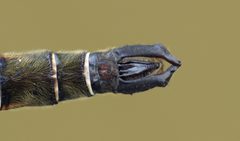
males resemble Somatochlora albicincta but have curved rather than bent hamule. Adult females have subgenital plate equal in length to ninth abdominal segment and not notched (vs. notched in S. albicincta). Distinguished from Delicate, Muskeg, and Whitehouse's Emeralds by absence of brown coloration at wing base. Among Hudsonian and Ringed Emeralds, has less distinct abdominal rings. Larvae identified by triangular , seven-segmented , and triangular epipropt slightly larger than .
Images
Habitat
of weakly minerotrophic wetlands. Prefers lentic bodies of water within and bordering bogs, specifically fens and heaths with water-suspended or water-saturated Sphagnum moss and graminaceous emergents. Avoids open, firm-edged secondary ponds of bogs. Breeds in small water-filled hollows (flarks) with sedges, rushes, and mosses. Larvae inhabit shallower water with leaf litter.
Distribution
Transcontinental across North America. Found in Quebec (type locality: Lake Mistassini region), Ontario, New Brunswick, Newfoundland, British Columbia (as far northwest as Willison Lake), and Maine (Piscataquis County). Recently discovered in Minnesota. Rarely found below 45°N latitude. Scattered breeding in United States with few confirmed sites.
Diet
Predatory in all life stages. Nymphs prey on other insect larvae, tadpoles, and small fish. are indiscriminate feeders of flying insects including mosquitoes, , and smaller .
Life Cycle
with , nymph, and stages. Eggs laid epiphytically on vegetation (e.g., moss) at or above water surface. Females oviposit unaccompanied, skimming water surface and rapidly tapping with tip. Nymph stage duration unknown; nymphs undergo series of moults as they grow. Specific larval development period and adult lifespan not documented.
Behavior
Females oviposit solitarily without male accompaniment. As typical for Somatochlora, mating likely occurs in tree tops for prolonged periods, though this has not been directly observed for this .
Ecological Role
Apex in bog pool microhabitats as both nymph and . Functions as for intact, weakly minerotrophic peatland .
Human Relevance
Conservation concern due to specificity and rarity. Subject to status assessments by NatureServe and Canadian at Risk. Vulnerable to peat mining and hydrological alteration of patterned peatlands. Designated species of special concern in Maine (2022).
Similar Taxa
- Somatochlora albicincta males similar but S. brevicincta has curved rather than bent hamule; females differ in subgenital plate shape (notched vs. not notched)
- Somatochlora franklini (Delicate Emerald)S. brevicincta lacks brown coloration at wing base present in Delicate Emerald
- Somatochlora septentrionalis (Muskeg Emerald)S. brevicincta lacks brown coloration at wing base present in Muskeg Emerald
- Somatochlora whitehousei (Whitehouse's Emerald)S. brevicincta lacks brown coloration at wing base present in Whitehouse's Emerald
- Somatochlora hudsonica (Hudsonian Emerald)S. brevicincta has less distinct abdominal rings
- Somatochlora incurvata (Incurvate Emerald)S. brevicincta has less distinct abdominal rings
More Details
Conservation Status
NatureServe rankings: Vulnerable (S3) in British Columbia and Minnesota; Imperiled (S2) in Ontario, Maine, New Brunswick, and Newfoundland; Apparently Secured (S4) in Quebec; Critically Imperiled (S1) in Nova Scotia. Minnesota entirely dependent on rare patterned peatlands, threatened by renewed peat mining interest.
Taxonomic History
One of the most recently described North American Odonata (1954). Described by Adrien Robert, Canadian entomologist and professor at University of Montreal. status 'potentially valid' with record credibility rating met.
Genetic Data
Data deficient . NCBI GenBank contains two COI gene sequences. Barcode Index Number (BIN) 250259 in BOLD Systems. No complete available.
Population Structure Hypothesis
Given broad distribution with little evidence of intermediaries between western and eastern , S. brevicincta could potentially encompass more than one , though no arguments have been advanced for this hypothesis.