
Somatochlora incurvata
Walker, 1918
Incurvate Emerald
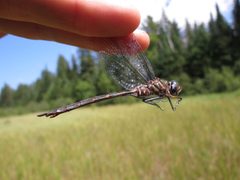
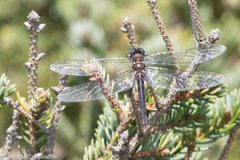
Somatochlora incurvata, the Incurvate Emerald, is a medium-sized in the Corduliidae. First described by Canadian entomologist Edmund Murton Walker in 1918 from Michigan specimens, it was initially suspected to be a local race of the closely related forcipate emerald. The occupies a restricted range in northeastern North America and is specialized to bog and fen , where larvae develop within saturated Sphagnum moss.
Pronunciation
How to pronounce Somatochlora incurvata: /sɒməˈtɒklɔːrə ɪnˈkɜːrvətə/
These audio files are automatically generated. While they are not always 100% accurate, they are a good starting point.
Identification
Distinguished from similar Somatochlora by combination of: larger body size relative to many ; metallic brown to black coloration with yellowish brown lateral spotting pattern; and green . Historical confusion with forcipate emerald (Somatochlora forcipata) noted at time of original description. Precise diagnostic characters separating it from other emerald dragonflies in the require examination of appendages and wing venation.
Images
Habitat
of bogs and fens. Larvae inhabit saturated Sphagnum moss. Breeding occurs in small pools within these wetlands, including temporary depressions such as footprints. forage across diverse beyond breeding sites.
Distribution
Restricted range in northeastern North America: Nova Scotia south to New York and west to Wisconsin.
Seasonality
active diurnally from June through October. overwinters as larvae.
Diet
Both larvae and are predatory, feeding on smaller insects and other .
Life Cycle
Hemimetabolous development with . laid in small pools within breeding . Larval development occurs within saturated Sphagnum moss. Larval stage overwinters. and activity June–October.
Behavior
patrol territories and forage for prey. Females oviposit in small pools including temporary depressions. Adults disperse from breeding sites to forage in varied .
Ecological Role
at both larval and stages, contributing to in bog and fen . Specialized association with Sphagnum moss suggests role as indicator of intact peatland ecosystems.
Human Relevance
Conservation concern due to specificity. Formerly considered rare; subsequent surveys indicate reasonable abundance within range. Threats include peat harvesting, cranberry farming, water pollution, and hydrological alteration. Globally ranked secure (G5) but rare in many jurisdictions within its range.
Similar Taxa
- Somatochlora forcipataForcipate emerald; originally considered potentially by Walker at time of S. incurvata description based on morphological similarity.
More Details
Taxonomic History
Walker initially described this in 1918 from Whitefish Point, Michigan specimens, with explicit uncertainty about whether it represented merely a 'local race' of Somatochlora forcipata rather than a distinct species.