
Somatochlora
Selys, 1871
Striped Emeralds, Striped Emerald Dragonflies
Species Guides
25- Somatochlora albicincta(Ringed Emerald)
- Somatochlora brevicincta(Quebec Emerald)
- Somatochlora calverti(Calvert's Emerald)
- Somatochlora cingulata(Lake Emerald)
- Somatochlora elongata(Ski-tipped Emerald)
- Somatochlora ensigera(Plains Emerald)
- Somatochlora filosa(Fine-lined Emerald)
- Somatochlora forcipata(Forcipate Emerald)
- Somatochlora franklini(Delicate Emerald)
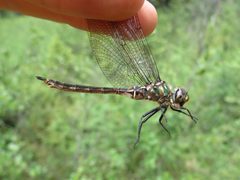
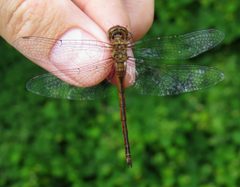
Somatochlora is a of 42 described of medium-sized in the Corduliidae, distributed across the Northern Hemisphere in Europe, Asia, and North America. Members are characterized by dark bodies with metallic green lustre, brilliant green , and often yellow thoracic or abdominal markings. Species-level identification is challenging and requires examination of male or female subgenital plates. Many species are with restricted distributions, particularly associated with and montane wetland systems.

Pronunciation
How to pronounce Somatochlora: /səˈmætəˌklɔrə/
These audio files are automatically generated. While they are not always 100% accurate, they are a good starting point.
Identification
Identification to requires examination of male or female subgenital plates, which are distinctively shaped in each species. The combination of metallic green body, brilliant green , and yellow thoracic/abdominal markings separates Somatochlora from many other Corduliidae. The distinctive male abdominal shape (bulbous segments 1-2, constricted segment 3, club-shaped remainder) is diagnostic for the except in S. borisi. Some species require expert examination and are difficult to distinguish in the field.
Images
Appearance
Medium-sized with dark bodies and metallic green lustre. are brilliant green. Many have dull to bright yellow markings on the and/or . Male abdomens distinctive: first two segments bulbous-shaped, third constricted, remainder club-shaped with straight ending. Female abdomens have straighter sides. Exception is S. borisi, which has Cordulia-like abdominal shape. Wings typically have two crossveins between hind wing base and triangle.
Habitat
Larvae typically inhabit bogs, fens, and forest streams; some occur in lakes. Not found in marshy ponds. Many species are restricted to very specific and are rare and local. Habitat specificity is pronounced, with individual species often limited to particular wetland types or stream conditions.
Distribution
Northern Hemisphere: Europe, Asia, and North America. Some extend into arctic regions north of the treeline. Southern limits include Spain, Turkey, northern India, northern Vietnam, Taiwan, and the southern United States. In North America, most species occur in the forest and/or Appalachian Mountains. Altitudinal range extends to at least 3,700 m in S. semicircularis. One species (S. sahlbergi) is circumboreal.
Diet
feed in on small insects. Larvae are aquatic feeding on small .
Life Cycle
: , nymph (naiad), . Eggs laid in water, aquatic vegetation, or submerged debris; in some females use projecting subgenital plate as pseudo-ovipositor to insert eggs into substrate. Nymph stage lasts from several months to multiple years depending on species. Adults may occur at some distance from breeding in mixed swarms.
Behavior
feed in and may form mixed swarms at some distance from breeding sites. Some are strong fliers that patrol territories.
Ecological Role
Aquatic and aerial as larvae and respectively. Some are indicators of intact bog, fen, and forest stream due to specificity.
Human Relevance
Subject of conservation concern for - . S. filosa and S. linearis are subjects of distributional research in Canada. Some species serve as indicators of wetland integrity.
Similar Taxa
- CorduliaS. borisi was formerly placed in Somatochlora but resembles Cordulia in abdominal shape; other Somatochlora distinguished by distinctive male abdominal
- Other Corduliidae generaSomatochlora distinguished by combination of metallic green lustre, brilliant green , yellow markings, and male abdominal shape (bulbous-constricted-club pattern)
More Details
Species diversity
42 described , making Somatochlora the most diverse in Corduliidae. 25 species are North American, 16 are Eurasian, and one (S. sahlbergi) is circumboreal.
Fossil record
Two fossil assigned: S. brisaci (Upper Miocene, France) and S. oregonica (Oligocene, Oregon).
Etymology
Name derived from Greek soma (body) and khloros (green), referring to the metallic green body coloration.
Sources and further reading
- BugGuide
- Wikipedia
- GBIF taxonomy match
- iNaturalist taxon
- NCBI Taxonomy
- Catalogue of Life
- What the Fossil Record Tells Us About Insect Extinctions in Deep Time
- Beauties in the Bog - Buglife Blog - Buglife
- The ubiquitous tiger beetle | Beetles In The Bush
- Découverte de la cordulie tricoteuse (Somatochlora filosa) au Canada et reconsidération de la cordulie linéaire (Somatochlora linearis) au Québec, deux espèces rhéophiles de libellules