
Aeshna
Fabricius, 1775
Hawkers, Mosaic Darners
Species Guides
15- Aeshna canadensis(Canada Darner)
- Aeshna clepsydra(Mottled Darner)
- Aeshna constricta(Lance-tipped Darner)
- Aeshna eremita(Lake Darner)
- Aeshna interrupta(Variable Darner)
- Aeshna juncea(Common Hawker)
- Aeshna palmata(Paddle-tailed Darner)
- Aeshna persephone(Persephone's Darner)
- Aeshna septentrionalis(Azure Darner)
Aeshna is a of large in the Aeshnidae, commonly known as hawkers in the Old World and mosaic darners in North America. The genus name was coined by Danish entomologist Johan Christian Fabricius in 1775, possibly from a printer's error in spelling the Greek 'Aechma' (spear). in this genus are characterized by their relatively large size, brown and with distinctive blue, yellow, or green markings. The genus has undergone significant taxonomic revision, with many Neotropical and other species reclassified into separate genera such as Rhionaeschna, Afroaeschna, and others based on phylogenetic studies.
Pronunciation
How to pronounce Aeshna: /ˈaɪʃnə/
These audio files are automatically generated. While they are not always 100% accurate, they are a good starting point.
Identification
Distinguished from other aeshnid by the combination of large size, brown base coloration with contrasting blue, yellow, or green spot patterns on the , and the characteristic 'mosaic' appearance of the abdominal markings. The genus Rhionaeschna, which contains many formerly placed in Aeshna, is found in the Neotropics and western North America. Afroaeschna, Andaeschna, Isoaeschna, Pinheyschna, and Zosteraeschna contain African and other species previously classified in Aeshna. Accurate identification to species level requires examination of abdominal spot patterns, color, and male terminal appendages.
Images
Appearance
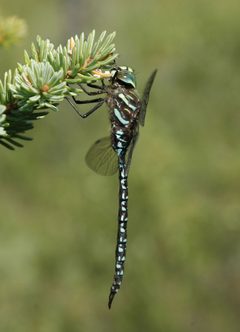
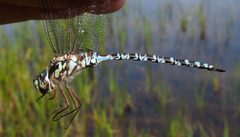
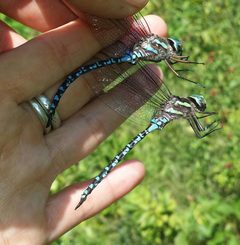
Relatively large with elongated bodies. and are predominantly brown in coloration. Thorax bears blue or yellow stripes or spots. Abdomen displays yellow, blue, or green spots arranged in a pattern that gives mosaic darners their . are large and prominent, often brightly colored in shades of blue, green, or yellow depending on .
Habitat
Associated with a variety of freshwater including lakes, ponds, slow-moving rivers, and bog pools. Several are bog requiring acidic conditions and Sphagnum vegetation. Found from lowlands to montane regions depending on species.
Distribution
Primarily Holarctic distribution following taxonomic revision. Found across Europe, Asia, and North America. Notable include Aeshna juncea (Common Hawker) and Aeshna caerulea (Azure Hawker) in the UK and Scotland, with the latter restricted to the Scottish Highlands. The formerly had broader distribution including Neotropical regions, but these have been reassigned to Rhionaeschna and other genera.
Seasonality
are active during warmer months. In temperate regions, period typically spans late spring through summer, with some flying into early autumn. Exact timing varies by species and latitude.
Diet
Predatory as both nymphs and . Nymphs feed on small including insect larvae and small aquatic organisms; larger nymphs may take small fish and tadpoles. Adults are aerial capturing small flying insects on the wing.
Life Cycle
with three stages: , nymph (naiad), and . Eggs laid in or near water, often in aquatic vegetation or submerged debris. Nymphal stage is entirely aquatic and may last from several months to multiple years depending on and environmental conditions. Nymphs undergo multiple as they grow. Final instar nymphs emerge from water onto emergent vegetation or other surfaces to metamorphose into adults. Adults undergo a maturation period before attaining full reproductive capability.
Behavior
are strong, agile fliers that patrol territories over water and adjacent areas. Males often fly long beats along shoreline vegetation. Both sexes hunt aerially, capturing prey on the wing. Adults may be observed perching on vegetation when not in active . Some are known to fly low over bog vegetation.
Ecological Role
Apex aerial in freshwater as ; significant predators as nymphs. Help regulate of smaller flying insects. Nymphs serve as prey for fish and other aquatic predators. Bog-dwelling are indicators of healthy, acidic wetland ecosystems.
Human Relevance
Subject of interest for enthusiasts and photographers. Several are common and widespread, making them accessible for observation and study. Some bog species such as Aeshna caerulea (Azure Hawker) are of conservation concern due to loss from peatland drainage, afforestation, and extraction. The serves as an example of ongoing taxonomic revision in Odonata based on molecular .
Similar Taxa
- RhionaeschnaFormerly included within Aeshna; separated based on phylogenetic studies showing Neotropical and western North American did not share common ancestry with Holarctic Aeshna. Retains 'sch' spelling in name as originally cited.
- AfroaeschnaContains African formerly placed in Aeshna.
- AndaeschnaContains South American formerly placed in Aeshna.
- AnaxAnother large aeshnid with similar size and ; distinguished by different abdominal patterning and structure.
More Details
Taxonomic History
The spelling 'Aeschna' was used intermittently but is now abandoned in favor of Fabricius's original 'Aeshna'. However, derived names such as Rhionaeschna retain the 'sch' spelling as this reflects their original citation.
Etymology
The name Aeshna may have resulted from a printer's error in spelling the Greek 'Aechma', meaning 'a spear'.
Phylogenetic Revision
Natalia von Ellenrieder's 2003 study demonstrated that Holarctic and Neotropical did not share a common ancestor, leading to the splitting of many species into separate .