
Micromus
Rambur, 1842
brown lacewings
Species Guides
6- Micromus angulatus(brown lacewing)
- Micromus borealis(Northern Brown Lacewing)
- Micromus posticus(brown lacewing)
- Micromus subanticus(Antique Brown Lacewing)
- Micromus variegatus(Variegated Brown Lacewing)
- Micromus variolosus(brown lacewing)
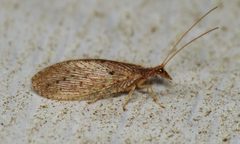
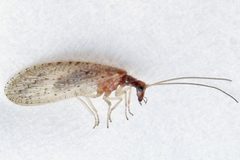
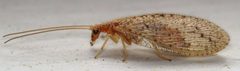
Micromus is a of small brown lacewings in the Hemerobiidae, containing over 80 and possibly as many as 170 . These 4–10 mm insects are distributed worldwide and are important of agricultural and horticultural pests. Both larvae and are predatory, feeding on soft-bodied insects and mites. Several species, particularly Micromus tasmaniae, have been mass-reared and deployed as agents.
Pronunciation
How to pronounce Micromus: //ˈmaɪ.ˌkroʊ.məs//
These audio files are automatically generated. While they are not always 100% accurate, they are a good starting point.
Identification
Micromus are distinguished from green lacewings (Chrysopidae) by their brownish rather than green coloration. Within Hemerobiidae, species-level identification requires examination of wing venation patterns, genitalia, and other subtle morphological features. The is characterized by small size (4–10 mm) and worldwide distribution. Specific identification to species level is challenging and typically requires examination.
Images
Habitat
Found in diverse terrestrial including agricultural fields, gardens, forests, and urban environments. and larvae occupy vegetation where prey occur. Specific microhabitat preferences vary by .
Distribution
Worldwide distribution. Records from North America (including Vermont, USA), Europe (Denmark, Norway, Sweden), and Australia. The has been documented across multiple continents with individual showing varying ranges.
Seasonality
are active year-round in suitable climates, with peak activity varying by region. In temperate zones, adults overwinter and become active in early spring. Multiple per year are possible where conditions permit.
Diet
Both larvae and are predatory, feeding primarily on soft-bodied arthropods including acarines (mites), scale insects, psyllids, aphids, , and the of lepidopterans and whiteflies. Specific prey preferences vary by , developmental stage, and availability.
Life Cycle
Complete : , larva, pupa, . In Micromus igortus, egg incubation averages 4.36 days, larval development 6.2 days, prepupal period 1.3 days, pupal period 6.1 days, and adult lifespan 9.6 days, with total lifespan approximately 29 days. Larval feeding potential increases across instars, with third instar larvae consuming the most prey. Developmental duration varies with temperature, , and prey .
Behavior
Predatory at all active life stages. Larvae and actively search for prey on vegetation. Late instar larvae consume significantly more prey than early instars. Adults may disperse to locate prey patches. Under laboratory conditions, rates follow Holling Type II curves. No has been observed in M. tasmaniae under tested .
Ecological Role
Important agents of agricultural and horticultural pests. , mites, scale insects, and other soft-bodied arthropods. Help regulate pest in diverse including crops, gardens, and natural vegetation.
Human Relevance
Several are mass-reared for biological pest control, particularly Micromus tasmaniae in Australia. Used in programs to reduce reliance on chemical . Valued as natural enemies in agricultural and greenhouse settings.
Similar Taxa
- Chrysopidae (green lacewings)Both are with predatory larvae and , but Chrysopidae are typically green in color with golden , while Micromus and other Hemerobiidae are brown or tan
- HemerobiusBoth in Hemerobiidae; Hemerobius are generally larger and differ in wing venation and genitalia structure
More Details
Biological control potential
Micromus angulatus has been evaluated for control of Aphis craccivora (cowpea aphid), with third instar larvae and showing highest rates (up to 909 aphids per day theoretically for adults). Micromus timidus shows highest on Aphis craccivora and greatest adult feeding potential on Aphis gossypii. M. tasmaniae has been mass-bred commercially in Australia for control.
Reproductive biology
In M. tasmaniae, female body weight does not significantly affect reproductive , but male body weight positively influences female , , and reproductive period, suggesting larger males transfer more sperm and nutrients.
Sources and further reading
- BugGuide
- Wikipedia
- GBIF taxonomy match
- iNaturalist taxon
- NCBI Taxonomy
- Catalogue of Life
- Bug Eric: Blacklighting Already?
- Reuse of science for the benefit of all: the beauty of open access | Blog
- Pensoft blog - Part 136
- Life History of Micromus Posticus Walker1
- Predation Efficiency and Biological Control Potential of Micromus angulatus Against Aphis craccivora
- Effect of body weight on reproductive performance of <i>Micromus tasmaniae</i> (Walker) (Neuroptera Hemerobiidae)
- Life Cycle and Feeding Efficacy of Micromus Igortus (Bank) Brown Lacewing Against Myzus Persicae (Sulzer)
- Biological Parameters and Feeding Potential of Micromus timidus Hagen (Neuroptera: Hemerobiidae) on Selected Aphid Species
- Life Cycle and Parasitism of Micromus posticus1 and M. subanticus in Florida
- Effect of photoperiod on development and reproduction in Tasmanian lacewing <i>Micromus tasmaniae</i> (Walker) (Neuroptera Hemerobiidae)
- The Lacewings Micromus angulatus and Chrysoperla carnea as Predators of the Rhododendron Aphid, Illinoia lambersi, Under Different Temperature Regimes.
- Chromosome-level genome of the brown lacewing Micromus angulatus (Stephens, 1836) (Neuroptera: Hemerobiidae).