
Liturgusa maya
Saussure & Zehntner, 1894
Mayan Lichen Mantis
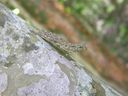
Liturgusa maya is a Neotropical bark mantis first described in 1894. It inhabits tree trunks and branches in tropical forests, exhibiting exceptional speed and flattened body adapted for among bark, moss, and lichen. The species has demonstrated notable geographic expansion through human-mediated introduction, with established non-native in Florida (USA) and the Galápagos Islands. In its native range, it has been documented as a frequent inhabitant of cacao agroecosystems in Peru. The species is parthenogenetic in at least some introduced populations.
Pronunciation
How to pronounce Liturgusa maya: /lɪˈtɜrɡjuːsə ˈmaɪə/
These audio files are automatically generated. While they are not always 100% accurate, they are a good starting point.
Identification
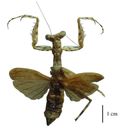
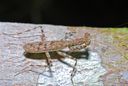
Flattened body profile distinguishes this from more cylindrical mantids. exhibit in size: females average 25.30 mm in length, males 20.38 mm. As a bark mantis, it is highly cryptic and difficult to locate due to mimicry of bark, moss, and lichen substrates. Specific diagnostic features for distinguishing L. maya from require reference to Svenson's 2014 revision of the Liturgusa.
Images
Habitat
Native inhabit tropical forest trunks and branches. Documented occurrences include cacao (Theobroma cacao) and citrus agroecosystems in the Tumbes region of Peru. Non-native populations occupy urban and rural areas of Santa Cruz Island in the Galápagos, and Florida, USA.
Distribution
Native range: Central and South America including Rica (Limón Province), Ecuador, Brazil (Central Amazonas), and Peru (Tumbes region). Introduced range: Florida, USA (established non-native ); Santa Cruz Island, Galápagos Islands (detected since at least 2017, established).
Life Cycle
15–17 days. Oothecae contain 23–37 individuals. Three have been recovered from field-collected oothecae: Podagrion sp. (Torymidae), Eupelmus sp. (Eupelmidae), and Horismenus sp. (Eulophidae), with Horismenus being the most significant. Horismenus liturgusae has been confirmed as a parasitoid in Ecuador.
Behavior
Extremely fast runner, violating the typical perception of mantids as slow, methodical hunters. Evades detection by running to the opposite side of tree trunks before being noticed—an escape tactic convergent with tree-dwelling lizards. Some individuals leap from tree trunks to avoid capture and play dead after fluttering to the forest floor; ability is limited. Active hunter that pursues prey visually rather than ambushing. Non-cannibalistic, unlike some .
Ecological Role
Potential role in cacao agroecosystem dynamics under investigation; presence may relate to organic crop management practices. Serves as for including Horismenus liturgusae. As an introduced in the Galápagos, poses potential but unspecified ecological risks to native .
Human Relevance
Documented as a frequent in Peruvian cacao crops, with research ongoing to clarify its relationship to organic agriculture management. Introduced in Florida and the Galápagos illustrate human-mediated range expansion. The species' parthenogenetic capacity in introduced populations may facilitate rapid establishment following introduction.
Sources and further reading
- BugGuide
- Wikipedia
- GBIF taxonomy match
- iNaturalist taxon
- NCBI Taxonomy
- Catalogue of Life
- Nineteen Speedy New Praying Mantis Species Discovered from Central and South America
- Nineteen new speedy praying mantis species discovered that hide and play dead to avoid capture | Blog
- Uncategorized | Blog - Part 25
- Bananas in Belize get some help from stingless bees: Stingless bees, tribe Meliponini — Bug of the Week
- Destination Toucan Ridge, Belize to visit rainforest recyclers: Conehead termites, Nasutitermes spp. — Bug of the Week
- Stingless bees in Belize - Tribe, Meliponini — Bug of the Week
- Liturgusa maya (Mantodea, Liturgusidae), the first record of an alien praying mantis in the Galápagos Islands
- Liturgusa maya, Saussure & Zehntner, 1894 (Mantodea-Liturgusidae), a species of mantis frequent in cocoa crops in the Tumbes region, Peru
- Distributional range expansion and first record of the parasitic wasp Horismenus liturgusae Hansson & Schoeninger, 2014 (Hymenoptera, Eulophidae) on Liturgusa maya Saussure & Zehntner, 1894 (Mantodea, Liturgusidae) from Ecuador