
Liturgusa
Saussure, 1869
Lichen Mantises, Bark Mantises
Species Guides
1- Liturgusa maya(Mayan Lichen Mantis)
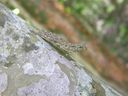
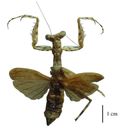
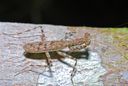
Liturgusa is a of Neotropical bark mantises comprising more than twenty . Unlike typical mantises, Liturgusa species are exceptionally fast runners that actively pursue prey rather than ambush it. They inhabit tree trunks and branches, where their flattened bodies and cryptic coloration provide effective camouflage against bark, moss, and lichen. The genus was revised in 2014, revealing substantially greater diversity than previously recognized.
Pronunciation
How to pronounce Liturgusa: /lɪˈtɜːrɡjʊsə/
These audio files are automatically generated. While they are not always 100% accurate, they are a good starting point.
Identification
Distinguished from other mantises by flattened, bark-mimicking appearance and exceptionally rapid running . Differs from ambush-hunting mantises in active foraging mode. Separated from Australian bark mantises (Ciulfina) by Neotropical distribution. of L. maya described as diagnostic for field identification in the Galápagos.
Images
Habitat
Tropical and subtropical forest . Arboreal: specifically tree trunks and branches. Some occur in agricultural settings, including cocoa and citrus crops. Introduced established in non-native urban and rural environments (Galápagos, Florida).
Distribution
Neotropical region. Native range includes Central America and South America, with records from Rica, Panama, Colombia, Ecuador, Peru, Brazil, and other countries. Non-native established : Galápagos Islands (Santa Cruz Island, since at least 2017) and Florida, USA.
Diet
Active that pursue prey rather than ambush. Specific prey items not documented in available sources.
Host Associations
- Podagrion sp. - Torymidae , recovered from field-collected (L. maya)
- Eupelmus sp. - Eupelmidae , recovered from field-collected (L. maya)
- Horismenus sp. - Eulophidae ; most important recovered from L. maya
Life Cycle
15–17 days; 23–37 individuals per ootheca (documented for L. maya).
Behavior
Exceptionally fast runners capable of high-speed locomotion on vertical surfaces. When threatened, individuals run to the opposite side of the tree trunk to evade detection—an escape tactic convergent with tree-dwelling lizards. Some leap from tree trunks and play dead after fluttering to the forest floor; is weak and not used for escape. Active hunters that visually pursue prey rather than waiting in ambush. Non-cannibalistic, unlike some other mantis groups.
Ecological Role
in arboreal and agricultural . Potential biocontrol agent in cocoa agroecosystems; role in organic crop management under investigation. As an introduced in the Galápagos, poses potential ecological risks to native fauna.
Human Relevance
Subject of taxonomic research including 2014 revision describing 19 new . Some species named for public figures (e.g., L. algorei for Al Gore, L. krattorum for wildlife educators). Established non-native in Galápagos and Florida demonstrate human-mediated . Potential value as biocontrol organisms in tropical agriculture.
Similar Taxa
- CiulfinaAustralian bark mantis with similar flattened , use, and active hunting ; distinguished by Australian distribution and not Neotropical
- Other LiturgusidaeRelated in same share general body plan but differ in specific morphological and behavioral details; Liturgusa distinguished by combination of extreme running speed and specific bark-mimicking
Misconceptions
The common perception that all praying mantises are slow, methodical ambush hunters does not apply to Liturgusa; these are fast, active pursuers. , often associated with mantises generally, has not been observed in this .
More Details
Taxonomic History
Major revision by Svenson (2014) in ZooKeys described 19 new , tripling known diversity. Many species known only from historical museum specimens collected before 1950 from localities now heavily impacted by agriculture or development.
Reproductive Biology
Introduced of L. maya in Galápagos appears to reproduce parthenogenetically, facilitating rapid establishment.
Conservation Concerns
Several may be threatened or extinct; not seen since early 1900s collection. Narrow geographic ranges of many species increase vulnerability to loss.
Sources and further reading
- BugGuide
- Wikipedia
- GBIF taxonomy match
- iNaturalist taxon
- NCBI Taxonomy
- Catalogue of Life
- Liturgusa-fossetti - Entomology Today
- Liturgusa fossetti Archives - Entomology Today
- Nineteen Speedy New Praying Mantis Species Discovered from Central and South America
- Nineteen new speedy praying mantis species discovered that hide and play dead to avoid capture | Blog
- Uncategorized | Blog - Part 25
- Liturgusa maya (Mantodea, Liturgusidae), the first record of an alien praying mantis in the Galápagos Islands
- Liturgusa maya, Saussure & Zehntner, 1894 (Mantodea-Liturgusidae), a species of mantis frequent in cocoa crops in the Tumbes region, Peru