
Horismenus
Walker, 1843
Species Guides
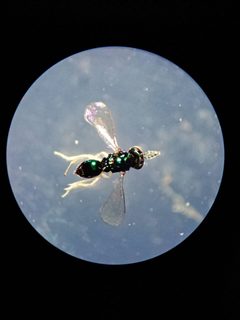
1Horismenus is a large of eulophid (Hymenoptera: Eulophidae) comprising over 400 described , primarily distributed in the Americas. Species are predominantly , with documented associations including bruchid beetles (Coleoptera: Chrysomelidae: Bruchinae) in bean seeds, cerambycid beetles, , and other insects. Several species exhibit hyperparasitoid . The genus has been the subject of recent taxonomic revision due to cryptic revealed through molecular analysis.
Pronunciation
How to pronounce Horismenus: /hɒˈrɪsmɛnəs/
These audio files are automatically generated. While they are not always 100% accurate, they are a good starting point.
Images
Habitat
Diverse spanning wild and agricultural systems, including: seed pods of Phaseolus beans (P. vulgaris, P. coccineus, P. lunatus) in Mexican oak woodland, pine-oak woodland, and humid environments from sea level to over 2400 m elevation; seed pods of Pithecellobium dulce in northeastern Brazil; stems of Pereskia (Cactaceae) and Sechium edule (Cucurbitaceae); citrus groves (Belize); and Atlantic Forest (Minas Gerais, Brazil).
Distribution
Primarily Neotropical, with records from North, Central, and South America. Documented localities include: USA (California, Florida, Georgia, Hawaii, Arizona), Mexico (multiple states across altitudinal gradients), Honduras, Brazil (Amazonas, Minas Gerais, northeastern region), and Ecuador. Some show narrow altitudinal distributions (e.g., H. missouriensis above 2400 m, H. depressus below 1200 m).
Diet
of various insect . Primary parasitoid of bruchid beetles (Acanthoscelides, Zabrotes, Bruchus, Mimosestes, Pseudopachymeria, Stator) within legume seeds; parasitoids of cerambycid larvae (Adetus analis); parasitoid of (Liturgusa maya); hyperparasitoid of braconid wasps (Cotesia invirae) in lepidopteran pupae; and potential hyperparasitoid of congeneric Horismenus .
Host Associations
- Acanthoscelides obvelatus - bruchid for H. butcheri and H. missouriensis
- Acanthoscelides obtectus - bruchid for H. depressus
- Zabrotes subfasciatus - bruchid for H. depressus
- Adetus analis - cerambycid beetle for two new Brazilian
- Liturgusa maya - for H. liturgusae
- Cotesia invirae - braconid for hyperparasitoid H. camobiensis
- Opsiphanes invirae - indirectlepidopteran of Cotesia invirae, indirect host for H. camobiensis
- Phaseolus vulgaris - plantcommon bean
- Phaseolus coccineus - plantscarlet runner bean
- Phaseolus lunatus - plantlima bean
- Pithecellobium dulce - plantBrazilian plant for three new
- Pereskia aculeata - plantornamental cactus, in Africa
- Sechium edule - plantminor crop in Brazil, Argentina, USA
Behavior
Several exhibit hyperparasitoid : H. abnormicaulis may act as hyperparasitoid on other Horismenus species; H. camobiensis is a confirmed hyperparasitoid of Cotesia invirae. H. depressus typically dominates guilds where present, though shows partitioning (rarely emerges from P. coccineus despite sympatry with P. vulgaris). H. missouriensis shows restricted plant use, not extending into P. vulgaris in sympatry with P. lunatus. endosymbionts detected in H. missouriensis, potentially obscuring mitochondrial population structure.
Ecological Role
agents of agricultural and forest pests, particularly bruchid beetles that damage stored legumes. Natural enemies within multitrophic systems involving wild and domesticated beans, their bruchid herbivores, and higher . Hyperparasitoid contribute to complex dynamics in tropical and subtropical .
Human Relevance
Evaluated as potential agents for Diaprepes abbreviatus and Pachnaeus litus (citrus weevils) in Belize; investigated for control of bruchid pests in bean storage systems; surveyed for biological control of Pereskia in Africa.
Similar Taxa
- H. depressus / H. depressoidesH. depressoides described as distinct from H. depressus based on morphological differences, though previously misidentified
- H. missouriensis / H. statorH. stator described as similar to H. missouriensis, requiring careful morphological examination
- H. butcheri / H. dennoi / H. multistriatusH. dennoi and H. multistriatus both similar to H. butcheri, distinguished by subtle morphological characters
Sources and further reading
- BugGuide
- Wikipedia
- GBIF taxonomy match
- iNaturalist taxon
- NCBI Taxonomy
- Catalogue of Life
- Uncovering Cryptic Parasitoid Diversity in Horismenus (Chalcidoidea, Eulophidae)
- Three new species of Horismenus Walker (Hymenoptera: Eulophidae) associated with seed pods of Pithecellobium dulce (Fabaceae)
- Species of Horismenus Walker (Hymenoptera: Eulophidae) associated with bruchid beetles (Coleoptera: Chrysomelidae: Bruchinae), including five new species
- Microsatellite markers in a complex of Horismenus sp. (Hymenoptera: Eulophidae), parasitoids of bruchid beetles
- Horismenus species (Hymenoptera: Eulophidae) in a bruchid beetle parasitoid guild, including the description of a new species
- New Hosts, Host Plants, and Distribution Records for Horismenus (Hymenoptera: Eulophidae) Species in a Bruchid Beetle Parasitoid Guild Attacking Wild Type Phaseolus Coccineus and P. Vulgaris in Central Mexico
- First Record of the Elusive Ant Parasitoid Horismenus floridensis (Hymenoptera: Eulophidae) in Mexico and New Association with an Ant Host
- Horismenus camobiensis (Hym.: Eulophidae), a new hyperparasitoid of Cotesia invirae (Hym.: Braconidae) in Opsiphanes invirae (Lep.: Nymphalidae) pupae
- Horismenus saturnus n. sp. (Hymenoptera, Eulophidae) a New Parasitoid Wasp from Eggs of Saturniidae (Lepidoptera) from the Atlantic Forest, Minas Gerais, Brazil
- A survey for potential biological control agents of Pereskia aculeata Miller (Cactaceae) in Brazil reveals two new species of Horismenus Walker (Hymenoptera: Eulophidae)
- Inconsistent genetic structure among members of a multitrophic system: did bruchid parasitoids (Horismenusspp.) escape the effects of bean domestication?
- Distributional range expansion and first record of the parasitic wasp Horismenus liturgusae Hansson & Schoeninger, 2014 (Hymenoptera, Eulophidae) on Liturgusa maya Saussure & Zehntner, 1894 (Mantodea, Liturgusidae) from Ecuador
- EXPLORATION IN BELIZE FOR PARASITOIDS ATTACKING EGGS OF CITRUS WEEVILS, AND AN EVALUATION OF PEDIOBIUS IRREGULARIS AND HORISMENUS BENNETTI (HYMENOPTERA: EULOPHIDAE) AS POTENTIAL BIOLOGICAL CONTROL AGENTS OF DIAPREPES ABBREVIATUS AND PACHNAEUS LITUS (COLEOPTERA: CURCULIONIDAE)