
Zabrotes subfasciatus
(Boheman, 1833)
Mexican bean weevil
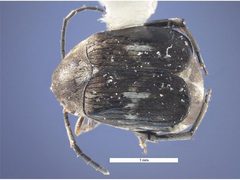
Zabrotes subfasciatus, commonly known as the Mexican bean weevil, is a small bruchine that infests stored legume seeds, particularly common bean (Phaseolus vulgaris). Females deposit on seed coats; larvae develop endophytically within the cotyledons, consuming the seed from the inside. A single seed can support up to 20 emerging . The has demonstrated capacity to utilize alternative including cowpea (Vigna unguiculata), lentil, chickpea, and soybean, with showing plasticity in host preference through artificial selection. Development from egg to adult takes approximately 34 days at 27°C and 70% relative humidity. Maximum female is around 55 eggs. The species is a significant post-harvest pest in tropical regions, with reported production losses up to 35%.
Pronunciation
How to pronounce Zabrotes subfasciatus: /zəˈbroʊtiːz ˌsʌbfæsiˈeɪtəs/
These audio files are automatically generated. While they are not always 100% accurate, they are a good starting point.
Identification
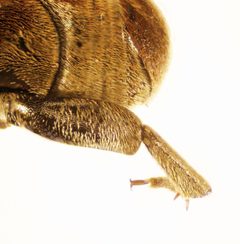
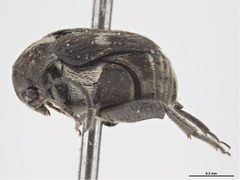
are small beetles, the smallest of common bruchids infesting stored legumes. Distinguishable from other stored-product bruchids by size and association with large-seeded legumes (Phaseolus lunatus, P. vulgaris). Similar to Acanthoscelides obtectus (common bean weevil) but differs in oviposition : Z. subfasciatus attaches to seed surfaces, while A. obtectus deposits eggs loosely among seeds. From Callosobruchus maculatus (cowpea weevil), distinguished by range plasticity and competitive dynamics; neither shows consistent competitive advantage over the other in mixed .
Images
Habitat
Stored legume products; primarily dried common bean seeds in post-harvest storage. Occurs in tropical and subtropical storage facilities, warehouses, and household stores. Laboratory studies indicate optimal conditions around 25-27°C with 70% relative humidity. Cold storage below room temperature significantly reduces viability and growth.
Distribution
in tropical and subtropical regions. Documented from Africa, North America, South America, Southern Asia, and Europe. Detected in Romania through imported beans from Syria and Ethiopia, though not established locally. Present in Galápagos Islands. Native range uncertain; likely Neotropical in origin based on association with Phaseolus .
Diet
Larvae feed exclusively on legume seed cotyledons. Primary is common bean (Phaseolus vulgaris). Demonstrated ability to develop on cowpea (Vigna unguiculata), lentil (Lens culinaris), chickpea (Cicer arietinum), and soybean (Glycine max). Host preference is determined by female oviposition ; performance on unusual hosts does not necessarily correlate with preference.
Host Associations
- Phaseolus vulgaris - primary common bean; main in storage
- Vigna unguiculata - alternative cowpea; demonstrated capacity for development and
- Phaseolus lunatus - lima bean; wild and cultivated forms
- Cicer arietinum - alternative chickpea; can adapt through selection
- Lens culinaris - alternative lentil
- Glycine max - alternative soybean
Life Cycle
are deposited on seed surfaces or nearby substrates. Larvae penetrate seed coats and feed internally on cotyledons, completing development without leaving the seed. Developmental duration approximately 34 days at 27°C and 70% RH. occurs within the seed. emerge through exit holes; up to 20 adults may emerge from a single seed at moderate densities. Sex ratio slightly male-biased at . Adult weight correlates with female but is not influenced by larval within seeds.
Behavior
Females exhibit aggregated oviposition, depositing on a subset of available rather than distributing evenly. Oviposition is modified by substrate texture: kaolin treatments cause females to deposit eggs on container walls rather than grain surfaces, disrupting larval establishment. Host deprivation conditions alter oviposition patterns. show behavioral plasticity in host acceptance: artificial selection can increase oviposition on initially less-preferred hosts within approximately 30 , though response is faster when choosing between varieties of a familiar host than between familiar and novel hosts.
Ecological Role
Pest of stored legume seeds causing direct weight loss, reduced nutritional quality, diminished germination and vigor, and seed hollowing. facilitates secondary damage by promoting fungal growth and mycotoxin development in stored grains. Serves as for hymenopterous in laboratory systems. Competes with other bruchid (e.g., Callosobruchus maculatus) in mixed infestations without consistent competitive dominance by either species.
Human Relevance
Major economic pest of stored common beans in tropical agriculture, with reported losses up to 35% of production. Control historically relied on chemical , with associated food safety and environmental concerns. Alternative management strategies include: (effective at 1g kg-1); kaolin particle films (effective at higher doses and exposure times than DE, with modified oviposition as secondary mechanism); cold storage to reduce viability; and development of bean varieties. Kaolin-neem oil mixtures have proven ineffective. The ' plasticity complicates management through host strategies.
Similar Taxa
- Acanthoscelides obtectusBoth are common bean bruchids; distinguished by oviposition —Z. subfasciatus glues to seed surfaces, A. obtectus deposits eggs loosely among seeds
- Callosobruchus maculatusCowpea bruchid with overlapping range; competition studies show neither has consistent advantage over the other in mixed of cowpea
- Zabrotes sylvestris with similar ; specific distinguishing characters require examination of genitalia or detailed morphological analysis
More Details
Taxonomic note
Zabrotes subfasciatus is classified in Bruchinae (formerly Bruchidae), now treated as a subfamily within Chrysomelidae based on molecular phylogenetic studies. Older literature may reference it as Bruchidae.
Host adaptation dynamics
maintained on unusual (chickpea) for 26 retain on the original host, but show reduced performance compared to original populations, indicating partial trade-offs that may facilitate diet breadth expansion.
Sources and further reading
- BugGuide
- Wikipedia
- GBIF taxonomy match
- iNaturalist taxon
- NCBI Taxonomy
- Development, fecundity and egg dispersion of Zabrotes subfasciatus
- The ability of Zabrotes subfasciatus to attack cowpeas
- Control of the Mexican bean weevil Zabrotes subfasciatus with kaolin
- Detection of Zabrotes subfasciatus and Bruchidius glycyrhizae (Chrysomelidae: Bruchinae) in Romania
- Host preference of the bean weevil Zabrotes subfasciatus
- Oviposition behavior of Zabrotes subfasciatus females (Coleoptera, Bruchidae) under conditions of host deprivation
- The biology and control of Zabrotes subfasciatus (Boheman) (Coleoptera: Bruchidae) infesting red kidney beans
- Host-age Structure and Parasitism in a Laboratory System of Two Hymenopterous Parasitoids and Larvae of Zabrotes subfasciatus (Coleoptera: Bruchidae)
- Ovary Activation Dynamics in the Bean Weevil Zabrotes subfasciatus (Bruchinae): The Essential Roles of Seeds and Males.