
Acanthoscelides obtectus
(Say, 1831)
Bean Weevil, Bean Bruchid, Dry Bean Weevil
Acanthoscelides obtectus is a small bruchid and major pest of stored legume seeds, particularly common bean (Phaseolus vulgaris). Native to mountainous regions of northern South America, it has spread globally through grain shipments and now occurs on every continent except Antarctica. The is notable for its ability to infest seeds both in the field and in storage, with larvae developing entirely within seeds while feed on pollen. Its economic impact stems from reduced seed quality, germination failure, and of legume products.
Pronunciation
How to pronounce Acanthoscelides obtectus: /əˌkænθoʊˈsɛlɪˌdez ɒbˈtɛktəs/
These audio files are automatically generated. While they are not always 100% accurate, they are a good starting point.
Identification
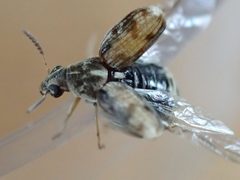
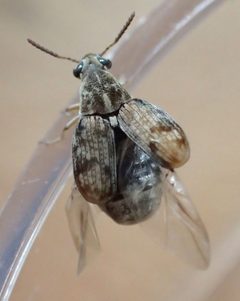
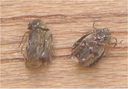
Distinguished from true weevils ( Curculionidae) by the absence of a long rostrum; is short and bent forward. bear longitudinal spots and expose the terminal abdominal segments. Legs and are reddish. Larvae are white with yellow (first instar) or brownish (second instar) heads and possess three pairs of legs and visible bristles. are milky white and laid on or in seed pods.
Images
Habitat
Warm climates with optimal temperatures of 27–29°C for , 24–27°C for larvae, and 22–26°C for pupae; occurs in agricultural fields, grain storage facilities, and warehouses; limited to regions with temperatures consistently above 0°C, reaching northernmost extent in northern Lithuania and southwestern Siberia
Distribution
Native to northern South America; introduced to Central America, Europe (end of 19th century), and subsequently worldwide. Present in Europe, Asia, Africa, North and South America, Australia, and Oceania. Specific records include: Albania, Austria, Belgium, Bosnia and Herzegovina, Bulgaria, Czech Republic, France, Germany, Greece, Hungary, Italy, Netherlands, Poland, Portugal, Romania, Russia, Slovakia, Spain, Switzerland, Turkey, United Kingdom, India, Iraq, Israel, Kazakhstan, Malaysia, Myanmar, Thailand, Vietnam, Angola, Burundi, Democratic Republic of Congo, Egypt, Kenya, Lesotho, Malawi, Mauritius, Morocco, Nigeria, Réunion, Rwanda, Senegal, South Africa, St. Helena, Eswatini, Tanzania, Uganda, Zambia, Zimbabwe, Canada, Mexico, USA, Belize, Rica, Cuba, Dominican Republic, El Salvador, Guadeloupe, Guatemala, Honduras, Nicaragua, Argentina, Bolivia, Brazil, Chile, Colombia, Guyana, Paraguay, Peru, Venezuela, Australia, New Zealand, Papua New Guinea, and Galápagos Islands
Seasonality
emerge from hibernation in April in temperate regions; continuous breeding possible in warm storage conditions with multiple overlapping ; single generation requires 100–110 days under optimal conditions
Diet
Larvae feed exclusively on seeds of leguminous plants, primarily common bean (Phaseolus vulgaris), lima bean (P. lunatus), and runner bean (P. coccineus); also recorded on cowpea (Vigna unguiculata), adzuki bean (V. angularis), chickpea (Cicer arietinum), faba bean (Vicia faba), grass pea (Lathyrus sativus), and certain pea (Pisum sativum) accessions; feed on pollen
Host Associations
- Phaseolus vulgaris - primary common bean; principal for larval development
- Phaseolus coccineus - primary runner bean
- Phaseolus lunatus - secondary lima bean
- Vigna unguiculata - secondary cowpea
- Vigna angularis - secondary adzuki bean
- Cicer arietinum - secondary chickpea
- Vicia faba - secondary faba bean
- Lathyrus sativus - secondary grass pea
- Pisum sativum - occasional certain accessions only
- Glycine max - laboratory limited accessions support development
Life Cycle
laid on seed pods or directly into pods through chewed holes, in groups of 2–20 eggs; total up to 200 eggs per female (average ~40). Egg development: 30–45 days. First instar larva: ~3 days, then to second instar. Larval stage: 3–3.5 weeks, feeding on seed cotyledon. occurs inside seed: 9–29 days. emerge and may hibernate within seeds. Complete : 100–110 days. Multiple successive generations possible in warm storage conditions.
Behavior
Females oviposit based on seed coat stimuli alone without assessing cotyledon quality; demonstrates ovipositional hierarchy among legume even in no-choice conditions. First instar larvae must penetrate seed coat; coats thicker than 0.1 mm prevent entry even when cotyledon is suitable. feed on pollen and do not damage seeds. Hibernate inside seeds or seed pods.
Ecological Role
Seed specializing on legumes; significant agricultural pest reducing seed viability, nutritional quality, and market value; serves as for ; influenced by seed coat physical properties and cotyledon chemistry
Human Relevance
Major economic pest of stored legumes globally; can reduce crop yields by up to 60% through larval consumption of seeds; causes germination failure, weight loss, and with ; managed through cultural practices (certified seed, timely harvest, residue destruction), plant-based extracts (eucalyptus oil, 1,8-cineole), , and using ; subject to and phytosanitary regulations in international grain trade
Similar Taxa
- Callosobruchus maculatusAlso a bruchid pest of stored legumes, particularly cowpea; distinguished by more elongated body, different elytral pattern, and preference for Vigna
- Callosobruchus chinensisAsian cowpea bruchid; similar size and habit but with distinct elytral markings and more restricted range
- Zabrotes subfasciatusMexican bean weevil; smaller size (2–3 mm), more restricted Neotropical distribution, and distinct elytral banding pattern
- Acanthoscelides obsoletusDistinct historically confused due to LeConte's 1870 misidentification; true A. obsoletus has different associations and morphological features
Misconceptions
Despite 'bean weevil,' this is not a true weevil ( Curculionidae) but belongs to Chrysomelidae: Bruchinae; do not feed on seeds and cause no direct damage, contrary to some reports; range is narrower than often assumed due to seed coat penetration requirements
Sources and further reading
- BugGuide
- Wikipedia
- GBIF taxonomy match
- iNaturalist taxon
- NCBI Taxonomy
- Eavesdropping on Soybean Weevils: Scientists Detect Subtle Acoustic Signals
- Acanthoscelides obtectus . [Distribution map].
- How bean weevil (Acanthoscelides obtectus, Coleoptera, Bruchinae) larvae die on legume seeds
- Fasulye Tohum Böceği Acanthoscelides obtectus Say (Coleoptera: Chrysomelidae)’un Önemi, Biyolojisi, Zararı ve Mücadelesi Importance, Biology, Damage and Management of Bean Weevil Acanthoscelides obtectus Say (Coleoptera: Chrysomelidae)
- How bean weevil (Acanthoscelides obtectus, Coleoptera, Bruchinae) larvae die on legume seeds
- Effect of Nostalgist BL on Biology of Acanthoscelides obtectus’ (Say) (Coleoptera: Bruchidae)
- Feeding, Longevity and Reproduction of Adults of Acanthoscelides Obtectus Say in Laboratory Conditions
- Nonrandom association between host choice and fitness in bean weevil (Acanthoscelides obtectus)
- Laboratory evolution of host plant utilization in the bean weevil (Acanthoscelides obtectus)
- Mating behavior in the seed beetle Acanthoscelides obtectus selected for early and late reproduction
- Eco-Friendly Management of Acanthoscelides obtectus Through Individual and Combined Applications of 1,8-Cineole and Diatomaceous Earth.